The OWASP MAESTRO 7-Layer Reference Architecture for Agentic AI (Threat Modeller's Field Guide)
STRIDE, PASTA, LINDDUN, OCTAVE, Trike, VAST — all of them were built for software, retrofitted to AI. OWASP MAESTRO is the first framework purpose-built for agentic AI. This field guide translates its 7 layers into a pentester's checklist with concrete attack patterns per layer.
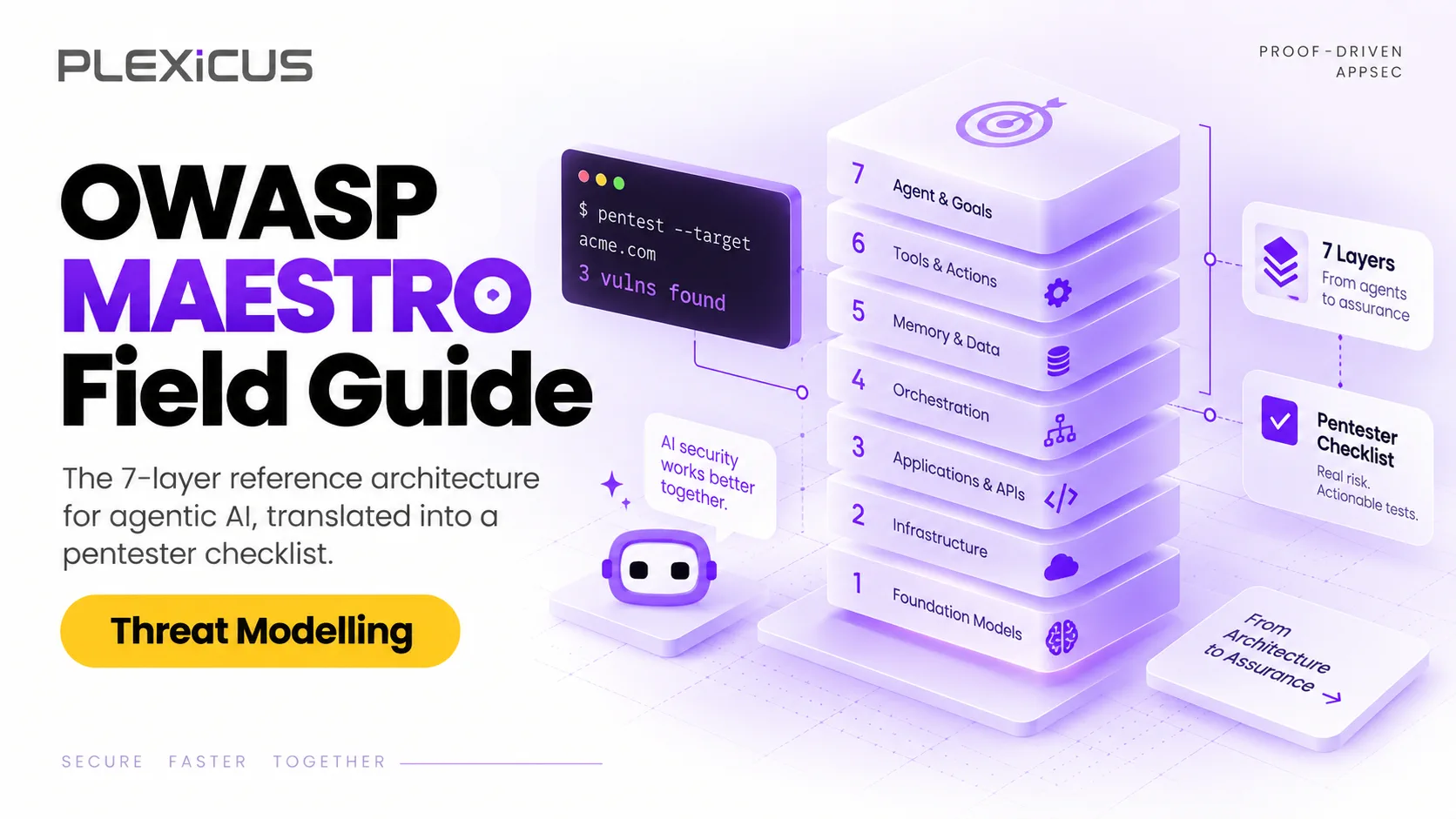
Every threat modelling framework your security team has ever used was built for software that humans wrote. STRIDE (1999) is for monolithic applications. PASTA (2008) is for service-oriented architectures. LINDDUN (2010) is for privacy in software systems. OCTAVE (2003) is for organisational risk. Trike (2005) and VAST (2011) are for scalable threat modelling.
None of them model the threat surface of an agent. None of them have a layer for “the model’s training data was poisoned.” None of them have a layer for “the agent’s tool description was rewritten after approval.” None of them have a layer for “the agent’s reasoning trace diverged from its stated goal.”
In February 2025, the Cloud Security Alliance published MAESTRO — the Multi-Agent Environment, Security, Threat, Risk, and Outcome framework. It is the first reference architecture purpose-built for agentic AI. This is the field guide your threat modelling team will use for the next three years.
This guide translates the 7-layer architecture into a pentester’s checklist, with concrete attack patterns and detection signals per layer.
What MAESTRO Is (And Why It Is Different)
MAESTRO is a 7-layer reference architecture for agentic AI systems. It was not retrofitted from STRIDE or PASTA. It was built bottom-up for the threat surface that emerges when an AI agent has:
- A persistent memory
- Tool-calling capabilities (often through MCP)
- A multi-step reasoning loop
- The ability to act on external systems
The seven layers, bottom to top:
- Foundation Models — the LLMs that power the agent
- Data Operations — the pipelines that feed context into the model
- Agent Frameworks — the runtime that orchestrates the agent loop
- Deployment & Infrastructure — where the agent runs
- Evaluation & Observability — how the agent’s behaviour is measured and logged
- Security & Compliance — the controls that govern the agent
- Agent Ecosystem — the other agents, tools, and services the agent interacts with
Each layer has its own threat model, its own attack patterns, and its own mitigations. Most existing frameworks collapsed all seven layers into a single “external dependencies” bucket. MAESTRO separates them.
The result is a framework that an agentic-AI pentester can use as a checklist. The rest of this guide is that checklist.
Layer 1 — Foundation Models
Threat surface
The model itself, its weights, its training data, and the supply chain that produced it.
Attack patterns
- Model poisoning via training data. A dataset contributor injects backdoored examples. The model learns the trigger. The trigger is activated in production.
- Weight exfiltration. An attacker compromises the model registry and copies the weights. The model is now available to competitors or for adversarial fine-tuning.
- Backdoored checkpoints on Hugging Face. A publicly available fine-tune of a known model contains a backdoor. The downstream agent inherits it.
- Adversarial fine-tuning of an open-source base. A team uses Llama 4 or Mistral as a base. An attacker publishes a “safety-tuned” variant that has been subtly misaligned. The team picks the wrong one.
Detection signals
- Hash mismatch between expected and loaded weights
- Suspicious gradient updates during fine-tuning
- Downstream behaviour that triggers on rare inputs (probabilistic backdoor detection)
- Unusual loss-curve spikes during training
Mitigations
- Pin model versions by hash, not by name
- Source weights from attested registries (Hugging Face signed commits, internal signed artefacts)
- Run adversarial-robustness evaluation before deployment
- Maintain an allowlist of model providers with provenance verification
Layer 2 — Data Operations
Threat surface
The data the agent consumes at runtime: retrieval-augmented generation (RAG) corpora, prompt templates, conversation history, tool outputs, and any other context that flows into the model at inference time.
Attack patterns
- Indirect prompt injection via RAG documents. The attacker plants text in a document the agent will retrieve. The text contains instructions the agent follows as if they came from the user.
- Prompt template smuggling. The attacker modifies a stored prompt template to include additional instructions that bypass the agent’s safety layer.
- Tool-output poisoning. The agent calls a tool. The tool returns a string that contains injected instructions. The agent treats the tool output as a trusted instruction source.
- Memory poisoning. The agent writes to its long-term memory. The attacker can write to the same memory store (often a vector database). Future retrievals include the attacker’s instructions.
- Log injection. The agent logs its reasoning trace. The attacker injects text into the log. A monitoring agent reads the log and treats the injected text as instructions.
Detection signals
- Tool outputs that contain instruction-like patterns (imperative voice, second-person address)
- RAG documents with unusually high instruction density
- Memory writes that do not match the agent’s observed interaction history
- Log entries that contain language patterns inconsistent with the agent’s persona
Mitigations
- Treat all retrieved content and tool outputs as untrusted data, not instructions
- Use a separate instruction channel (system prompt) that is isolated from the data channel
- Sandbox tool outputs through a structured parser, not raw string concatenation
- Apply provenance tracking to every memory write
Layer 3 — Agent Frameworks
Threat surface
The runtime that orchestrates the agent loop: the planning module, the tool-selection logic, the memory interface, the reasoning trace, and the execution scheduler.
Attack patterns
- Reasoning trace manipulation. The agent’s chain-of-thought is exposed in logs. The attacker reads the trace, identifies the goal, and plants a misleading observation that redirects the next step.
- Tool-selection hijacking. The agent selects tools based on a planner. The attacker registers a malicious tool with a name similar to a legitimate one. The planner picks the wrong tool.
- Loop amplification (denial of wallet). The agent enters a reasoning loop that costs API tokens. The loop runs indefinitely until the budget is exhausted.
- Sub-agent escape. A supervisor agent spawns a sub-agent. The sub-agent has fewer constraints than the supervisor. The sub-agent performs actions the supervisor would not have approved.
- Reasoning-vs-action drift. The agent’s stated reasoning diverges from its actual actions. The auditor reads the trace and sees no problem. The actions tell a different story.
Detection signals
- Reasoning traces that contain language inconsistent with the agent’s persona or goals
- Tool selections that do not match the agent’s stated plan
- Token spend anomalies per agent invocation
- Sub-agent invocations that exceed the supervisor’s stated budget
- Discrepancy between trace and action logs
Mitigations
- Sandbox the planning module from the execution module
- Require explicit confirmation for tool invocations outside an allowlist
- Cap token spend per invocation and per session
- Maintain a strict supervisor/sub-agent hierarchy with capability inheritance rules
- Compare reasoning traces against action logs as a continuous check
Layer 4 — Deployment & Infrastructure
Threat surface
The runtime environment where the agent executes: containers, serverless functions, VMs, the underlying operating system, the secrets used by the agent, and the network paths the agent can reach.
Attack patterns
- Container escape. The agent runs in a container. A vulnerability in the container runtime allows escape to the host. The agent now has the host’s privileges.
- Credential theft from runtime. The agent has API keys, database credentials, or OAuth tokens in its environment. A tool-output prompt injection causes the agent to exfiltrate them.
- Lateral movement to internal services. The agent has network reach to internal services. The attacker uses the agent as a pivot point.
- Persistent runtime backdoor. The attacker installs a backdoor in the agent’s container image. Every redeployment re-introduces it.
- Side-channel data leakage. The agent’s compute patterns (timing, GPU utilisation) leak information about the prompt or the model’s state.
Detection signals
- Unexpected outbound connections from the agent’s runtime
- Unusual file system or network activity
- Container drift from the known-good image
- Discrepancy between declared and actual egress rules
Mitigations
- Run the agent with the minimum privileges required (read-only file systems, no outbound network except to allowlisted endpoints)
- Source container images from attested registries with hash pinning
- Use network policies to enforce egress allowlists
- Rotate credentials on every agent restart
- Deploy runtime threat detection (e.g., Falco, Tetragon) on the agent’s host
Layer 5 — Evaluation & Observability
Threat surface
The telemetry, logging, evaluation, and observability infrastructure that monitors the agent.
Attack patterns
- Log poisoning. The agent’s logs include the tool outputs. The attacker injects text into a tool output that flows into the logs. The SIEM ingests the log and treats the injected text as an alert description.
- Telemetry spoofing. The agent’s evaluator reports metrics that look healthy. The metrics are fabricated. The agent is misbehaving.
- Eval set poisoning. The evaluation dataset is stored in the same place as production data. The attacker modifies the eval set. The agent “passes” evaluations that no longer reflect real behaviour.
- Evaluator-agent collusion. A separate agent evaluates the production agent. Both are reachable from the same prompt-injection sink. The attacker uses the sink to manipulate the evaluator.
Detection signals
- Log entries that contain language patterns inconsistent with the agent
- Sudden metric improvements that do not match operational changes
- Eval set hashes that change without a corresponding code or data commit
- Discrepancy between evaluator output and ground-truth observations
Mitigations
- Separate the logging channel from the agent’s data channel
- Sign and hash all eval sets; alert on hash drift
- Treat evaluator outputs as untrusted; cross-check with raw telemetry
- Use external ground-truth signals (e.g., user feedback, system-of-record diffs) to validate eval results
Layer 6 — Security & Compliance
Threat surface
The controls, policies, and compliance regimes that govern the agent’s behaviour: RBAC, scope enforcement, audit logging, human-in-the-loop approval, and the policy-as-code artefacts that encode the rules.
Attack patterns
- Scope escalation via tool composition. Each tool the agent uses has a narrow scope. The agent chains tools in a way that the composition has a broader scope than any individual tool.
- Human-in-the-loop bypass. The approval workflow assumes a human will reject a dangerous action. The agent generates a confusing description of the action. The human approves.
- Policy-as-code injection. The policy engine reads rules from a versioned artefact. The attacker modifies the artefact. The agent now operates under new rules.
- Audit log tampering. The agent has access to its own audit log. The attacker uses the agent to rewrite the log to cover tracks.
Detection signals
- Tool invocations that exceed the declared scope of any single tool
- Approval patterns inconsistent with the agent’s stated action
- Policy artefact hash changes without a corresponding commit
- Audit log entries that are modified post-hoc
Mitigations
- Apply capability checks at the composition level, not just the individual tool level
- Require plain-language summaries of the action alongside the action itself
- Sign and hash policy artefacts; alert on drift
- Write audit logs to an append-only store the agent cannot access
Layer 7 — Agent Ecosystem
Threat surface
The other agents, tools, MCP servers, external services, and humans that the production agent interacts with.
Attack patterns
- MCP tool poisoning. The MCP server changes its tool description after the agent has approved it (“rug pull”). The new description contains different behaviour.
- MCP server compromise. The MCP server itself is compromised. The agent’s tool calls now route through attacker-controlled code.
- Cross-agent prompt injection. Agent A and Agent B communicate. Attacker plants instructions in A’s context that target B specifically.
- Tool marketplace supply chain. A community-published tool contains malicious code. The agent imports it. The tool exfiltrates credentials at first use.
- Human impersonation. The agent receives a message that appears to be from a human operator. The operator is actually the attacker. The agent follows the instructions.
Detection signals
- Tool description drift after approval
- Unexpected behaviour changes in long-running tools
- Cross-agent messages with instruction-like content
- Tools from marketplaces with low provenance scores
- Operator messages with anomalous patterns
Mitigations
- Pin MCP tool descriptions at approval time; alert on drift
- Use a tool allowlist with provenance requirements
- Sandbox cross-agent communication through structured messages
- Require multi-factor authentication for operator instructions
- Maintain a tool inventory with risk scores
A Worked Example — Hexstrike-AI
In May 2026, Check Point Research published an analysis of Hexstrike-AI, a FastMCP server that orchestrates 150+ exploitation tools. The campaign chained Citrix CVE-2025-7775, CVE-2025-7776, and CVE-2025-8424 in days-to-exploit compressed to under 10 minutes.
Mapped to MAESTRO:
| MAESTRO layer | Hexstrike-AI exposure |
|---|---|
| L1 — Foundation Models | Uses off-the-shelf Claude/GPT-4 models; no model-level exploit observed |
| L2 — Data Operations | RAG corpus contained publicly available exploit documentation — not directly exploited |
| L3 — Agent Frameworks | Tool-selection hijacking was the primary attack vector — the orchestrator picked malicious tools over legitimate ones |
| L4 — Deployment & Infrastructure | The server was hosted on exposed infrastructure; lateral movement was straightforward |
| L5 — Evaluation & Observability | Logs were minimal; the campaign ran for days before detection |
| L6 — Security & Compliance | Scope enforcement was nominal; the chained CVEs exceeded any individual tool’s stated scope |
| L7 — Agent Ecosystem | The MCP layer was the primary attack surface; tool descriptions were rewritten post-approval in at least one variant |
The MAESTRO mapping makes the threat surface legible at every layer. A pentester working the same target today has a checklist that walks bottom-up.
The Pentester’s Checklist (Compact)
For each layer, before you start a pentest engagement against an agentic AI system, confirm:
- L1 — Models: What models power the agent? What is the provenance? Are weights pinned?
- L2 — Data: What is the agent reading at runtime? Is retrieved content treated as instructions or as data?
- L3 — Frameworks: Is there a separate planner and executor? Are sub-agent capabilities inherited or scoped?
- L4 — Infrastructure: What are the runtime privileges? What is the egress policy? Is the image attested?
- L5 — Telemetry: What is logged? Where do logs flow? Can the agent write to its own audit log?
- L6 — Controls: How is scope enforced at the composition level? Where do human approvals happen?
- L7 — Ecosystem: What MCP servers does the agent use? Are tool descriptions pinned? What other agents does it communicate with?
This is the bar. Every engagement that does not cover all seven layers is a partial engagement.
Why This Is the Reference Architecture for the Next Five Years
The agentic AI threat surface is not going to shrink. The models will get more capable. The tool ecosystems will get larger. The supply chain will get more complex. The number of agents per enterprise will multiply.
MAESTRO is the first framework that acknowledges all of this and gives the industry a shared vocabulary. The earlier your team adopts it, the faster your pentesters, your threat modellers, and your auditors speak the same language.
The teams that wait will be the ones whose audit reports list “AI security” as a single control. The teams that adopt MAESTRO now will have a layered, evidence-backed, replay-verifiable defence in depth — and that is the bar for proof-driven AppSec in 2026 and beyond.
Related reading:
- From Alert to Fix: Closing the Loop with Proof-Driven AppSec — the operational loop MAESTRO maps onto
- What Is Deep Code Analysis? — the static-analysis layer that pairs with MAESTRO L1–L3
- 78% of AI-Generated PRs Contain a Vulnerability — the production failure mode MAESTRO L2 / L7 is built to model