Top 10 Wiz.io Alternatives for 2026: Moving from Visibility to Remediation
By 2026, cloud security priorities have changed. Visibility is no longer the main selling point since Wiz.io already set the standard in the early 2020s. Now, the main challenge is keeping up with the pace of change.
AI-powered coding tools are speeding up feature releases, so developers are producing more code; and more bugs than ever before. In 2025, 41% of all code was AI-generated, with over 256 billion lines created by AI in just one year.
If your CNAPP (Cloud-Native Application Protection Platform) shows you a beautiful graph of 10,000 vulnerabilities but leaves your team to manually fix each one, it is not a security tool. It is a data entry task. This guide reviews the best Wiz alternatives for 2026 that prioritize automated remediation and developer flow.
At a Glance: Top 10 Wiz.io Alternatives for 2026
| Platform | Best For | Core Differentiator | Setup Type | Pricing Model |
|---|---|---|---|---|
| Plexicus | Automated Fixes | Codex Remedium AI Agents | Agentless (OIDC) | Per Developer |
| Aikido | Lean Teams | Reachability-only scanning | Agentless | Flat Monthly |
| Orca Security | Data Governance | SideScanning AI+ (DSPM) | Agentless | Per Workload |
| Snyk | Shift-Left | Developer-native IDE workflow | Integration | Per Developer |
| Prisma Cloud | Compliance | Unified Policy-as-Code | Hybrid | Credit-based |
| Sysdig | Runtime / K8s | eBPF-based active blocking | Agent-based | Per Node |
| Aqua Security | Containers | Image sandbox detonation | Hybrid | Quote-based |
| CrowdStrike | Threat Intel | Unified EDR and Cloud Security | Agent-based | Per Workload |
| CloudGuard | Networking | Hybrid-cloud perimeter control | Hybrid | Quote-based |
| Lacework | Anomalies | Polygraph behavior mapping | Agentless | Data-volume |
Why Listen to Us?
At Plexicus, we do more than build security tools; we work directly in the CI/CD pipeline. We think a good security tool should be judged by how many alerts it resolves, not just how many it finds. With billions of lines of AI-generated code out there, manual work just cannot keep up.
We believe in Product-Led Security. Security tools should help the people writing code, not just those reviewing it.
1. Plexicus (The Remediation Leader)
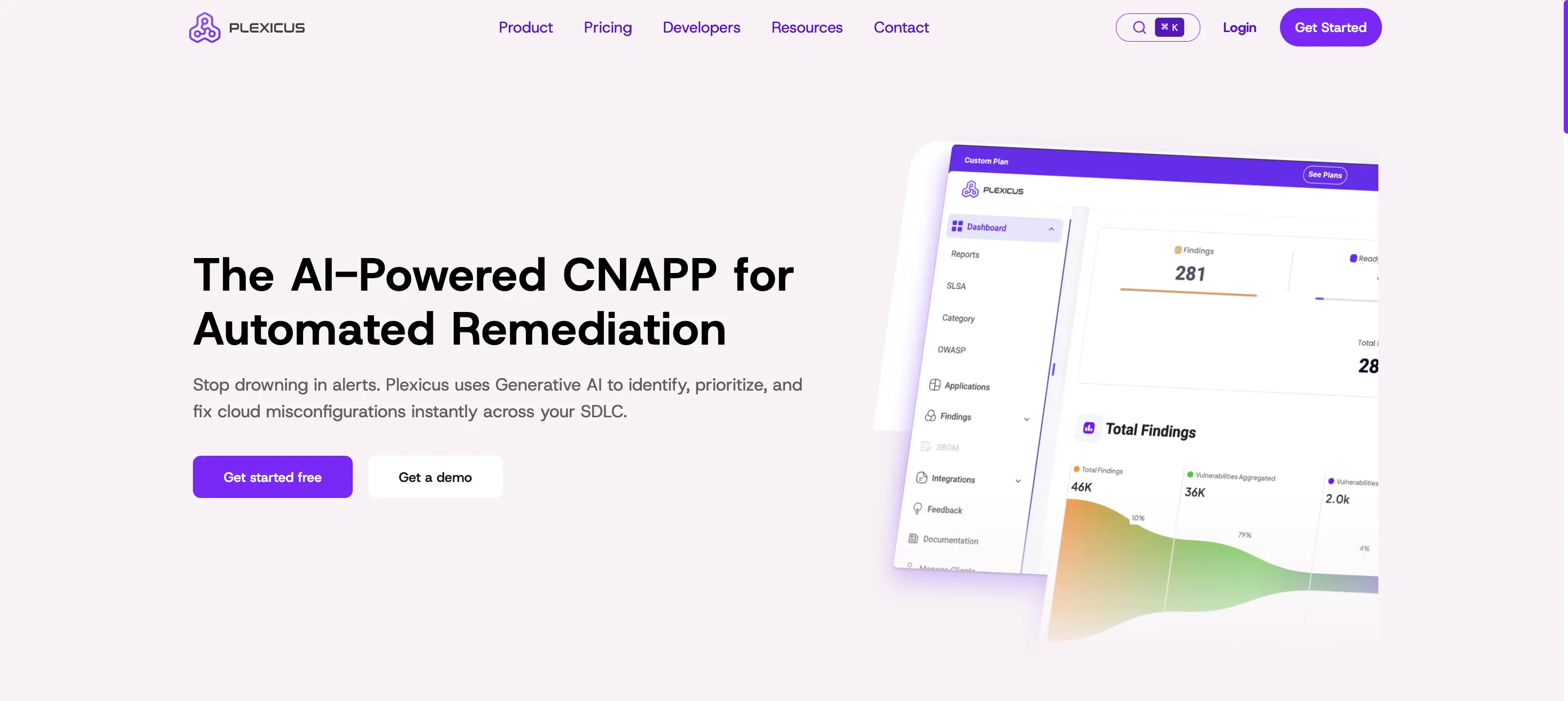
Plexicus AI emerged in 2026 as the primary alternative for organizations suffering from “Wiz fatigue.” While Wiz tells you the house is on fire, Plexicus sends an AI firefighter to put it out.
- Key Features: Codex Remedium is a proprietary AI agent that scans the code, understands the context of a vulnerability, and generates a functional Pull Request (PR) with unit tests.
- Pros: Reduces Mean Time to Remediate (MTTR) by up to 95%. It has high developer adoption because it does the work for them.
- Cons: Broad feature set can require more setup time to align with internal coding standards.
- Why Choose It: If your security team is a bottleneck for your release cycle, and you need to automate the actual fixing of vulnerabilities.
- 2026 Pricing: Transparent $49.90/developer/month for full CNAPP capabilities.
How to use Plexicus for Auto-Remediation:
- Log in to your dashboard, add your SCM or Cloud credentials.
- Navigate to the Findings menu.
- Filter by Impact to prioritize which needs to be fixed
- Click the View to enter the detailed finding view.
- Click the Auto Remediation button to start the remediation process.
- Review the AI-generated code in the sidebar and click Submit Pull Request.
- If needed, you can also edit the code yourself
2. Aikido Security
Aikido remains the king of “No Fluff.” In 2026, they have doubled down on noise reduction, ensuring that if a developer gets an alert, it is 100% exploitable.
- Key Features: Reachability checking that suppresses alerts for libraries that are installed but never actually executed.
- Pros: Drastically lower false-positive rates. Setup takes under 10 minutes.
- Cons: Not designed for massive, multi-thousand-node enterprises.
- Why Choose It: Best for high-growth startups and mid-market firms that do not have a 20-person security team.
- 2026 Pricing: Start for free. Paid plans are at $350/month.
3. Orca Security
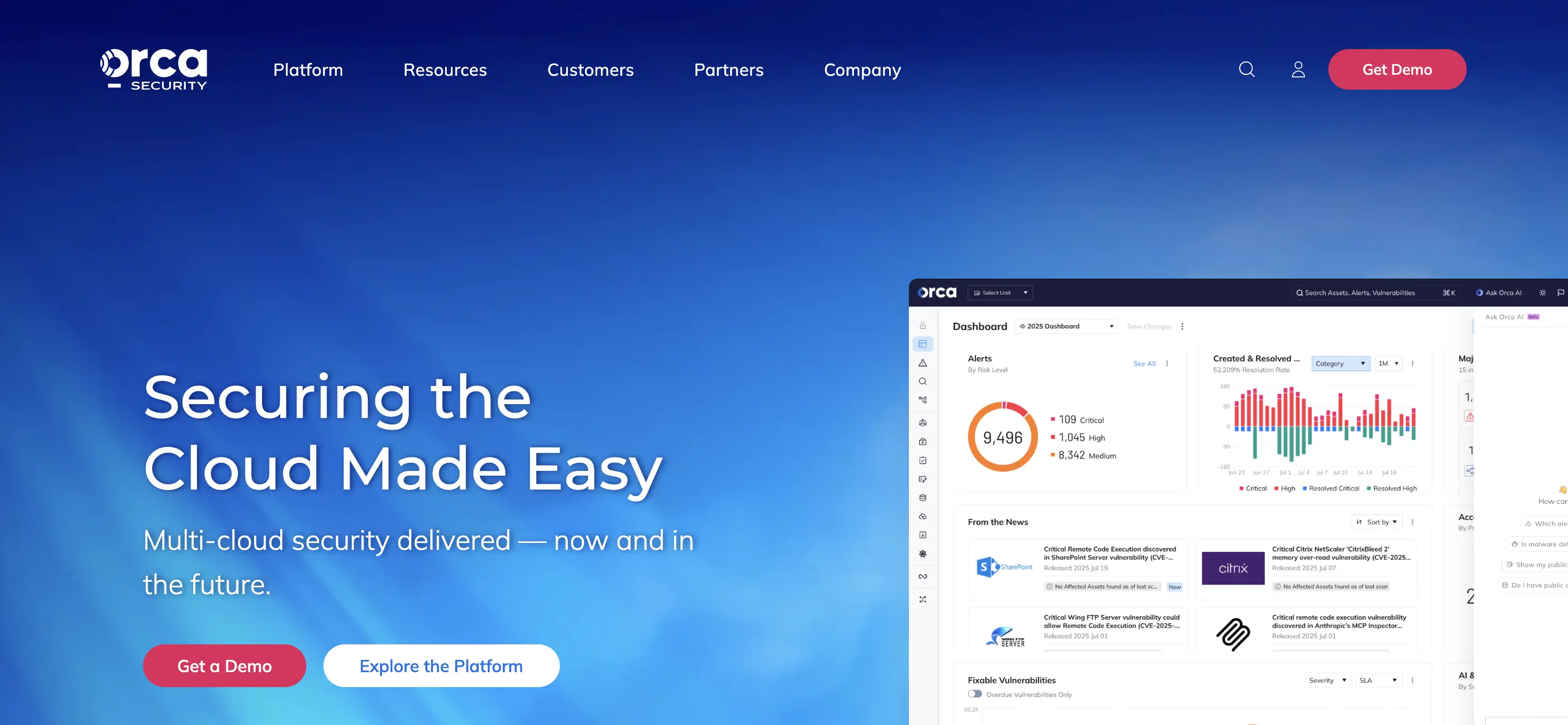
Orca is the most direct competitor to Wiz. In 2026, Orca has pivoted heavily into DSPM (Data Security Posture Management), identifying sensitive data (PII) at risk across multi-cloud environments.
- Key Features: SideScanning AI+, which reads block storage without agents to find “Shadow AI” instances and exposed LLM prompts.
- Pros: Incredible visibility into unmanaged assets.
- Cons: Can be expensive for large-scale ephemeral workloads.
- Why Choose It: If your primary concern is “Who has access to our data?”
- 2026 Pricing: Quote-based and workload-centric.
4. Snyk
Snyk is the incumbent for teams that want to stop bugs in the IDE. Their 2026 updates include “DeepCode AI,” which provides real-time security suggestions as developers type.
- Key Features: Industry-leading vulnerability database with native integration with almost every CI/CD tool.
- Pros: High developer trust. Excellent at securing the Software Supply Chain.
- Cons: CSPM (Cloud Posture) is still secondary to its AppSec roots.
- Why Choose It: If your team prioritizes “preventative” security at the commit level.
- 2026 Pricing: Free tier available. Paid starts at $25/dev/month.
5. Prisma Cloud (Palo Alto Networks)
The enterprise heavyweight. Prisma Cloud is for organizations that need to satisfy every regulator on the planet while managing thousands of cloud accounts.
- Key Features: Unified policy-as-code that applies to both IaC templates and live runtime environments.
- Pros: Most comprehensive feature set in the market.
- Cons: Complex to manage. It requires specialized training.
- Why Choose It: Large enterprises with strict regulatory requirements.
- 2026 Pricing: Credit-based model.
6. Sysdig Secure
Sysdig is the expert in “Runtime.” In 2026, Sysdig is the gold standard for runtime security in Kubernetes.
- Key Features: Falco Runtime X uses eBPF to detect and block threats like container escape or cryptojacking in real-time.
- Pros: Best forensics for post-incident investigation.
- Cons: Requires agents or sensors for deep visibility.
- Why Choose It: High-security environments that require active blocking.
- 2026 Pricing: Node-based.
7. Aqua Security
Aqua provides a full lifecycle approach specifically for containerized and serverless apps.
- Key Features: Dynamic threat analysis that “detonates” container images in a sandbox to see their behavior.
- Pros: Superior image signing and supply chain integrity.
- Cons: Can feel siloed if you have a lot of non-containerized workloads.
- Why Choose It: If your stack is 100% Kubernetes.
- 2026 Pricing: Quote-based.
8. CrowdStrike Falcon Cloud Security
If you are already using CrowdStrike for your endpoints, their cloud module is a seamless addition.
- Key Features: Integrated EDR (Endpoint Detection and Response) and CSPM.
- Pros: Single agent for everything. It has world-class threat intelligence.
- Cons: Not a “pure-play” AppSec tool. It is weaker in source code analysis.
- Why Choose It: For teams that want to consolidate endpoint and cloud security.
- 2026 Pricing: Quote-based.
9. Check Point CloudGuard
CloudGuard is built for the “network-first” security team. It focuses on the perimeter and how traffic moves between cloud environments.
- Key Features: Advanced network threat prevention and WAF integration.
- Pros: Excellent for hybrid-cloud network security.
- Cons: UI can feel “legacy” compared to newer startups.
- Why Choose It: Organizations with complex network architectures.
- 2026 Pricing: Quote-based.
10. Lacework (FortiCNAPP)
Now part of Fortinet, Lacework focuses on Anomaly Detection using machine learning to find unusual behavior.
- Key Features: Polygraph Data Platform that maps every interaction in your cloud to find unusual behavior.
- Pros: Finds “Zero Day” threats that scanners miss.
- Cons: Can be hard to investigate why an alert was triggered.
- Why Choose It: Teams that want a “set it and forget it” approach to breach detection.
- 2026 Pricing: Usage-based.
FAQ: Frequently Asked Questions
With 41% of code being AI-generated, how do these tools keep up?
Standard scanners struggle with the sheer volume of AI-generated code. Platforms like Plexicus use their own AI agents to scan at the same speed the code is being produced, providing near-instant remediation before the code is even merged.
Is “agentless” always better than agent-based in 2026?
Not necessarily. Agentless tools (Wiz, Orca, Plexicus) are best for rapid visibility and posture. However, if you need to block an active attack in progress or do deep forensics, you still need runtime agents or eBPF sensors like Sysdig.
How does Plexicus differ from Wiz?
Wiz is a Visibility platform. Plexicus is a Remediation platform. Wiz shows you the attack path on a graph. Plexicus integrates into your GitHub or GitLab and opens a Pull Request to fix the vulnerability automatically using AI.
What is ASPM, and why do I need it?
Application Security Posture Management (ASPM) bridges the gap between your code and your cloud. It maps a vulnerability in a line of code to the specific container running in AWS. It is the connective tissue that Wiz often lacks.
Final Thought
In 2026, the best security tool is the one that stays out of the way. If your current platform generates more tickets than your team can close, you are suffering from alert inflation.
Try Plexicus AI, it can help you to prioritize and fix security issue. Get started for free.