Wasmtime Sandbox Escapes: Updating the CLI Won’t Patch Your Embedded Runtime
Map embedded Wasmtime dependencies to shipped artifacts, choose the correct advisory fix and verify rebuilt deployments with a Plexicus evidence workflow.
Beyond ASPM
Proof-Driven AppSec for teams building with AI
Plexicus uses AI Swarm Pentest to explore authorized application paths, validate what is exploitable, and give teams evidence they can use to prioritize remediation.
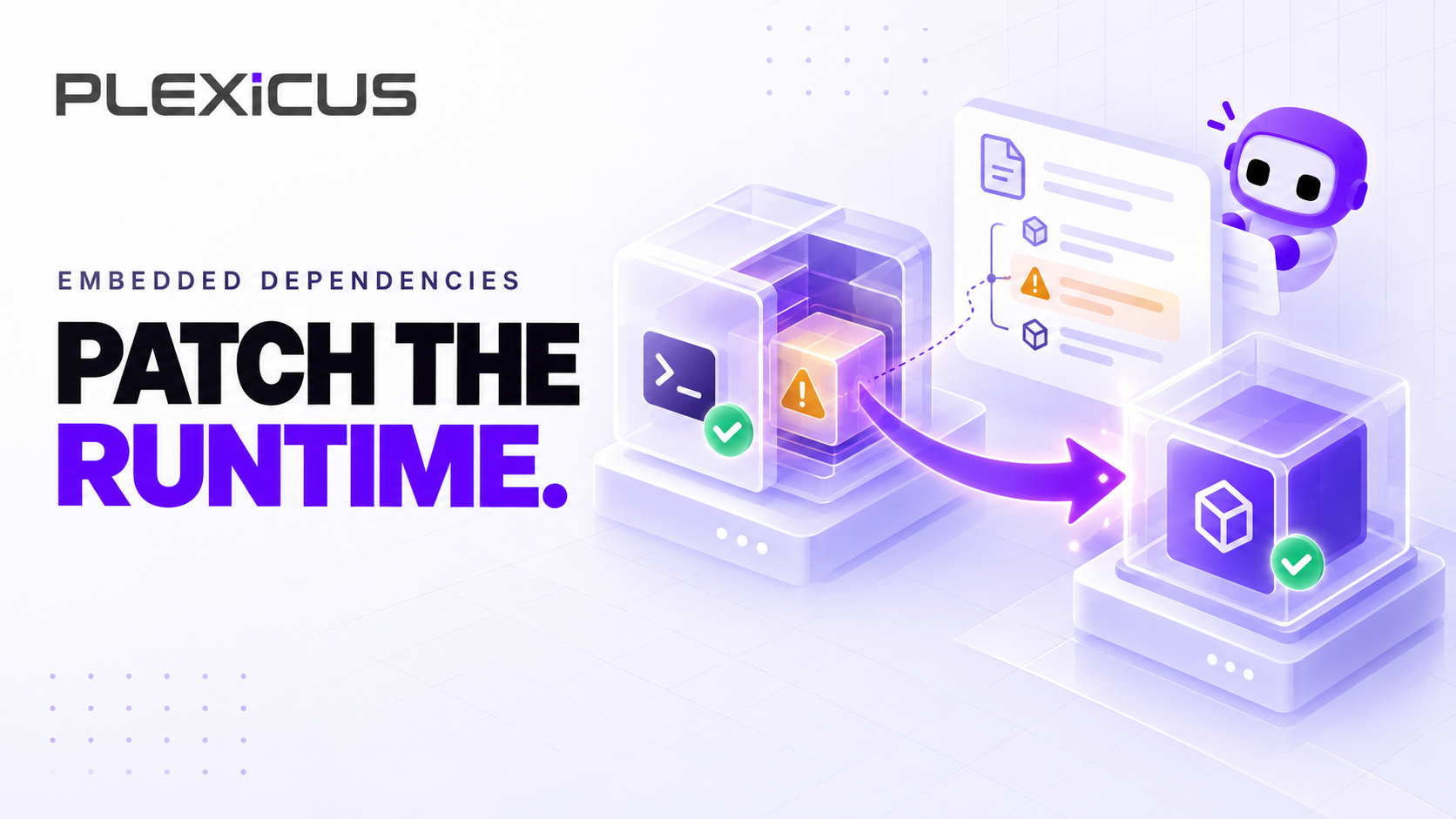
Explore AI Swarm PentestThe easiest Wasmtime patch to verify may be the one your application never uses. A developer updates the command-line tool, runs wasmtime --version, and sees a fixed release. The production service still embeds an older Rust dependency in its own binary.
For security teams, this is an inventory and deployment problem as much as a dependency-update problem. The question is not only “which version is installed?” It is which runtime compiled this application’s untrusted modules, and which deployed artifact contains it?
Two advisories, different patch boundaries
On October 19, maintainers published two Cranelift sandbox-escape advisories: one involving SSA index overflow; the other an aarch64 br_table compilation error. Their fixed releases differ. SSA advisory · aarch64 advisory.
| Advisory | Affected versions | Published fixes |
|---|---|---|
| GHSA-897f-g5gm-fmxm | <36.0.19; >=37.0.0, <43.0.0 | 36.0.19, 43.0.0 |
| GHSA-mghf-wjfp-p5xm | <36.0.19; >=37.0.0, <48.0.7; >=49.0.0, <49.0.4 | 36.0.19, 48.0.7, 49.0.4 |
Read each advisory with its backend and architecture conditions. In particular, 43.0.0 fixing the first issue does not make it a fix for the second. This table is a checked snapshot from October 27, 2026, not a promise that any listed release fixes every subsequent vulnerability. Select a supported release after reviewing the current advisories and compatibility requirements.
Find the runtime your service actually ships
Consider a plugin service that accepts customer-supplied WebAssembly. The repository can contain a direct wasmtime dependency, a wrapper that brings it in transitively, or a prebuilt library from another supplier. The team responsible for the service needs an artifact-level answer, not a list of developer laptops.
Start with the production build inputs. In a Rust workspace, these commands are useful discovery steps:
cargo tree --locked | rg 'wasmtime|cranelift'
cargo metadata --locked --format-version 1 > dependency-metadata.json
Run them against the actual workspace and build configuration. A dependency appearing in the tree does not establish runtime reachability. A name missing from that tree does not prove a downloaded native library or a supplier binary is absent. Record those coverage limits.
For each relevant artifact, capture the repository and commit, resolved runtime version, target architecture, compiler backend, enabled features, build job and immutable image or binary digest. Then identify which service instances actually run that digest. A multi-architecture image tag alone does not answer what an ARM worker executes.
Turn an SBOM entry into a remediation decision
An inventory entry should lead to an owner and a decision. Does the service process modules from untrusted users? Is compilation performed by the application, a separate worker or a deployment pipeline? Which backend and target are selected there? If the answer is unknown, keep the status unknown rather than recording an unsupported “not affected.”
Wasmtime documents its sandbox model and host interfaces in its security guide. That model is useful design context; a design goal is not proof that a particular shipped build has no implementation flaw.
Prioritize affected, reachable compilation paths first. Record the reasoning for other deployments separately. Do not extrapolate the aarch64 condition to the other advisory or assume that a configuration change is a documented workaround for both.
Rebuild, redeploy and verify the result
Updating a lockfile is a proposed fix. Build and deploy evidence establish what changed in the service.
| Stage | Evidence to retain |
|---|---|
| Dependency change | Resolved version and reviewed source change |
| Rebuild | Build configuration, successful job and artifact digest |
| Rollout | Digest actually running on each relevant architecture |
| Functional verification | Expected plugin behavior and application regression results |
| Closure | Advisory-specific rationale, owner and remaining coverage gaps |
Include long-running workers and rollback artifacts in the plan. Replacing an image in a registry does not replace an already running process. A successful application test also does not independently reproduce or disprove a compiler escape; describe what the test actually verifies.
Where Plexicus fits
Plexicus XBOM presents software, cryptographic and AI inventories in one workflow. Deep Code Analysis presents code-flow and business-impact context. Use an XBOM walkthrough to ask how your resolved dependencies and artifact evidence enter that workflow, and a code-analysis review to examine where customer modules reach the embedding application.
Those product descriptions do not establish automatic discovery of every embedded Wasmtime copy, compiler-level exploit reproduction or complete binary coverage. Make those requirements explicit in the scope and retain evidence for any claim of coverage.
The useful outcome is a traceable chain: advisory → dependency → build → deployed digest → verification. An isolated version screenshot cannot provide that chain.
Need to connect inventory to remediation evidence? Request an XBOM walkthrough or explore Deep Code Analysis. Bring one embedding service, its build inputs and its deployed digest so the discussion starts with a real artifact.