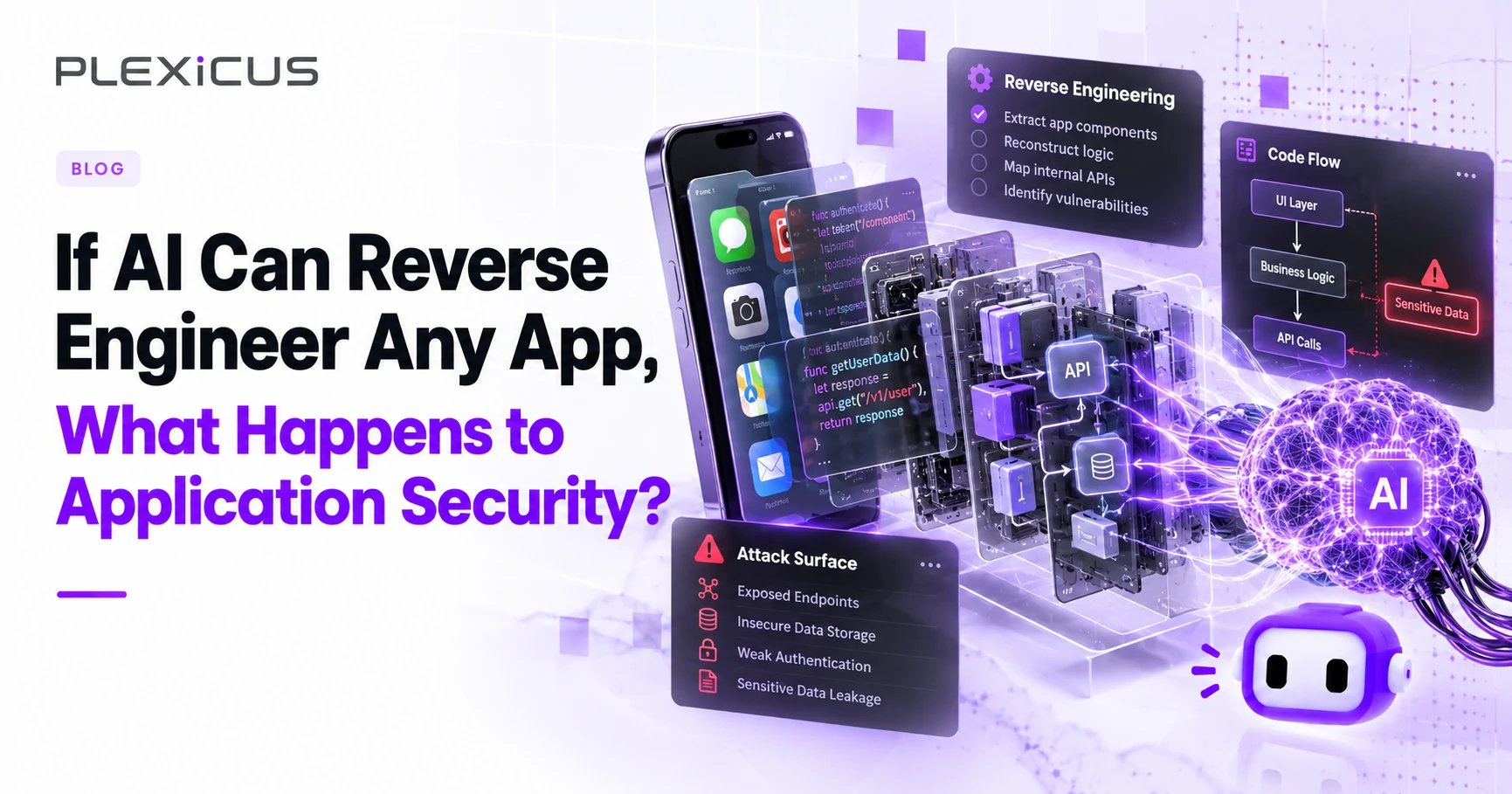
If AI Can Reverse Engineer Any App, What Happens to Application Security?
AI can help analysts navigate compiled software, but a decompiler output is not a vulnerability report. See how REA changes analysis, why reverse- engineering agents need protection, and how teams can validate findings.
Beyond ASPM
Proof-Driven AppSec for teams building with AI
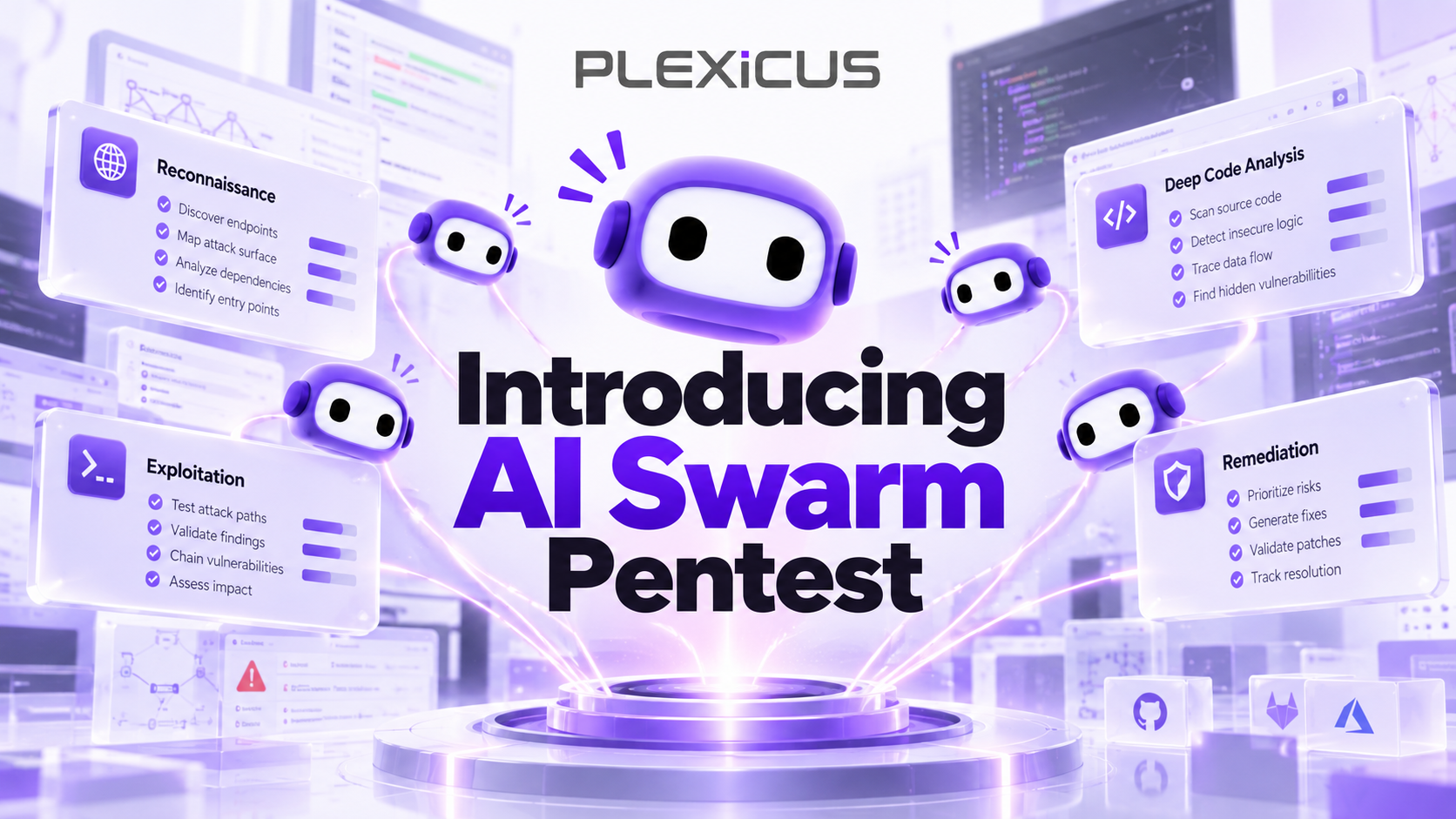
Plexicus uses AI Swarm Pentest to explore authorized application paths, validate what is exploitable, and give teams evidence they can use to prioritize remediation.
Explore AI Swarm PentestA Fireship video published on October 12, 2026, asks whether every application is becoming “open source” whether its creator wants that or not.
It explores AI-assisted software analysis, including Reverse Engineer Anything (REA). REA is an open-source toolkit that connects coding agents to reverse-engineering tools through MCP.
The idea is compelling: an agent can help inspect a compiled application, navigate analysis output, and explain parts of its behavior without access to the original source. That could make some investigations faster.
It does not make proprietary software open source, recover the exact original source, or prove a security flaw. Each conclusion is a hypothesis until independent evidence supports it.
For application security (AppSec), the useful question is not whether AI can “understand any app.” It is how to use AI to improve visibility while keeping artifacts, tools, and conclusions inside a defensible security process.
What Reverse Engineer Anything does
REA connects AI coding agents to reverse-engineering capabilities.
Depending on the artifact and its setup, analysts can investigate native binaries, JavaScript and Electron applications, .NET assemblies, Android packages, firmware, and other formats.
For native binary analysis, workflows may involve established tools such as Ghidra, IDA, or Hopper. These tools predate current AI agents.
They can disassemble machine code, produce approximate pseudocode, show references between functions, and expose executable structures for human investigation.
Use REA only for lawful, authorized analysis. Its repository says tool analysis runs locally, but analysis results are sent to the configured model provider; that provider’s data policy applies.
REA does not grant licenses for IDA or Hopper, which are licensed separately. The agent layer can help formulate questions, retrieve relevant output, follow references, and summarize a possible implementation path.
An analyst might use it to narrow down where a feature is handled in an unfamiliar desktop program, then inspect the relevant functions and test their interpretation.
The agent assists an investigation; it does not automatically reconstruct the full program or certify its behavior.
Compilers remove or transform information, symbols may be absent, and decompiled pseudocode can be incomplete or misleading. A reconstructed feature may only resemble the original behavior.
Why this matters to AppSec
More visibility into software without source access
Organizations rely on third-party applications, native libraries, mobile clients, firmware, and commercial products whose source code they cannot inspect. Binary analysis can add visibility when source-oriented methods are unavailable.
It may help identify a suspicious input path, hardcoded data, or an unexpected feature for further review. A suspicious function is still not proof of exploitability.
Analysts need to establish whether an input can reach it, under what configuration, and with what security impact.
An inventory such as an SBOM helps identify components, but neither an SBOM nor binary inspection alone proves that a component is safe or vulnerable.
Faster hypothesis generation
Reverse engineering traditionally requires specialist knowledge of executable formats, assembly, memory layouts, calling conventions, and compiler behavior.
AI may help analysts navigate some of that complexity: trace a candidate input across functions, locate a risky operation, or collect related output.
This can focus human effort on areas such as memory-safety operations, cryptographic use, native parsers, and boundaries where untrusted data influences privileged behavior. Tool output remains a lead to investigate.
Static observations may lack runtime context, and model-generated explanations can be wrong.
A possible input to authorized testing
Binary analysis may inform a penetration test when the owner has explicitly authorized the target and methods.
An analyst could investigate a suspicious path and design a controlled test to see whether it is reachable and exploitable under the agreed conditions. REA is not, by itself, a complete autonomous penetration-testing platform.
Reverse-engineering support does not guarantee vulnerability discovery, exploitation, or remediation. Keep testing within written scope and validate security claims with reproducible evidence.
The security assumption reverse engineering challenges
Compiled code is harder to read than source, but implementation secrecy is not a security boundary. Consider a desktop client that performs an authorization check locally.
If the backend accepts the request without enforcing the same permission, a user may bypass the client-side check by changing the client or calling the service directly.
The root issue is misplaced trust in client-controlled behavior, not the existence of a decompiler. Security-sensitive authorization belongs at a trusted service boundary.
This aligns with the OWASP ASVS v5.0, V8 Authorization.
Obfuscation, anti-debugging, and anti-tampering can increase the effort needed to inspect or modify software. They can be useful as defense in depth for some mobile applications, games, and client environments.
The OWASP MASVS-RESILIENCE treats resilience controls as supplementary: they cannot compensate for broken authentication, authorization, or cryptographic design.
Reverse-engineering agents can be attacked too
An AI agent may analyze a binary that contains attacker-controlled strings, metadata, or other content.
If tools return that content and the agent treats it as instructions, the artifact can cross a trust boundary through indirect prompt injection. A simplified sequence looks like this:
- An agent receives an unfamiliar binary for analysis.
- A reverse-engineering tool extracts strings, metadata, or pseudocode.
- Some extracted content is crafted to influence an AI system.
- The agent mistakes the content for trusted instructions or a reliable conclusion.
- It may then propose an out-of-scope action or repeat a false claim in its report.
A related risk is false corroboration: several tool outputs may repeat the same artifact-derived text. Those outputs are not independent evidence just because they appear in separate panels or formats.
A July 2026 arXiv preprint, “When Binaries Talk Back: Representation-Confusion Attacks on LLM-Assisted Reverse Engineering”, studies this class of risk under controlled conditions.
The experiment used controlled synthetic Linux ELF/x86-64 C programs and two models. Before the paper’s proposed runtime controls, it reports that models proposed an attacker-planted unsafe action in 35 of 40 adversarial cases.
REA itself was not evaluated, and these percentages are not a measure of real-world failure prevalence. This is a result from the authors’ specific models, tasks, and setup.
The broader lesson is that an analyzed artifact must remain untrusted data, never an authority over the agent. Secure an analysis workflow by:
- treating extracted strings, metadata, pseudocode, and documents as untrusted input;
- limiting tool permissions and requiring approval for sensitive or out-of-scope actions;
- recording provenance so each claim points to its source artifact and tool output;
- validating important findings with independent, authorized tests; and
- isolating unknown binaries and generated analysis code from credentials and production systems.
This threat maps to OWASP LLM01
Prompt Injection.Limit agent permissions in line with OWASP LLM06
Excessive Agency.An evidence-led workflow for AI-assisted binary analysis
A reliable process moves from observation to validation. The following seven stages are a practical reference architecture, not a claim that REA or Plexicus implements every stage.
- Define authorized scope. Record the artifacts, environments, permitted methods, and actions that need human approval.
- Preserve the artifact. Record hashes, versions, architecture, provenance, and available component information so results can be tied to the exact build.
- Analyze with appropriate tools. Inspect imports, symbols, code paths, disassembly, and pseudocode; note tool versions and limitations.
- Generate hypotheses. Ask AI to surface suspicious behavior, but label each observation as a candidate finding.
- Validate in isolation. Run controlled tests within scope to determine whether the suspected weakness is reachable and real.
- Record evidence and impact. Preserve test results, relevant locations, environment assumptions, and observed consequences; separate evidence from model interpretation.
- Verify remediation. Re-test the original condition and check for regressions after a fix.
The result should be a reviewable security finding, not just a persuasive explanation.
Binary analysis complements other AppSec methods
| Method | What it helps inspect | Important limitation |
|---|---|---|
| SAST | Source code and supported code representations | May miss runtime conditions or unsupported paths |
| SCA | Known components and dependency risks | Does not reveal every unknown flaw |
| DAST | Observable behavior of a running application | Coverage depends on reachable paths and test conditions |
| Binary analysis | Compiled code and executable structures | Decompiled logic can be incomplete or ambiguous |
| AI-assisted reverse engineering | Navigation and correlation across artifact analysis | Model conclusions need verification |
| Penetration testing | Security behavior under authorized conditions | Coverage depends on scope, time, and access |
The goal is not to replace SAST or DAST with binary analysis. It is to combine evidence from suitable methods to understand application risk more accurately.
How developers can prepare
- Enforce authorization on trusted systems. Do not rely only on client-side checks for sensitive operations.
- Minimize secrets in distributed software. Avoid embedding privileged, long-lived server credentials in downloadable applications.
- Secure native components. Use memory-safe designs where practical, compiler hardening, input validation, and appropriate tests.
- Track distributed artifacts. Include packaged binaries, firmware, and third-party components in risk and response processes.
- Use obfuscation as defense in depth. Apply it where the threat model warrants it, without treating it as a substitute for secure architecture.
- Protect analysis agents. Keep untrusted artifacts from overriding instructions; restrict file, network, credential, and execution access independently of the model.
- Require reproducible evidence. A confident explanation is not a verified vulnerability.
These practices align with OWASP MASVS-RESILIENCE. They also align with OWASP ASVS v5.0, V8 Authorization.
The final published SSDF is NIST v1.1.
NIST SP 800-218 v1.2 (Rev. 1) was an initial public draft dated December 2025, not a final version: NIST SP 800-218 Rev. 1 IPD.
Will AI reverse engineer every application?
“Every” hides major technical differences. A simple function, a heavily obfuscated native program, a distributed service, and hardware-dependent firmware are not equally easy to analyze.
An agent may reconstruct one path without understanding the whole application, or generate similar-looking code that is not equivalent. A more defensible expectation is that AI may lower the cost of examining some compiled software.
That can help defenders and researchers, while also lowering barriers for attackers. The effect depends on implementation, governance, authorization, and independent validation—not on a claim that all software is now open source.
AppSec needs proof, not just visibility
REA connects established reverse-engineering tools with AI-assisted workflows. Its significance is the questions it raises about software transparency and the systems that analyze untrusted artifacts.
Finding a suspicious code path is only a starting point. Teams must still establish whether it is reachable, exploitable, impactful, and fixed.
AI can speed up investigation, but security outcomes require evidence, validation, and accountable remediation. That is the premise behind Proof-Driven AppSec: move from observations to validated findings and verified fixes.
Explore Plexicus to learn about AI-assisted security testing, Deep Code Analysis, and evidence-driven application security.
Frequently asked questions
Can AI reverse engineer closed-source software?
AI can assist with disassembly, decompilation, and behavioral analysis. It cannot guarantee recovery of the exact original source code or reveal unseen server-side components.
What is Reverse Engineer Anything (REA)?
REA is an open-source toolkit that connects AI coding agents to reverse-engineering capabilities through MCP. Its supported artifacts and integrations depend on the setup.
Can AI-assisted reverse engineering find vulnerabilities?
It can help identify suspicious code paths and generate hypotheses. Further analysis and authorized testing are needed to establish whether a finding is a real vulnerability.
Does reverse engineering make proprietary apps insecure?
No. Security should not depend on keeping implementation secret. Reverse engineering can expose weaknesses when applications trust client-side enforcement or hidden behavior.
Can reverse-engineering agents be affected by prompt injection?
Yes. Attacker-controlled strings or tool output can influence an agent if treated as trusted instructions. Research has demonstrated representation-confusion risks in controlled experiments.
Can AI reverse engineering replace penetration testing?
No. It can inform authorized testing, but inspecting code is different from demonstrating exploitability and impact under test conditions.
References and further reading
- Fireship: Every app on Earth is now open source… whether it likes it or not
- Reverse Engineer Anything (REA)
- Ghidra
- When Binaries Talk Back: Representation-Confusion Attacks (July 2026)
- OWASP MASVS-RESILIENCE
- OWASP ASVS v5.0, V8 Authorization
- NIST SP 800-218: Secure Software Development Framework, v1.1 final
- NIST SP 800-218 Rev. 1 initial public draft