Tailworm’s AppSec Lesson: Prove the Privilege Boundary, Not Just the Login
A practical evidence workflow for testing authorization boundaries, connecting code context to impact, and reviewing remediation with Plexicus.
Beyond ASPM
Proof-Driven AppSec for teams building with AI
Plexicus uses AI Swarm Pentest to explore authorized application paths, validate what is exploitable, and give teams evidence they can use to prioritize remediation.
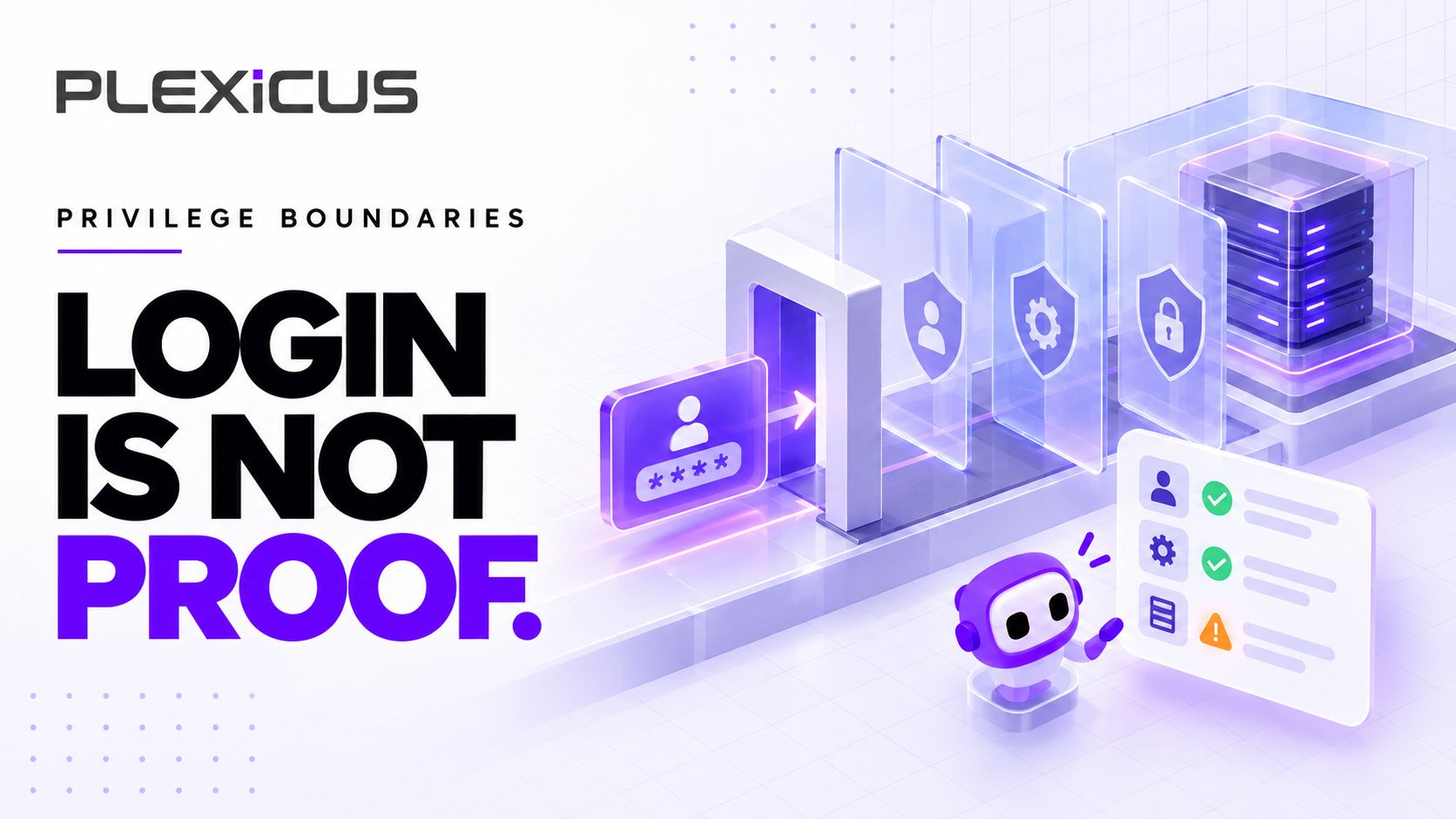
Explore AI Swarm PentestA valid login is the beginning of an application security test. It does not prove that the authenticated identity can only perform the operations your business intended. The useful question comes one step later: what can this identity make a more privileged component do?
The Tailworm researchers report privilege-boundary findings in Tailscale v1.104.2 and headscale v0.29.5. These are researcher claims, not findings independently reproduced by Plexicus. Research report.
This article turns that research signal into an assessment plan for your own applications. It does not establish that your environment is vulnerable, prescribe a vendor patch, or claim that Plexicus detected the reported issues. Check the vendor’s security bulletins for its published advisories.
Start with the operation after authentication
Imagine an application that lets a support operator preview a customer export. The operator is authenticated correctly. A backend worker holds credentials that can read every customer’s records. If the export request names another customer, the worker must still enforce the operator’s permitted scope. A successful login and a successful worker job can coexist with a broken tenant boundary.
The same review applies to an AI assistant invoking a privileged tool, a webhook triggering a deployment, or an API asking a service account to fetch a file. The design review should connect the caller, the requested operation, the resource and the identity that ultimately performs the operation. Tailscale’s own SSH documentation is useful context for understanding its particular access model; it is not evidence that an unrelated application has the same behavior.
Build a boundary test matrix
Use synthetic accounts and disposable resources in an authorized environment. Write down the expected result before testing. Otherwise a surprising response can quietly become the assumed policy.
| Test identity | Requested operation | Expected evidence |
|---|---|---|
| Owner in tenant A | Read its own export | Synthetic export returned; owner recorded |
| Member in tenant A | Read an administrator-only export | Denial; no job or download created |
| Owner in tenant B | Read tenant A’s export | Denial; no cross-tenant data returned |
| Revoked account | Reuse an earlier export link | Outcome matches the documented revocation policy |
| Worker with broad credentials | Execute a request outside the caller’s scope | Scope enforced at the privileged operation |
A status code alone is weak evidence. A rejected request might still enqueue work. A successful response might contain only an error envelope. Check the resulting resource, audit event and worker action as well as the response body.
OWASP recommends least privilege, default denial and authorization checks on every request. Use those principles to review your matrix, then add the application-specific invariants that a generic scanner cannot infer. OWASP authorization guidance.
Review the gap between a check and its use
Some boundaries depend on state that can change: account membership, object ownership, file paths or a job’s approval status. MITRE describes this general weakness as a time-of-check/time-of-use race. CWE-367.
For an export job, ask whether authorization is checked when the request arrives, when the job starts, and when the download is served. Decide which changes must invalidate pending work. Test that decision with a controlled state change rather than assuming one early check protects the entire lifecycle. Keep concurrency tests bounded and use synthetic data so the exercise does not disrupt other users.
Use Plexicus to connect validation, code and a reviewable fix
Plexicus presents AI Swarm Pentest for scoped assessment evidence and Deep Code Analysis for code-flow and impact context. Those product descriptions support a conversation about this workflow; they are not a guarantee of coverage for every infrastructure daemon, protocol or race condition.
A useful engagement starts with an explicit question: can a tenant member cause the export worker to read another tenant’s synthetic record? Agree on identities, assets, excluded operations and stop conditions. Require the result to name the tested build and configuration. An untested path should remain an untested path.
Then connect the observed behavior to the code that chooses the tenant, resolves the resource and launches the worker. A remediation proposal should identify where the caller’s authority is lost. Retest the original negative case and a legitimate owner request after the change. “Forbidden request now fails” is incomplete if the permitted workflow also breaks.
For every finding, retain the request and response with secrets removed, the observed effect, the relevant code location, the expected policy, and the retest result. Track the stages separately: reported, reproduced, fix proposed, merged and retested. A merged change alone does not prove the deployed boundary holds.
The result worth measuring
Count how many important boundaries have a stated policy, a reproducible negative test and a verified outcome on the deployed version. That is more actionable than the number of authorization-related alerts in a dashboard.
Want to apply this workflow to your application? Request an AI Swarm Pentest or explore Deep Code Analysis. Bring one critical workflow and its role model so the assessment can start with a concrete boundary to prove.