PHP2Shell: An Application Fix Cannot Replace a Runtime Patch
Separate PHP runtime exposure from application findings, verify worker replacement and keep remediation evidence reviewable with Plexicus.
Beyond ASPM
Proof-Driven AppSec for teams building with AI
Plexicus uses AI Swarm Pentest to explore authorized application paths, validate what is exploitable, and give teams evidence they can use to prioritize remediation.
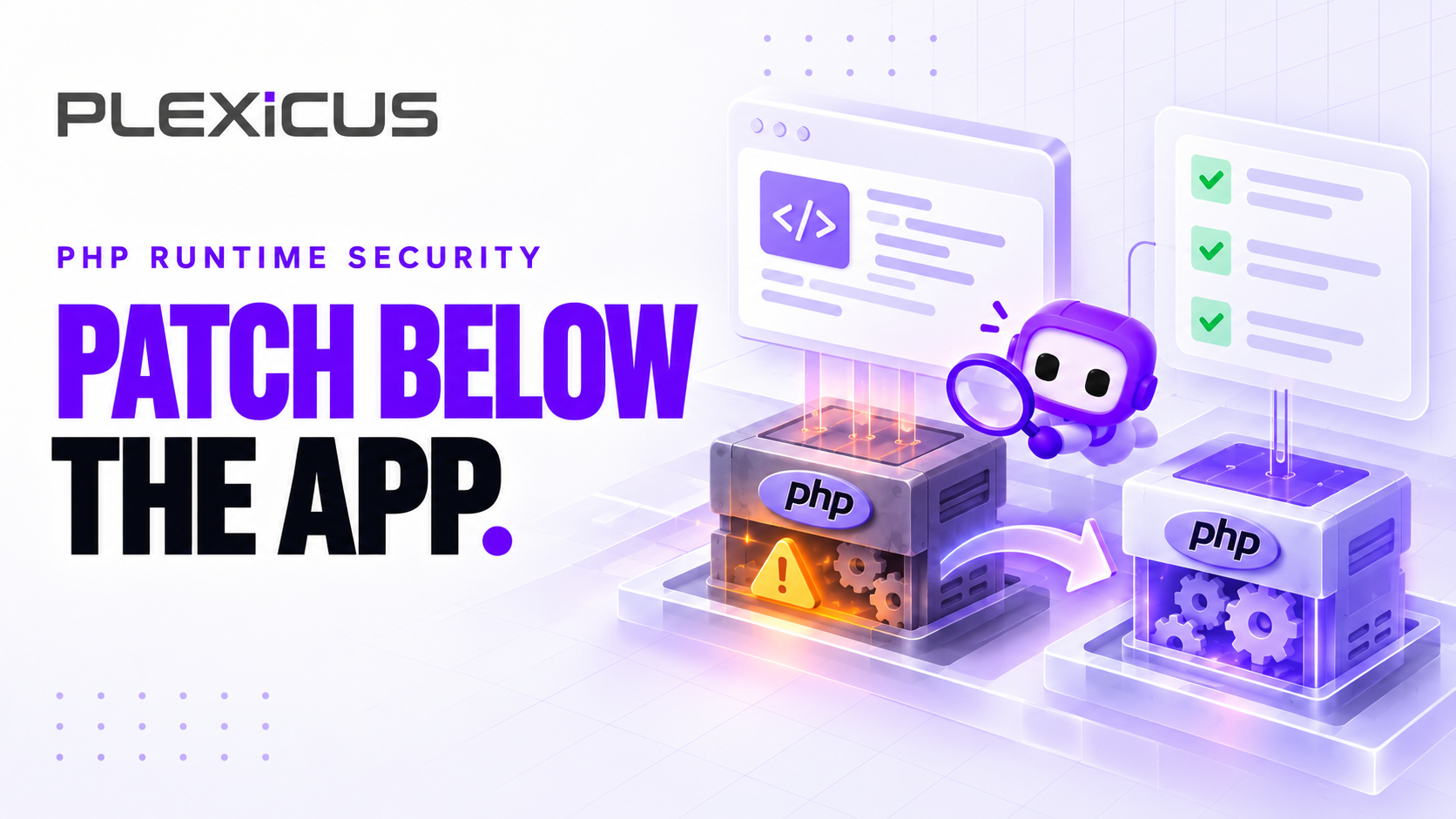
Explore AI Swarm PentestA pull request can fix an application bug and still leave the service exposed to a runtime vulnerability. The two changes have different owners, different artifacts and different evidence. PHP’s October security advisories make that distinction concrete.
The October 21 releases 8.2.35, 8.3.36, 8.4.27 and 8.5.12 address CVE-2026-109618 and CVE-2026-109619. PHP release announcement.
The out-of-memory advisory describes an Apache mod_php path before application code runs. An application middleware change cannot protect a path that executes before that middleware. OOM advisory.
The second advisory describes request-owned state surviving in a persistent worker. A later request can encounter that stale state. Global-state advisory.
These are upstream findings, not vulnerabilities independently reproduced by Plexicus. This article provides a remediation evidence workflow, not an exploit test or a claim that your deployment is affected.
Give runtime and application work separate closure criteria
Imagine a checkout team that adds validation to its upload handler. The pull request is reviewed, tests pass and the change reaches production. That is useful evidence about the handler. It does not establish which PHP package handles incoming requests, whether the package contains the upstream fixes or whether older workers remain active.
Open separate work items when necessary. The application item should name the code behavior and its regression test. The runtime item should name the vendor advisory, installed package, affected service and rollout evidence. Cross-link them so a green application task cannot silently close an unfinished runtime upgrade.
Identify the request-serving environment
Start with the web service, not a developer’s shell. Record the PHP integration model, package supplier, architecture, configuration sources and owning team. Command-line output can be a useful inventory clue, but the CLI and web service may use different binaries or configuration.
| Question | Evidence to collect |
|---|---|
| What receives production requests? | Service configuration and process identity |
| Which package contains the fix? | Supplier advisory and package release identifier |
| What was deployed? | Reviewed change, build identifier or immutable image digest |
| Did workers change? | Rollout or restart completion and running-instance evidence |
| What remains uncertain? | Explicit coverage gap and responsible owner |
For a vendor-maintained distribution, establish the patch status from that vendor rather than comparing an upstream version string alone. Do not expose a public diagnostic page containing environment details to obtain this evidence.
Treat mitigation advice as scoped and time-sensitive
PHP’s October 23 update recommends disabling session upload progress until the next regular bugfix release for a specific remaining configuration issue. PHP informational advisory.
Consult the latest upstream and supplier instructions before applying or removing temporary settings. Record the setting, scope, owner and condition for removal. A configuration workaround for one path must not become a blanket claim that every advisory is mitigated. This article does not assert that the October patch releases resolve every later PHP vulnerability.
Verify the service after the change
A package transaction is an intermediate result. Confirm the deployed service uses the intended package and complete the relevant worker replacement. Include secondary instances, maintenance environments and rollback images in the review. Otherwise a later rollback can reintroduce the package you just removed.
Run authorized application regression checks with ordinary test data: checkout, authentication, uploads and session behavior where relevant. A passing functional check establishes that those workflows still work. It does not independently prove the absence of a memory-corruption exploit. Retain that distinction in the closure note.
Use Plexicus for a reviewable application remediation workflow
Plexicus Deep Code Analysis presents code-flow and impact context. Remediation presents suggested changes for team review, with supporting context. These capabilities can help organize application findings that accompany a runtime response. They do not establish automatic patching of PHP infrastructure or complete discovery of every request-serving worker.
Bring runtime package and rollout evidence into the team’s decision alongside code findings. Keep “change proposed,” “merged,” “deployed” and “verified” separate. The useful handover shows what each action fixed, what the evidence demonstrates and which owner still has work.
Need to connect a finding to a reviewed change? Explore Plexicus Remediation or request Deep Code Analysis. Start with one application workflow and its runtime boundary so code fixes and operational patches have clear acceptance criteria.