A Fruit Fly Connectome Is a Test Case for AppSec Demo Claims
A fruit-fly connectome offers a vivid test of a security principle: a demo is not proof until controls show what the advertised system contributes.

Beyond ASPM
Proof-Driven AppSec for teams building with AI
Plexicus uses AI Swarm Pentest to explore authorized application paths, validate what is exploitable, and give teams evidence they can use to prioritize remediation.
Explore AI Swarm PentestA security demo can make an untested claim feel proven. The useful question is what the system caused—and what the engineer supplied.
A mapped fruit-fly nervous system makes that question visible.
The 2026 male central nervous system map contains about 166,700 neurons, 11,710 neuron types, and 125 million synaptic contacts (MaleCNS project; Cambridge repository; Google Research).
A connectome maps which neurons connect through synapses.
Its v1.0 data appeared in June; the accompanying Cell paper was published September 3, 2026.
A connectome is a structural map, not a recording of a living fly’s thoughts or a complete specification for running one. Simulations add assumed neural dynamics, sensory inputs, and output controls.
The engineers who choose those parts can shape much of what a viewer sees.
The hero image is a Plexicus editorial illustration of the online experiments, not a scientific image or a screenshot of a validated fly playing those games.
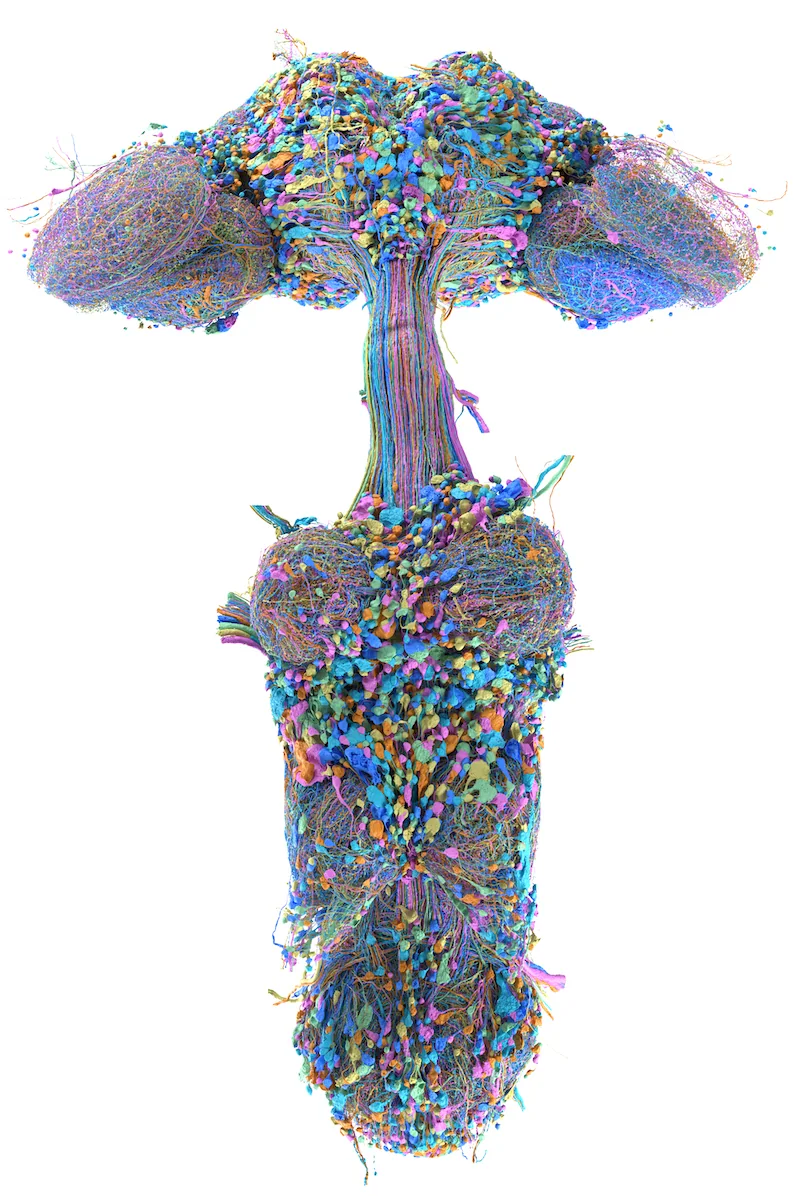
MaleCNS visualization showing one representative cell from each annotated neuron type. Credit: FlyEM Project Team/HHMI Janelia, Cambridge Connectomics Group, and Google Research. Original gallery and context.
The control experiment is the story
Intezer tested whether a fruit-fly connectome could help classify 12,716 of its own security alerts.
Only 606 alerts (4.8%) were escalated; the other 12,110 were marked no action needed. With this class imbalance, Intezer reports both ROC-AUC and precision-recall AUC (PR-AUC).
The real connectome scored 0.887 ROC-AUC and 0.300 PR-AUC. Intezer says every model used identical five-fold stratified splits and the same regularization grid.
Controls scored higher: scrambled wiring 0.910 / 0.385, a random reservoir 0.918 / 0.426, and logistic regression on hashed alert tokens 0.922 / 0.476 (ROC-AUC / PR-AUC).
These are company-reported results, not an independent or peer-reviewed replication. The real connectome carried usable information, but it did not outperform the reported controls.
The comparison is more informative than a working demo alone: does the advertised component add value beyond a scrambled network, a random reservoir, or a simpler classifier?
The feature paths differ: the connectome uses 121 smell channels; the strongest linear baseline uses a 4,096-dimensional hashed token set.
That representation choice matters when interpreting the comparison. The scores do not establish how connectomes perform on other tasks.
CVE-FLY is the AppSec hook
CVE-FLY explores using a neural policy to steer a fuzzer’s tradeoff between exploring new paths and exploiting promising ones.
The repository uses a female-brain model, not MaleCNS, and reports reaching a deliberately planted heap overflow in a toy C program after 3,458 executions.
That is not a fly hacking a program. The README says the toy target exposes a synthetic progress score, while Python’s PRNG still mutates the input bytes.
The repository reports no statistical benchmark against random, fixed, or AFL++ policies. Its single run is a proof of architecture, but does not establish improved code coverage measured through compiler instrumentation or superiority over established fuzzers.
What the map and demos do—and do not—show
The 2026 MaleCNS reconstruction covers the brain, optic lobes, and ventral nerve cord.
It extends earlier work: the 2024 FlyWire female-brain connectome contained 139,255 neurons and about 54.5 million synapses, and a female brain and ventral nerve cord map was also released.
A wiring diagram does not specify each neuron’s membrane voltage, each synapse’s functional strength, the animal’s neuromodulatory state, or how its body responds.
Developers must supply dynamics and decide how external events stimulate the model.
The 2024 Nature model by Shiu and colleagues showed that a relatively simple connectome-based model could make useful predictions about feeding and grooming circuits.
That supports studying computation in the wiring; it does not establish a faithful reconstruction of an individual fly’s experience.
Game integrations make those design choices easier to see:
Game state → engineered sensory encoding → simulated neural activity on measured wiring → selected neural readout → engineered game controls.
A Minecraft mod maps game stimuli to sensory populations, runs a MaleCNS-derived graph with simplified dynamics, then decodes activity into movement.
Its documentation describes thresholds and a hand-built body layer.
Fly64 applies a similar idea to Super Mario 64, using a virtual visual perspective and selected neural groups to control movement and jumps.
Its creator calls it educational and unvalidated; the technical notes say the measured wiring does not establish recovered physiology, behavior, experience, or consciousness.
In Doom, DOOMFLY connects a live game arena to MaleCNS activity: game frames stimulate modeled visual neurons, and selected outputs become movement and firing commands.
Its neuroscience review describes a closed-loop connectome simulation while calling the sensory mapping, neural dynamics, and motor decoder approximations.
Its training notes report failed validation gates; learned survival has not been demonstrated.
A widely shared Beat Saber clip added to the meme, but a short video cannot show the model, control mapping, or validation.
The Beat Saber tile in the hero illustration represents that meme, not an independently verified result.
Eon Systems’ March 2026 virtual-fly demonstration is separate from these games; it used an earlier female FlyWire map, simplified dynamics, and a physics-simulated body.
Eon’s technical note outlines those limits, while the Carboncopies response argues “upload” overstates the evidence; neither demonstrates transfer of an individual fly’s mind.
A checklist for testing an AI security demo
Use the fly as a worked example, then ask the same questions of an AI pentest or autonomous-agent demo:
| Fly experiment | AI pentest or autonomous-agent demo |
|---|---|
| Scope and anatomy: Which parts of the reconstructed nervous system were included, filtered, or cropped? | Scope and target: Which hosts, code, identities, and attack paths were in scope, and what was excluded? |
| Fixed script, learned dynamics, or human help: Which neural behaviors were modeled, and where did the developers set rules or intervene? | Script, model, or human help: Which steps were fixed automation, model decisions, prompts, or operator actions? |
| Input mapping and interface: Who translated game state into sensory inputs and neural outputs into controls? | Input mapping and interface: What data reached the agent, what tools could it use, and did the demo bypass the advertised path? |
| Controls: Did measured wiring beat scrambled wiring, a random reservoir, or a simpler model? | Controls: Did the system beat a simpler tool, a random policy, or a human on the same target and budget? |
| Finding and fix retest: Did the behavior survive held-out tests, ablation, and independent reproduction? | Finding and fix retest: Is the finding reproducible, and does the proposed patch pass a fresh retest? |
One common AppSec failure mode is a scanner flag on a dangerous code sink that no attacker-controlled path can reach.
A sink is an operation that could cause harm. Reachability asks whether attacker-controlled input can get there; exploitability asks whether it can cause real impact. A proof of concept can demonstrate both.
Call the finding a false positive only after checking that no other attacker-controlled path reaches the sink.
Ask for the comparison
A game connected to simulated fly wiring is a striking demonstration. Intezer’s controls and CVE-FLY’s limits show why the next step is to test the advertised contribution, not infer it from the video.
When a vendor shows you an AI security demo, ask: what was it compared against, and what happens when you remove the component being sold?