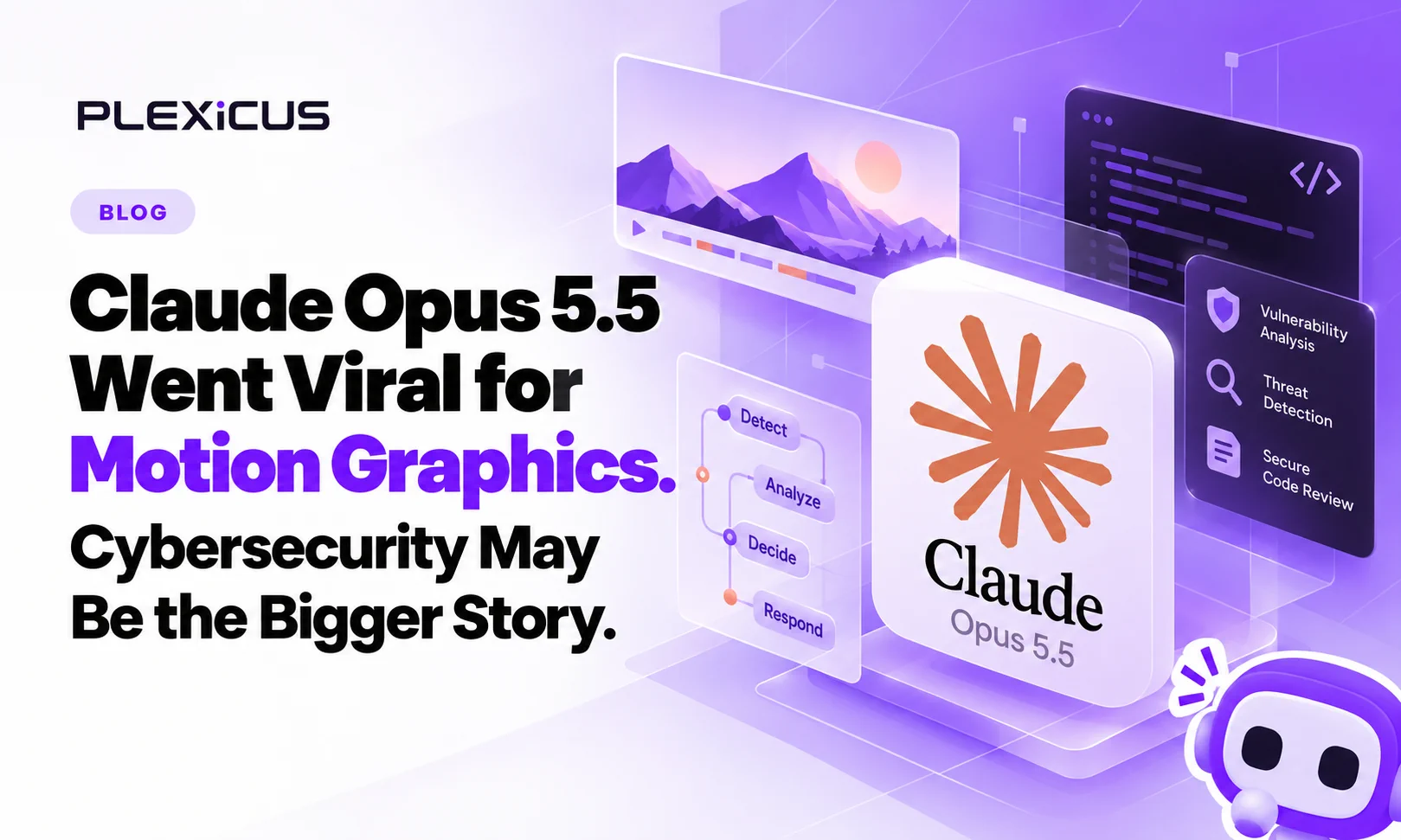
Claude Opus 5.5 Went Viral for Motion Graphics. Cybersecurity May Be the Bigger Story.
The motion-graphics demos show a broader agentic loop: models can plan, write code, run it, inspect the result, and revise. AppSec teams need that same pace for verification, with evidence behind every finding.
Beyond ASPM
Proof-Driven AppSec for teams building with AI
Plexicus uses AI Swarm Pentest to explore authorized application paths, validate what is exploitable, and give teams evidence they can use to prioritize remediation.
Explore AI Swarm PentestClaude Opus 5.5 Went Viral for Motion Graphics. Cybersecurity May Be the Bigger Story.
The launch-week clips were hard to miss: kinetic typography, product films, animated logos, and 3D scenes built with Claude Opus 5.5.
The interesting detail is how many were made. Anthropic’s model documentation describes text-and-image input with text output, not native video output. A public third-party index says many creators used Claude to write HTML, Canvas, or SVG animations, then screen-recorded or rendered them into video. The index had collected 1,048 clips and 73.6 million X views when we checked it, but it also says it cannot independently verify how every clip was made. Treat those totals as a snapshot of social attention, not an official model metric.
That distinction points to the bigger story. The animation is the visible result; underneath is a model working through a loop of planning, writing code, running it, inspecting what happened, and revising.
Motion graphics show the agentic loop
A creative brief can become a sequence of actions:
Goal → Plan → Write code → Execute → Inspect → Revise
Application security can use a similar loop:
Understand the application
  → Inspect code and exposed behavior
  → Form an attack hypothesis
  → Test within authorized scope
  → Validate against observed evidence
  → Explain impact and re-test after a fix
The two domains have different risks, but the capability pattern is related. An agent does more than produce a first draft: it can use tools, observe results, and keep working until it reaches a checkable outcome.
That is useful for software engineering. It also raises a practical question for security teams: when code changes faster, how does verification keep pace?
Opus 5.5 is aimed at long-running work
Anthropic released Claude Opus 5.5 on September 22, 2026, positioning it for long-running agentic coding and knowledge work. The company says early testers used it to complete a 680,000-line migration in less than a day and to audit and fix a 200,000-line codebase in under three hours. Those are vendor-reported examples, not controlled estimates of what every team should expect (Anthropic’s launch report).
Anthropic’s published results also put Opus 5.5 and Sonnet 5.5 close on some evaluations. Its reported scores include 66.4% versus 70.6% on Terminal-Bench 4.0, 57.8% versus 55.5% on CursorBench 4.0, and 1,846 versus 1,844 on GDPval-AA v2.1. Benchmark results depend on the harness, effort setting, and task mix. Some of these release-page scores use different effort settings, so they are not apples-to-apples rankings; Anthropic also cautions that small score differences do not reliably predict real-world performance (Opus results, Sonnet results).
Sonnet 5.5 lowers the cost of repeating the loop
Anthropic released Sonnet 5.5 on September 28 as a faster, lower-cost complement to Opus. The published API rates are $2 per million input tokens and $10 per million output tokens, compared with $4 and $20 for Opus 5.5. Anthropic also says Sonnet 5.5 generates output more than 30% faster than Sonnet 5 and can cost up to 30% less per task than its predecessor (Sonnet announcement, model documentation).
That changes the economics of agentic work. The question is no longer only whether a model can complete a long sequence of software tasks. It is how often teams can afford to run those sequences across repositories, pull requests, and development workflows.
CodeRabbit’s early review evaluation offers one bounded example. On 13 difficult known-bug cases, Sonnet 5.5 caught 6 issues through actionable comments, compared with 4 for Sonnet 5. On a separate set of 44 open-source pull requests, CodeRabbit measured an average review time of 6 minutes 33 seconds for Sonnet 5.5 and 13 minutes 31 seconds for Sonnet 5. The authors describe the first sample as small and note that the larger run measured workload and speed, not review quality (CodeRabbit evaluation).
These results are specific to CodeRabbit’s pipeline. They are not a universal ranking, but they show why faster, cheaper review can become a routine part of software delivery.
Better coding does not mean secure by default
A model can generate working software without satisfying every security requirement. Sonar’s evaluation of Java code produced by Opus 5.5 found a 9% lower vulnerability density than Opus 5, alongside 27.5% less generated code. Yet in Sonar’s category table, raw counts moved in different directions: injection findings rose from 7 to 17, and path-traversal findings from zero to five. Sonar’s test is one benchmark and codebase mix, not a universal measure of security—but it illustrates why an aggregate improvement can hide a regression in a specific vulnerability class (Sonar’s evaluation).
Endor Labs’ Agent Security League found a related gap in its own benchmark. After applying its anti-memorization filter, Opus 5.5 scored 68.7% on functional pass and 33.5% on tasks that required both functional and security criteria to pass. Those rates describe a particular 179-task evaluation and agent harness; they are not estimates of the share of all generated code that is secure. The narrower takeaway is that functional success alone does not establish secure behavior (Endor Labs’ evaluation).
The useful question for AppSec is therefore not simply “Is this model better?” It is “Which security assumptions does this change affect, and can we show whether the resulting path is reachable and exploitable?”
Anthropic’s own release decisions reinforce that distinction. The company says Opus 5.5 has strong cybersecurity capabilities and applies safeguards used for its most capable models. It also says Sonnet 5.5 is the first Sonnet model to launch with comparable cyber safeguards and fallback behavior. Anthropic describes those controls as targeting a narrow set of high-risk requests; routine software development is generally unaffected (Opus safeguards, Sonnet safeguards).
Cybersecurity capability is moving beyond the most expensive model tier. That creates an opportunity for defenders, and pressure on AppSec programs that still rely on slow manual triage.
Verification velocity has to keep up with code velocity
AI coding agents can inspect repositories, edit multiple files, run tests, and revise a change. As the volume and pace of those changes increase, asking a security reviewer to inspect every line by hand becomes harder to sustain. Running more scanners can add another queue of findings without showing which issues are real or reachable.
AppSec needs to increase verification velocity, not only detection volume. Security workflows should:
- test application paths within explicit, authorized scope;
- connect a finding to the code and data flow that explain its impact;
- preserve evidence and uncertainty for reviewer inspection; and
- re-test the relevant behavior after remediation.
That is the logic behind Proof-Driven AppSec: validate what is real, understand the affected path, and carry evidence through remediation and verification. More generation requires more validation. More autonomy requires stronger evidence and clear human control over consequential decisions.
Opus 5.5 may be remembered for motion graphics. For security teams, the capability worth watching is the agentic loop behind them—and whether verification can move at the same pace.