What Is AI Pentesting? The Complete Guide to How AI Changes Offensive Testing for 2026
A complete guide to AI pentesting in 2026: what it is, how an agent run works, what counts as proof, what it misses, and how it sits next to scanning, SAST, DAST and a human pentest.
Beyond ASPM
Proof-Driven AppSec for teams building with AI
Plexicus uses AI Swarm Pentest to explore authorized application paths, validate what is exploitable, and give teams evidence they can use to prioritize remediation.
Explore AI Swarm PentestYour application changed this week. A new endpoint, a dependency bump, a permission rule someone edited on a Friday.
The scan you ran in March does not know any of that. The report you paid for last quarter describes a system that no longer exists.
AI pentesting is penetration testing in which AI agents map an authorized target, form hypotheses about attack paths, run the tests inside an agreed scope, and hand your team the evidence for what they could actually prove.
In the Stack Overflow Developer Survey 2026, 83% of respondents said they use at least one AI tool. Stack Overflow. The surface these teams ship keeps moving, and the testing that is supposed to keep up with it does not.
This guide explains what AI pentesting is, how it differs from scanning and from a human penetration test, how an agent run works from scope to re-test, what counts as proof, what it cannot tell you, and how to evaluate it.
What Is AI Pentesting?
AI pentesting, short for AI penetration testing, is offensive security testing in which artificial intelligence agents carry out the work a penetration tester would do: mapping the target, deciding where an attacker would focus, attempting the attacks, and reporting what worked with evidence.
A penetration test itself is not new. NIST’s Technical Guide to Information Security Testing and Assessment (SP 800-115) describes evaluators mimicking real-world attacks to find ways around the security features of an application, system or network. The National Cyber Security Centre defines it as “a method for gaining assurance in the security of an IT system by attempting to breach some or all of that system’s security, using the same tools and techniques as an adversary might.” NCSC
AI pentesting changes who does the work and how often you can afford to do it. It does not change what a finding is.
Five things separate a real AI pentest from an automated scan with a new label:
- Authorization: the owner agreed to the test, in writing, before anything ran.
- Scope: targets, techniques, time window and test access are bounded, and so is what the agents may do.
- Hypothesis: the agent proposes an attack path instead of matching a signature.
- Execution: the attempt actually happens against the running application, not in a static model of it.
- Evidence: every claim of a finding arrives with proof of what was done and what it reached.
Without authorization and scope it is not a test. It is an attack, and it does not matter which entity is running it.
Two different things people mean
The phrase is used for two different activities, so it is worth separating them at the start.
AI used to test your application. Agents plan and run offensive tests against your own software, APIs and source code, under an agreed scope. This is what this guide covers.
Testing the AI inside your application. Prompt injection, tool misuse and excessive agency in an AI feature are their own class of problem, and they are tested differently. Our guide What Is Application Security? covers the wider program this sits in.
Most search results blend the two. When you are buying, ask which one a product actually does.
What do people call it?
AI pentest, AI penetration testing, autonomous pentesting and agentic pentesting all describe the same activity, with one difference in emphasis: “assisted” usually means a person drives each step, while “autonomous” means the agent runs a whole phase without a person in the loop. Vendors use the words inconsistently. Ask what a human does, and at which step, rather than which adjective the page uses.
Why AI Pentesting Matters in 2026
Four dated facts explain the shift. None of them is a promise about AI. They are the conditions that make it worth running.
1. Exploited vulnerabilities are the top way in
Verizon’s 2026 Data Breach Investigations Report reports that 31% of breaches now start with software vulnerabilities, ahead of stolen passwords. The incidents in that edition took place between November 1, 2024 and October 31, 2025.
A vulnerability that exists is a line in a report. A vulnerability that an attacker can reach is a breach waiting for someone to try. A pentest, human or AI, is the exercise of trying first.
2. A large share of new code now starts with an AI assistant
The same survey (n = 17,464 respondents) found coding assistants used by 66% of them and automated agent workflows by 26%, and its usage-frequency question (n = 14,478) found that 73% of coding-assistant users use them daily. Stack Overflow. These are self-reported figures from respondents who chose to answer, not a census of all software teams.
The code that comes out has its own profile. A study comparing more than 500,000 code samples in Python and Java, written by human developers and by three large language models, found that AI-generated code contains more high-risk security vulnerabilities than human-written code. Cotroneo et al., arXiv:2508.21634, August 2025. The paper was accepted at IEEE ISSRE 2025 and is posted as a preprint; it covers two languages and three models, so read it as a signal about defect profile, not as a universal ratio.
More code, written faster, by a different process, is more surface to test and less history to rely on.
3. Agent teams can already exploit real vulnerabilities
The research is specific enough to be useful, and specific enough to be honest about its limits.
Fang and colleagues collected 15 one-day vulnerabilities in real-world systems. Given the CVE description, a GPT-4 agent exploited 87% of them, while every other model they tested and the scanners ZAP and Metasploit exploited 0%. Without the description, the same agent managed 7%. Fang et al., arXiv:2404.08144, April 2024.
Zhu and colleagues built a benchmark of 14 real-world, previously unknown vulnerabilities and showed that a planning team of agents improved over prior agent frameworks by up to 4.3 times. Zhu et al., arXiv:2406.01637, June 2024, later published at EACL 2026.
Read those carefully. The first gives the agent the vulnerability description. The second runs on a benchmark of 14. Neither says an agent will find whatever is in your application; both say the capability is real and already measurable.
4. Autonomy is being measured in public
In the final round of the DARPA AI Cyber Challenge, held August 2025, competing autonomous systems were scored over 54 million lines of code. The systems identified 54 of the round’s 63 synthetic vulnerabilities, 86%, and patched 43 of those, and teams also reported 18 real, non-synthetic vulnerabilities to open-source maintainers. Team Atlanta’s system won.
These were synthetic, competition-grade challenges chosen to be solvable inside a time limit. The result establishes that autonomous discovery and patching works under competition conditions; it does not establish a detection rate on production software.
AI Pentesting vs. Vulnerability Scanning
Scanning and AI pentesting both look at your application. They answer different questions.
| Vulnerability scan | AI pentest | |
|---|---|---|
| Question | What known weaknesses are present? | What can an attacker actually reach? |
| Method | Signatures, versions, known patterns | Hypotheses, attempted paths, chaining |
| Exploitation | Rarely | Yes, inside the agreed scope |
| Output | A list of candidate issues | Findings with evidence, impact and a path |
| False positives | Common | Lower by design, because each claim was demonstrated |
| Frequency | Continuous | Scheduled, per release or per meaningful change |
A scan says this server runs a version with a known flaw. An AI pentest says we used that path to read a record we should not have seen, and here is the request.
A scan finds candidates. A pentest decides which candidates are real.
You need both. Scanning runs all the time and gives breadth. Our guides What Is SAST? and What Is DAST? cover the two automated families in depth.
AI Pentesting vs. a Human Penetration Test
This is the comparison people actually argue about, so it is worth being precise.
| Human penetration test | AI pentest | |
|---|---|---|
| Pace | Booked in advance, run as a project | A scoped session that can be repeated |
| Breadth in the time available | Limited by people and hours | Much wider sampling of routes and roles |
| Novel attack chains | Strong, experience-driven | Improving, strongest where evidence repeats |
| Context of your business | Grown over the engagement | Only what the scope and inputs give it |
| Rules and safety | People apply judgment moment to moment | Rules encoded in the guardrails, plus a human decision |
| Cadence | Often annual, sometimes quarterly | Per release or per change |
A human tester notices that the billing page behaves oddly, remembers a similar client from three years ago, and spends an hour on a hunch. Agents do not do that well yet, and anyone who tells you otherwise is describing a benchmark, not your codebase.
What agents do well is the repetitive middle: enumerating routes, replaying a request with a variation, correlating responses, reproducing a finding a second time to check it. That work is what makes tests expensive and therefore infrequent.
The realistic position in 2026 is breadth from the agents, depth and judgment from people, on the same scope and the same evidence standard.
Our post What Is Penetration Testing? describes the human process in full, and our comparison of AI pentest tools looks at the market.
AI Pentesting vs. SAST and DAST
Three testing families, three angles on the same application.
- SAST reads source code without running it and reasons about patterns and data flow.
- DAST sends requests to a running application and flags responses that look like a known weakness.
- AI pentesting uses those signals, plus its own hypotheses, to attempt a path and prove what an attacker could do with it.
The line matters because the first two produce alerts while the third produces demonstrations. For a direct side-by-side of the automated pair, read SAST vs. DAST: the difference and why to use both.
OWASP’s Web Security Testing Guide explains why automation alone falls short: web applications are almost always bespoke, so testing them is closer to research than to running known exploits, and automated tools alone can be poor at it. OWASP WSTG introduction
Tools give breadth. A pentest, human or AI, is the part that tries.
How AI Pentesting Works
Methodologies name the steps differently. The arc is the same as a human engagement, with agents on the steps that scale.
Scope      -> authorized target, rules, access, what is off limits
Map        -> routes, endpoints, roles, dependencies, exposed services
Hypothesize-> which attack paths are worth an attempt, and in what order
Attack     -> run the attempts inside the rules, record what happened
Chain      -> link steps into a path toward something worth having
Verify     -> reproduce independently; unverified claims are discarded
Report     -> evidence, impact, priority, how to fix, what was not proven
Re-test    -> confirm the fix closed the path, wired into your pipeline
1. Scope and rules of engagement
Everything starts with permission and boundaries. The authorized application, API or environment, the rules of engagement and any test access are defined, and the scope is agreed in writing before work starts.
A good scope also names what is out: third-party services you do not own, destructive actions, production data you will not let anyone touch. Test risky flows such as payments with test accounts instead of excluding them.
The NCSC lists what the output of the scoping exercise should state: the technical boundaries of the test, the types of test expected, the timeframe and the effort needed, the testing team’s requirements such as test accounts in advance, and any reporting requirements. NCSC
Scope is a safety control, not paperwork. It is what keeps the work from becoming an incident.
2. Map the surface
The agent enumerates what actually exists: routes, endpoints, parameters, user roles, session handling, exposed services, dependency versions. This phase regularly surfaces admin panels or endpoints the team did not know were still reachable.
3. Form hypotheses
This is the step that separates an agent from a scanner. The agent proposes paths that are worth attempting and orders them by what they could reach: customer data, money movement, administrative control.
A payment API and a marketing page do not deserve the same attempts. Hypothesis turns “test everything” into “test the paths to what matters”.
4. Attack inside the rules
The agent tries the path and records exactly what happened. Exploitation here is controlled: the goal is proof, such as reading one record that should be private, not damage. The NCSC notes that testers should make every effort to avoid undue impact, while acknowledging that unexpected reactions cannot be fully ruled out. NCSC
5. Chain the steps
One weakness is rarely the whole story. A leaked identity leads to an authorization bypass, the bypass leads to data access, the data contains credentials for the next system. NIST’s own definition of penetration testing emphasizes combinations of vulnerabilities that give more access than any single one could. NIST Glossary
A chain of three medium findings can deserve more attention than one isolated critical.
6. Verify independently
A second pass attempts to confirm the observed behavior. If it cannot reproduce the result, the claim does not become a finding. We return to this step below, because it is where most AI pentest products either earn their keep or quietly fail.
In the platform, a run shows its coordination as it happens:
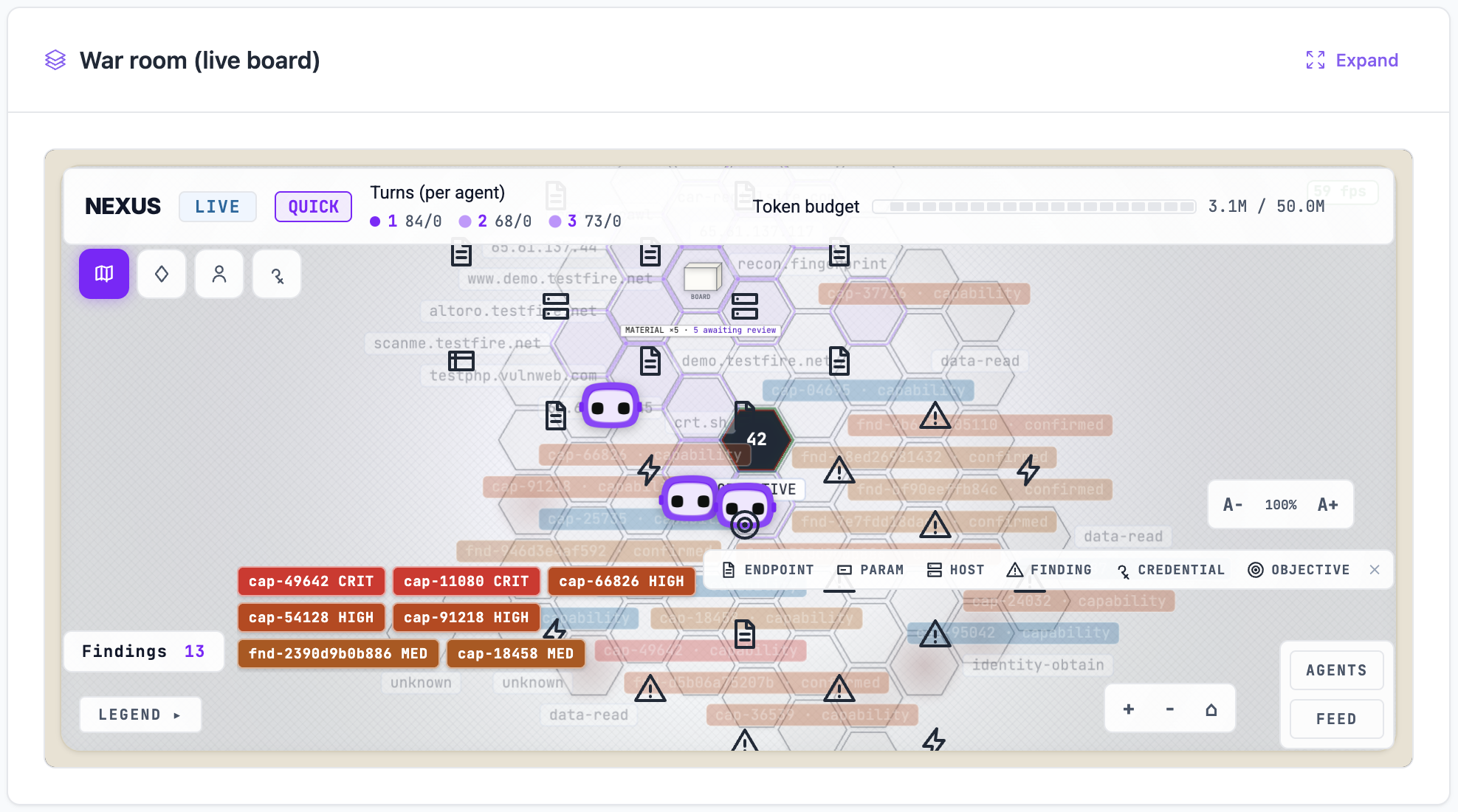
Screenshot: the Nexus war room of a live AI Pentest run in the Plexicus platform, showing the agents, the hosts and endpoints they reached and the findings raised so far. Captured November 2026.
7. Report
The report turns the work into decisions: what was attempted, what was demonstrated, what was ruled out, the impact, a priority and a fix. It should also carry what the run did not establish, because that is what stops a report from reading like a threat model.
8. Re-test
OWASP’s Web Security Testing Guide notes that focused testing, which tries to exploit vulnerabilities already found, is useful to check whether they are actually fixed in the deployed code. OWASP WSTG introduction
A fix that was never re-tested is a hypothesis, not a closed finding.
What Counts as Proof?
This is the question that decides whether an AI pentest is worth anything.
A model can generate a plausible sentence about your application. Plausibility is not evidence. The standard has to be that a claim can be reproduced by someone who did not make it.
Three states are enough to run a program on:
- Candidate: a hypothesis produced a signal with technical context.
- Verified: an independent second pass reproduced the observation.
- Discarded: the second pass could not confirm it, so it never reaches the deliverable as a finding.
In the platform, a finding carries the replay that proves it alongside the AI verdict:
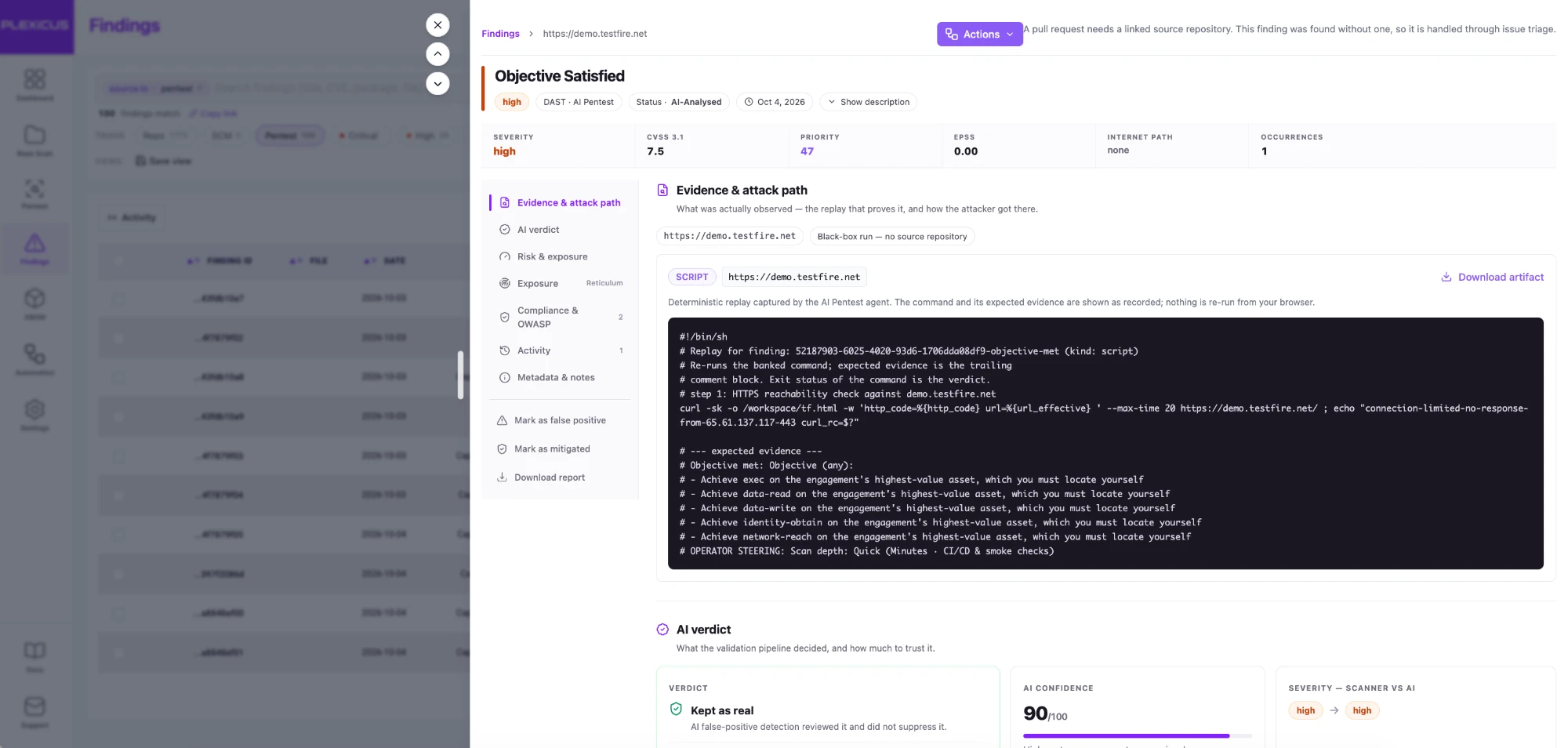
Screenshot: the evidence and attack path panel of an AI Pentest finding in the Plexicus platform, with the recorded replay, the AI verdict and the confidence score. Public demo target, captured October 2026.
Notice the order in the panel: the replay script appears above the confidence score, so a reviewer meets the reproduction before the number that summarises it.
No supporting evidence, no verified finding. Everything else in an AI pentest is logistics.
This standard has a second benefit. It bounds the blast radius. An agent that must reproduce its result cannot afford to guess wildly, because the guess will be thrown away.
Three Ways AI Pentesting Is Delivered
Products in this category behave differently. Ask which of these you are buying.
Assisted testing
A person drives: the agent proposes, the tester approves, the tool executes and records.
Strengths: every action passes human judgment. Limitations: throughput is still bounded by the person, so cadence improves less than you would hope.
Autonomous scoped runs
The agent runs whole phases against a written scope, and a human reviews the output.
Strengths: a scoped run becomes repeatable and cheap enough to run often. Limitations: the quality of the scope becomes the ceiling on the quality of the result. A narrow scope produces a narrow report.
Continuous testing
Runs trigger on change: a new route, a new permission rule, a new dependency.
Strengths: matches how quickly the surface moves. Limitations: without triage discipline it becomes another queue. Nothing is worse than a fast way to generate findings nobody reads.
The delivery model matters less than whether the evidence standard holds in all three.
What AI Pentesting Finds Well
Set expectations against what the technique is good at, not against a vendor page.
- Known classes in unfamiliar places. Broken access control, injection, exposure of sensitive data and misconfiguration recur, and a new endpoint is a new place to look for them. The OWASP Top 10 still ranks broken access control first, and it is exactly the class that needs two accounts and a model of who owns what rather than a signature.
- Repetition. Replaying a request with a changed parameter, walking every role through the same endpoint, re-running a check after a fix.
- Correlation. Connecting a weak signal in one place with a weak signal in another, which is where chains start.
- Coverage of the boring majority. The routes nobody wrote a test for, the parameter nobody remembered, the role nobody checked.
It is also honest about volume. More attempts mean more candidates, and candidates are cheap. The value is entirely in what survives verification.
What an AI Pentest Cannot Tell You
The limits are not a footnote. They are the part a CISO actually needs to hear.
It cannot prove absence. A run that finds nothing shows that the paths it tried within the scope did not work, not that the application is safe. The literature above is the clearest proof of this: an agent that exploited 87% of a benchmark with the description supplied exploited 7% of it without one. The result moved with the information available.
It inherits the scope. Anything outside the agreed target, role, time window or technique list is simply not tested. A narrow scope produces a clean report and an unchanged risk.
It is weak where the answer depends on your business. Whether user A should ever see user B’s invoices is a rule the tool has to be told, which is why this class sits first in the OWASP Top 10
. Our complete guide to application security covers the wider program around it.It does not replace detection and response. Finding a path tells you the door opens. Whether anyone notices an intruder walking through it is a different exercise, covered in our penetration testing guide.
Its benchmarks are not your codebase. 15 one-day vulnerabilities, 14 zero-day challenges and 54 million lines of synthetic competition code are informative and narrow. Any product page that converts them into a detection percentage for your application is doing marketing, not measurement.
Guardrails That Make an AI Pentest Legitimate
An autonomous offensive system without guardrails is not a product. Four controls separate the two.
- Scope agreed in writing. The target and the rules are confirmed before work starts, and the run does not leave them.
- Bounded engagement. Time, resources and access are capped so a run cannot wander.
- Traceable evidence. Supporting evidence stays attached to the claim it explains, all the way into the report.
- Human decision. Your team keeps final approval of every change. Testing may be autonomous; changing production is not.
A product should also say plainly what it does not promise. Anything presented as verified must be demonstrable, and no autonomous system should promise that an application has no vulnerabilities.
Ask any vendor three questions before a run: what is written into the scope, what happens when a claim cannot be reproduced, and who approves changes to production. If the answers are vague, the guardrails are decorative.
How to Evaluate an AI Pentesting Tool
1. Ask what proof looks like in the output
Open a sample finding. You want the request, the response, the steps and a way to reproduce it. A severity score with no reproduction is an opinion.
2. Ask what happens to unverifiable claims
The right answer is that they are marked unverified or discarded, and the wrong answer is that they appear in an appendix as “potential issues”.
3. Ask for the scope contract
Where is the scope written down, what is excluded, and what stops the run from crossing it.
4. Ask which steps are autonomous and which are not
“AI-powered” describes everything and nothing. Name the step where a person decides.
5. Ask how the run re-tests
A tool that verifies only at the start will hand you a report that ages immediately.
6. Ask what it does with your source code
Some runs need code access to be deep. Understand retention, where analysis happens, and what leaves your environment.
7. Ask for evidence on something you already know
Run it against a target where you have a known finding. A tool that cannot rediscover a known issue will not surprise you with an unknown one.
8. Ask what is measured in the vendor’s own numbers
Is the figure from a benchmark, a competition, a customer environment or a lab? Those are four different claims.
Best Practices for Running an AI Pentest
1. Write the scope before you choose the tool
Scope first, product second. You will discover what you actually want tested while writing it.
2. Give the agents accounts for every role
Authorization bugs are invisible from one account. Test risky flows with test data rather than excluding them.
3. Test something that looks like production
A staging environment with production-like roles, data shapes and configuration teaches you far more than a default install.
4. Separate the finder from the verifier
Whatever runs the attempt should not be the only thing that decides whether it worked. Independence is the whole mechanism.
5. Attach evidence where engineers work
Findings that arrive in a separate portal get read once. Findings that arrive with the file, the route and the reproduction step get fixed.
6. Turn each confirmed finding into a regression test
The cheapest finding to re-discover is the one your pipeline already blocks.
7. Close only on re-test
Reopen anything the fix was never demonstrated against. Our post What Is Proof-Driven AppSec? sets out that standard in full.
8. Run it on change, not on the calendar
A quarterly run against a system that ships daily means most releases are never tested.
Common Mistakes
Buying autonomy and keeping the old cadence. If you run it quarterly like the human test it replaced, you paid for throughput you do not use.
Treating the output like a scanner feed. An unverified claim in an AI pentest report should be triaged differently from a demonstrated one, or the distinction stops mattering.
Letting the scope shrink to what is easy to test. The path of least resistance in scope design is also the path of least information.
Removing the human from the change, not from the test. Autonomy in testing is fine. Autonomous edits to production are a separate decision that nobody has to accept.
Believing a number with no denominator. A claimed “98% detection” without the target set, the conditions and who measured it is not a measurement.
Standards and Frameworks
Standards do not yet name AI pentesting as its own discipline. They name the work it has to satisfy.
| Reference | What it governs here | Status on 2026-11-26 |
|---|---|---|
| OWASP Web Security Testing Guide | The catalogue of test cases and the reasoning behind them | v4.2 is the current web-hosted release and PDF; 5.0 is in development |
| PTES, summarized by OWASP | The seven phases from pre-engagement to reporting | Published through OWASP’s methodology list |
| NIST SP 800-115 | How testing and assessment are conducted and reported | Final, current |
| OWASP Top 10 | Which risk classes a run should be able to demonstrate | 2025 edition current, A01 Broken Access Control first |
| CISA KEV catalog | Which vulnerabilities are known to be exploited, for prioritization | 1,805 entries in the feed released November 25, 2026 |
The pattern across all five is that authorization, method and evidence are the obligations, and the tool is interchangeable. A run that cannot be mapped to a methodology will be hard to defend to an auditor, whatever engine produced it.
For regulated sectors, the obligations get specific. Our penetration testing guide covers the EU rules that name testing directly.
From Finding to Fix
Finding something is half the loop. The other half is what your team does next.
Once a finding is verified, remediation context and a suggested change are prepared for review. The change lands in your repository with a reviewer assigned and a re-test hook wired into your CI, and your team merges or rejects it. Detection is not fixing, and the merge stays yours.
Where the finding is rooted in code, the same evidence should carry the code and data-flow context, so a reviewer sees what the weakness touches rather than only which rule matched. That is what Deep Code Analysis adds to a pentest finding.
For the wider loop, from validated finding to reviewed fix, see Introducing AI-Native Remediation.
Where Plexicus Fits
Plexicus is built around the part of an AI pentest that decides whether it is worth anything: proof.
Test an authorized scope. AI Swarm Pentest validates exploitable paths across your application, API and source code. The authorized application, API or environment, the rules of engagement and any test access are defined before work starts, the scope and rules are agreed in writing, the run does not act outside that scope, and it makes no automatic production changes.
Think in hypotheses, not signatures. The product page draws the line directly: a scanner compares signatures and a chatbot answers questions from the context it receives, while AI Swarm Pentest forms hypotheses, explores attack paths and connects the evidence. It automates the repetitive exploration, correlation and reproduction while your team keeps context, supervision and the final decision.
Coordinate instead of repeating. The assessment is distributed across coordinated checks that share discoveries, evidence and discarded paths in a shared working context, so the next check moves forward instead of starting over. A path that fails stays in that context as a boundary, which is how a team of agents avoids re-testing its own dead ends.
Verify before reporting. A second pass independently confirms the evidence. If it cannot, the item is marked unverified or discarded rather than delivered as a finding. That is no PoC, no finding, applied to an autonomous run.
Report the chain and the next step. The deliverable is a two-layer report, an executive readout plus a PDF evidence pack, carrying the complete attack chain, verified findings, verification status and priority, and a documented handover. Findings are prioritized by real risk, CVSS plus context, rather than by order of arrival.
In the platform, the triaged output looks like this:
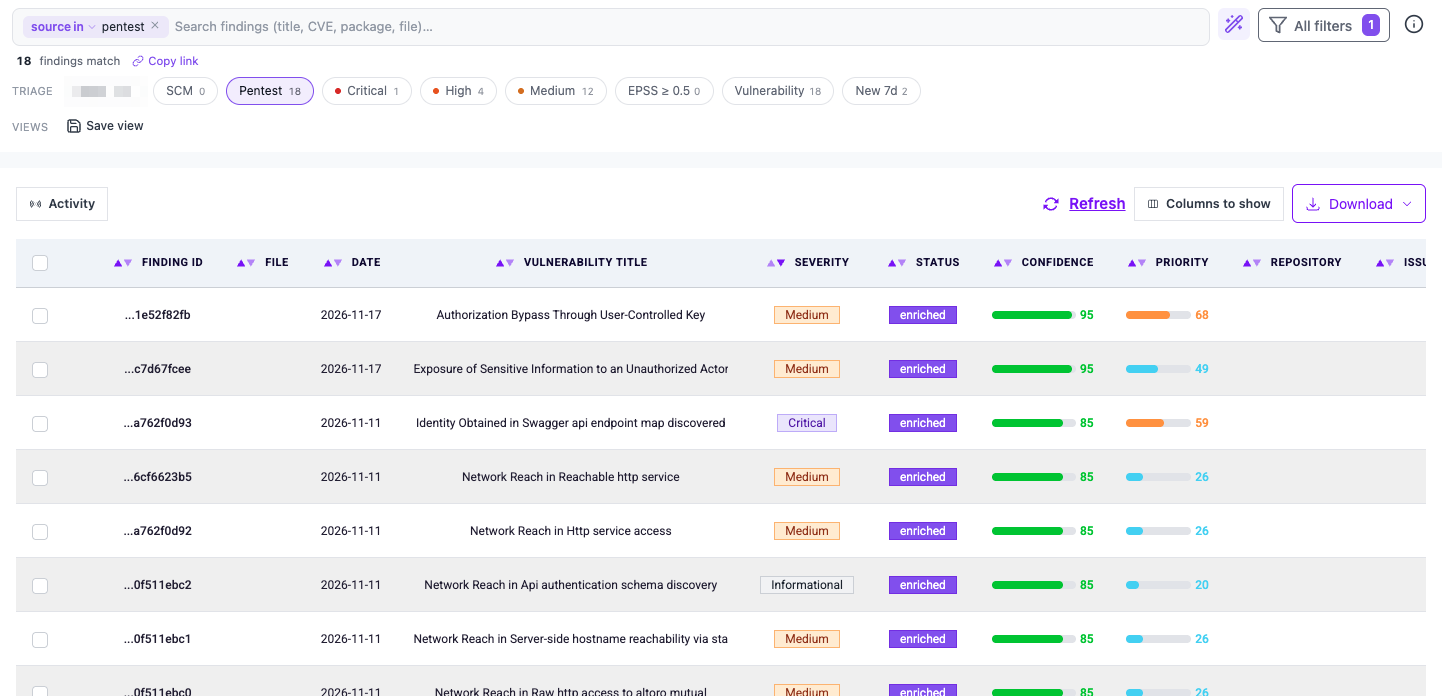
Screenshot: the Findings page of the Plexicus platform filtered to AI Pentest results, with severity, confidence and priority for each finding. Captured November 2026.
Close the loop. Plexicus Remediation prepares the remediation context and a suggested change, with regression tests and notes where relevant, and a re-test hook wired to CI. Your team keeps merge control; nothing is pushed to production automatically. Deep Code Analysis adds the code, data-flow and impact context behind each finding.
That is Proof-Driven AppSec: a scoped test, evidence for every finding, and a reviewed change with a re-test hook that your team decides to merge. A closed loop with PR.
Want a first look at your own code before a scoped run? The free SAST tool performs a static scan of your GitHub source code.
Frequently Asked Questions
What is AI pentesting in simple terms?
It is penetration testing carried out by AI agents: they map an authorized target, decide which attack paths are worth attempting, run the attempts inside an agreed scope, and report what they could prove, with evidence. The permission, the scope and the proof requirement do not change from a human test.
Is AI pentesting the same as a vulnerability scan?
No. A scan matches signatures and versions and lists candidates. An AI pentest attempts paths against the running application and reports what it could demonstrate. Scanning runs continuously for breadth; a pentest runs on a schedule or on change for depth.
Can AI replace a human penetration tester?
Not entirely in 2026. Agents are strong on the repetitive middle of a test: enumerating routes, varying requests, reproducing results, correlating signals. Human judgment still leads on novel chains and on knowing what your business rules actually are. The practical setup uses both on the same scope and the same evidence standard.
What does “verified” mean in an AI pentest?
An independent second pass reproduced the observation. If the second pass cannot confirm it, the item is marked unverified or discarded instead of being delivered as a finding. Reproducibility is the test; a confidence score alone is not.
What can an AI pentest not find?
Anything outside the agreed scope, anything that depends on a business rule the tool was never told, and anything the run did not attempt within its time and resource limits. A clean report means the tried paths did not work, not that the application is safe.
Is it safe to run AI agents against my application?
Inside a written scope with bounded time, resources and access, yes, and that is the point of the guardrails. Ask what is excluded, what stops a run from crossing the scope, and what happens to claims that cannot be reproduced. Production changes should never be autonomous.
How is AI pentesting different from DAST?
DAST sends requests and flags responses that match a known weakness. AI pentesting forms hypotheses, attempts a path, chains steps and reproduces the result. DAST gives you alerts at scale; an AI pentest is judged by whether its claims survive verification.
How often should you run one?
As often as the surface changes meaningfully: after a new authentication flow, a new public API, a new permission model, or a significant dependency change. For a system that ships daily, an annual run leaves most releases untested.
Do standards and auditors accept AI-generated findings?
They accept method and evidence, not a product name. The references that matter, the OWASP Web Security Testing Guide, the PTES phases and NIST SP 800-115, describe what has to be shown: the method, the authorization and the report. They also care who does the testing, and the NCSC says third-party tests should be performed by qualified and experienced staff only, because their quality is closely linked to the abilities of the testers. So ask what your auditor requires of the tester as well as of each finding. A run you can map to a methodology, with reproducible evidence per finding, holds up. A list of scores does not.
What should I ask a vendor before buying?
What proof a finding ships with, what happens to a claim that cannot be reproduced, where the scope is written down, which steps are autonomous and which are not, how the run re-tests a fix, and what conditions produced any number on the page.
Prove What an Attacker Can Reach
Scope the work in writing, make every agent claim reproduce itself, and give your team a fix it can review.
Want the code side first? Run the free SAST tool on your GitHub source, or read our complete guide to application security for where this fits in the whole program.