What Is Software Composition Analysis (SCA)? The Complete Guide for 2026
A complete guide to software composition analysis in 2026: what SCA finds, how it works step by step, how to prioritize what it reports, where it stops, and how it connects to SBOMs, VEX and reviewed fixes.
Beyond ASPM
Proof-Driven AppSec for teams building with AI
Plexicus uses AI Swarm Pentest to explore authorized application paths, validate what is exploitable, and give teams evidence they can use to prioritize remediation.
Explore AI Swarm PentestYour team writes a small part of the code it ships.
The rest arrives through a package manager: frameworks, parsers, logging libraries, HTTP clients, and the libraries those libraries depend on.
Software composition analysis (SCA) is the practice of identifying the third-party and open-source components inside your software and the risks they carry: known vulnerabilities, license obligations, outdated or unmaintained versions, and packages that should never have been installed.
OWASP puts it plainly. Its Component Analysis page describes component analysis as identifying potential areas of risk from the use of third-party and open-source components, and says that a software-only subset of it, with limited scope, “is commonly referred to as Software Composition Analysis (SCA)”.
The scale is the reason it matters. In its 2026 Open Source Security and Risk Analysis report, published on February 25, 2026, Black Duck found open source in 98% of the 947 commercial codebases it audited. These are company-reported figures from a vendor’s audit dataset, not an independent study.
And attackers use the gap. Verizon’s 2026 Data Breach Investigations Report executive summary found that exploitation of vulnerabilities rose to 31% of initial access in its dataset, the most common vector, and that breaches with third-party involvement reached 48%.
You cannot patch a library you do not know you ship.
This guide explains what SCA finds, how it works, how it differs from SAST, DAST and an SBOM, how to prioritize what it reports, and where it stops.
What Is Software Composition Analysis?
SCA answers one question first: what is this software made of?
Every other answer depends on it. A vulnerability alert, a license review or an upgrade plan only makes sense once you know which component, at which version, sits in which application.
OWASP makes the same point. Its Component Analysis page treats an accurate inventory of all third-party and open-source components as central to identifying risk, and says that without it the other factors are impractical to judge with confidence.
Once the inventory exists, SCA compares each component against outside data:
- Vulnerability databases, to find known vulnerabilities in the versions you use.
- License data, to find obligations and conflicts.
- Release and maintenance data, to find components that are outdated, end of life or abandoned.
- Malicious package data, to find packages that were published to cause harm.
The result is a list of risks tied to components. The quality of that list depends on the quality of the inventory under it.
What counts as a “component”?
A component is any unit of code your team did not write and does not fully control.
That includes open-source libraries from public registries such as npm, PyPI or Maven Central. It also includes commercial SDKs, vendored source code copied into your repository, binaries bundled into a build, and the base layers of a container image.
SCA is mostly about open source because that is where most components come from. The same method applies to any third-party code.
Direct vs. transitive dependencies
A direct dependency is a package your team chose and declared in a manifest file, such as package.json or requirements.txt.
A transitive dependency is a package that one of your dependencies pulled in. Your team never chose it, and often never sees it.
One direct dependency can bring its own dependencies, and each of those can bring more. The tree you ship is deeper than the list you wrote.
The OWASP Top 10
says you are likely vulnerable if you do not track the versions of all components you use, “both client-side and server-side”, including nested (transitive) dependencies. An SCA tool that reads only the manifest sees the first layer and misses the rest.Why SCA Matters in 2026
Four facts explain why SCA moved from a compliance checkbox to a core control.
1. Supply chain risk is now near the top of the OWASP Top 10. In the 2025 edition, “Software Supply Chain Failures” is A03. OWASP notes that the category started in 2013 as “Using Components with Known Vulnerabilities” and has grown to cover all supply chain failures. Exactly 50% of respondents to its community survey ranked it first.
2. The number of known vulnerabilities per codebase rose sharply. Black Duck’s 2026 OSSRA report, according to its summary of the findings, found:
| Finding (Black Duck 2026 OSSRA, 947 audited codebases) | Value |
|---|---|
| Mean open-source vulnerabilities per codebase | 581, up 107% year over year |
| Codebases with at least one vulnerability | 87% |
| Codebases with high-risk vulnerabilities | 78% |
| Codebases with critical-risk vulnerabilities | 44% |
| Codebases with open-source license conflicts | 68%, up from 56% |
| Codebases with components four or more years out of date | 92% |
| Components in use that are the latest version | 7% |
These are vendor figures from Black Duck’s own audits of commercial codebases, not an independent or peer-reviewed sample. They describe the codebases Black Duck audited, which are not a random sample of all software.
3. Exploitation is common and remediation is slow. Verizon’s 2026 executive summary reports that only 26% of the critical vulnerabilities in the CISA Known Exploited Vulnerabilities (KEV) catalog were fully remediated by organizations in 2025, down from 38% the year before, and that the median time to full resolution rose to 43 days.
4. Regulation now asks for component inventories. The EU Cyber Resilience Act (Regulation (EU) 2024/2847) requires manufacturers to identify and document vulnerabilities and components, including by drawing up a software bill of materials that covers at least the top-level dependencies. According to the European Commission, reporting obligations have applied since September 11, 2026, and the main obligations apply from December 11, 2027.
SCA tooling can produce that inventory and keep it current.
SCA vs. SAST: What Is the Difference?
SAST examines the code your team wrote. SCA examines the code your team imported.
Static application security testing reads first-party source code and looks for weaknesses such as injection or broken access checks. It finds flaws that do not have a CVE yet, because nobody has reported them.
SCA does not read your logic. It identifies components and looks up what is already known about them.
| SCA | SAST | |
|---|---|---|
| Looks at | Third-party and open-source components | First-party source code |
| Finds | Known vulnerabilities, licenses, outdated and malicious packages | Unknown weaknesses in your own code |
| Main input | Manifests, lockfiles, binaries, images | Source code |
| Main output | Component list with matched advisories | Code findings with file and line |
| Typical fix | Upgrade, replace or remove a package | Change your own code |
You need both. A clean SAST report says nothing about a vulnerable library, and a clean SCA report says nothing about a SQL injection in your controller.
SCA vs. SBOM: Tool or Document?
An SBOM is a document. SCA is a process that can produce one and then acts on it.
The CRA defines a software bill of materials as “a formal record containing details and supply chain relationships of components”. It is a list, in a standard format such as CycloneDX or SPDX.
SCA builds that list, then enriches it with vulnerabilities, licenses and maintenance data, and keeps it current.
| SBOM | SCA | |
|---|---|---|
| What it is | A formal, machine-readable record of components | A practice and a set of tools |
| Answers | What is in this build? | What is in this build, and what is wrong with it? |
| Changes when | A new build is generated | A new build ships or a new advisory is published |
| Shared with | Customers, auditors, regulators | Usually your own teams |
On July 29, 2026, CISA and its partners released the 2026 Minimum Elements for a Software Bill of Materials, which, according to CISA, updates and replaces the minimum elements the NTIA published in 2021. An SBOM generated by SCA tooling should be checked against that current baseline.
For the wider picture, where software, cryptography and AI models share one inventory, see our guide to XBOM.
SCA vs. DAST and Penetration Testing
SCA tells you a vulnerable version is present. Testing tells you whether it can be exploited in your application.
Dynamic testing and penetration testing attack the running application. They do not care which library caused a weakness. They show what an attacker can reach.
The two answer different questions:
SCA:      Is a component with a known vulnerability in this build?
Testing:  Can an attacker reach and exploit it in this application?
Decision: Fix now, schedule, or record why it does not apply.
A finding confirmed by both is the strongest signal you can give a developer. A finding only SCA reports is a hypothesis until someone checks the path.
How Software Composition Analysis Works
A typical SCA workflow has seven stages.
Discover -> Resolve -> Identify -> Match -> Assess -> Report -> Monitor
1. Discover what is in the project
The tool finds manifest files and lockfiles in the repository: package-lock.json, poetry.lock, pom.xml, go.sum, Cargo.lock and their equivalents.
Some tools also inspect build outputs, binaries and container images, which matters when code reaches the product without a manifest entry.
2. Resolve the full dependency tree
A manifest lists what you asked for. A lockfile records what the package manager actually installed, including every transitive dependency and its exact version.
Resolving the tree is where most coverage is won or lost. A tool that guesses versions from a manifest range can report a vulnerability you do not have, or miss one you do.
3. Identify each component precisely
Each component needs an identifier that other systems understand.
The most common is the Package URL, or PURL, such as pkg:npm/lodash@4.17.21. The PURL specification is now an Ecma standard, ECMA-427, and is used as a standard identifier for software components.
The NVD uses a different scheme, Common Platform Enumeration (CPE). A tool that maps between the two schemes has to get the mapping right, or it reports a vulnerability against the wrong package.
4. Match against vulnerability data
The tool compares each identified component and version with one or more vulnerability sources:
- The National Vulnerability Database (NVD), hosted by NIST, which publishes CVE records with severity scores and CPE product data.
- OSV, an open, distributed vulnerability database for open source that uses a schema designed to map precisely to package versions.
- The GitHub Advisory Database, where GitHub reviews advisories for validity and maps them to packages in supported registries, and which also lists malware.
OWASP’s Component Analysis page adds a point teams often miss: a vulnerability does not need to be in a database to be known. A post, a defect tracker entry, a commit log or release notes can be enough. Using more than one source closes gaps.
5. Assess licenses, age and health
The same inventory feeds a license review. The SPDX License List gives standard identifiers, such as MIT or GPL-3.0-only, so a tool can flag copyleft or unknown licenses consistently.
The tool also checks age and maintenance: is this the latest version, is the project still active, has it reached end of life? OpenSSF Scorecard, for example, publishes security health metrics for open-source projects.
6. Report findings where developers work
Results go to the pull request, the ticket queue or a dashboard, and an SBOM is exported for others.
A good report names the component, the version, the path that brought it in, the advisory, the fixed version and the severity.
7. Monitor after release
An SCA scan is a snapshot. Vulnerabilities are published after you ship.
A component that was clean at release can match a new advisory next month. Continuous SCA re-checks the inventory of deployed versions against new data, without waiting for the next commit.
Methods of Software Composition Analysis
Tools combine four methods. Each sees a different part of the software.
Manifest and Lockfile Analysis
The tool reads the files that package managers use to declare and pin dependencies.
Strengths: fast, cheap, and easy to run in every pull request. With a lockfile, versions are exact.
Limitations: it only sees what a package manager declared. In its 2026 OSSRA summary, Black Duck reports that 17% of open-source components entered codebases outside standard package managers, through copied snippets, vendor inclusions or AI generation, which makes them invisible to manifest-based scanning. That is a vendor figure from its own audits.
Binary and Artifact Analysis
The tool inspects compiled output: JAR files, wheels, executables and firmware.
Strengths: it finds components that were bundled, renamed or copied in, and it checks what actually ships rather than what a manifest claims.
Limitations: identification is harder, so versions can be uncertain. It is slower and usually runs later in the pipeline.
Container Image Analysis
The tool reads the layers of a container image, including operating system packages from the base image.
Strengths: it covers the runtime your application actually runs on, which application manifests do not describe.
Limitations: base images include operating system packages your application may never call, so findings pile up quickly and need strong prioritization.
Reachability Analysis
The tool checks whether your code calls the vulnerable function inside the vulnerable component, directly or through other packages.
Strengths: it is the most effective way to cut noise. A vulnerable function your code never calls is a lower priority than one on a live request path.
Limitations: static reachability is an estimate. Reflection, dynamic loading and configuration can hide a real path, and a “reachable” verdict does not prove an attacker can control the input. Reachability narrows the list. It does not confirm exploitation.
What Risks Does SCA Find?
SCA covers five kinds of risk. Most tools are strongest on the first.
Known vulnerabilities
A component version with a published advisory. This is the core of SCA and the main reason teams adopt it.
The defining example is Log4Shell. In December 2021, CISA’s Log4j guidance, now archived, described CVE-2021-44228 as a critical remote code execution vulnerability in Apache Log4j versions 2.0-beta9 to 2.14.1, under “active, widespread exploitation”. The NVD record gives it a CVSS base score of 10.0.
CISA noted at the time that Log4j was very broadly used in consumer and enterprise services, websites and applications. A current inventory turns “are we affected?” into a query instead of a manual search.
License risk
Open-source licenses come with conditions. Some require you to publish source code when you distribute a product that includes the component.
Black Duck’s 2026 summary reports license conflicts in 68% of the codebases it audited, the largest yearly increase in the report’s history, and links part of the rise to AI assistants generating code derived from copyleft sources without the license information. These are vendor-reported figures.
Outdated and unmaintained components
An old version may not have a known vulnerability yet, but it will be harder to fix when one appears.
OWASP notes that API changes are expected between major versions, so components that are not updated continuously may result in longer remediation times. An abandoned project may never publish a fix at all.
Malicious packages
A malicious package is not a mistake. It was published to steal data or run code on the machines that install it.
OWASP’s Component Analysis page lists threats against public repositories, including typosquatting, which takes advantage of common misspellings of package names. The GitHub Advisory Database lists malware separately from vulnerabilities, because the fix is different: remove the package and investigate, do not upgrade it.
OWASP’s 2025 Top 10 cites the Shai-Hulud attack of 2025, which it calls the first successful self-propagating npm worm and says reached over 500 package versions before npm stopped it.
Compromised upstream projects
Sometimes a trusted project itself is compromised.
In March 2024, CISA reported malicious code embedded in XZ Utils versions 5.6.0 and 5.6.1, tracked as CVE-2024-3094, and recommended downgrading to an uncompromised version such as 5.4.6. SCA cannot detect a backdoor on day zero, but once the advisory exists, a current inventory lets you find the affected versions with a query.
AI Coding Assistants and SCA
AI coding assistants add dependencies quickly, and sometimes they add ones that do not exist.
A study by Spracklen and co-authors, accepted at the 2025 USENIX Security Symposium, generated 576,000 code samples with 16 popular code-generation models. It found that the average share of hallucinated packages was at least 5.2% for commercial models and 21.7% for open-source models, with 205,474 unique hallucinated package names.
An attacker can register one of those names and wait for the next assistant to suggest it. This attack is sometimes called “slopsquatting”, a play on typosquatting.
This changes what SCA must check. A package that installs cleanly and has no CVE can still be the wrong package. Two checks help:
- Does the package exist in the registry with a history, and does it match the name the team meant to use?
- Did a person choose it, or did it arrive in an AI-generated change that nobody reviewed?
For more on how coding agents widen the attack surface, read AI Coding Agents Are Now a Supply Chain Attack Vector.
How to Prioritize SCA Findings
The hardest part of SCA is not finding vulnerabilities. It is deciding which ones to fix first.
A large application can report a long list of matches. Treating them all as urgent is the fastest way to make developers ignore the tool.
Four signals help, and they answer different questions:
| Signal | Question it answers | Source |
|---|---|---|
| CVSS | How severe is this vulnerability in general? | The CVE record, for example in the NVD |
| EPSS | How likely is exploitation in the next 30 days? | FIRST |
| KEV | Is it known to be exploited in the wild? | CISA |
| Reachability | Does our code call the vulnerable function? | Your own analysis |
The Exploit Prediction Scoring System (EPSS) from FIRST is a data-driven model that estimates the probability that a published CVE will be exploited in the wild in the next 30 days, and publishes a score every day for every CVE.
CISA’s Known Exploited Vulnerabilities catalog is, in CISA’s words, “the authoritative source of vulnerabilities that have been exploited in the wild”. The release of November 20, 2026 listed 1,790 entries.
For US federal agencies, the KEV catalog was established under BOD 22-01 in 2021. On June 10, 2026, CISA issued BOD 26-04, Prioritizing Security Updates Based on Risk, which revoked BOD 22-01, builds on the catalog and adds risk questions such as exploit automation, technical impact and whether the asset is publicly exposed. It binds federal executive branch agencies, but the questions are useful to anyone.
A practical order:
- Known exploited and reachable. Fix now.
- Known exploited, reachability unknown. Check the path today.
- High EPSS or critical CVSS, reachable. Schedule in the current sprint.
- Not reachable. Record why, with evidence, and keep watching.
- Everything else. Batch into routine upgrades.
A score is a starting point. Proof is the decision. When a finding can be shown to be exploitable in your own application, its priority is no longer a matter of opinion.
Recording Decisions With VEX
Some findings will not be fixed because they do not apply.
VEX (Vulnerability Exploitability eXchange) is a machine-readable statement of whether a known vulnerability actually affects a specific product. CycloneDX describes VEX as a way to convey the exploitability of vulnerable components in the context of the product where they are used.
Under the OpenVEX specification, a statement gives one of four statuses for one vulnerability in one product: not_affected, affected, fixed or under_investigation. A not_affected statement must include a justification or an impact statement, for example that the vulnerable code is not in the execute path.
That justification is only as good as the evidence behind it. A reachability trace, or a test that rules out the exploit condition, is evidence. A guess is not.
Best Practices for Software Composition Analysis
1. Commit lockfiles and scan them
Lockfiles record exact versions, including transitive ones. Scanning a manifest range instead of a lockfile produces both false positives and misses.
2. Scan in the pull request, not only on a schedule
A new dependency is cheapest to question before it merges. Show the developer the new component, its license and its known vulnerabilities in the review.
3. Monitor what is deployed
Keep the inventory of every version in production and re-check it when new advisories appear. New vulnerabilities do not wait for your next commit.
4. Use more than one vulnerability source
Combine the NVD, OSV and the GitHub Advisory Database. They differ in coverage, timing and version precision.
5. Prioritize with exploitation data and reachability
Rank by KEV, EPSS and reachability, not only by CVSS. Keep critical-but-unreachable findings visible, with a recorded reason.
6. Treat malicious packages as incidents
A malicious package match is not a backlog item. Remove it, rotate the secrets the install could reach, and check the machines that installed it.
7. Set a license policy before you need one
Decide which license categories are allowed, which need review and which are blocked. Enforce it in the pull request.
8. Reduce the number of components
OWASP recommends removing unused dependencies and avoiding components with duplicate functionality. Every package you remove is one you never have to patch.
9. Export the inventory as an SBOM
Generate CycloneDX or SPDX output from each build, so customers, auditors and your own incident team work from the same list.
10. Close the loop with a reviewed fix
A finding is only resolved when a change is merged and verified. Track time from detection to merged fix, not only the number of open findings.
Common SCA Mistakes
- Scanning only direct dependencies. The packages your team never chose are still in the build.
- Treating every CVE as urgent. Severity without exploitation and reachability context floods the backlog.
- Patching once a quarter. A monthly or quarterly patch cycle leaves days or months of exposure, a pattern OWASP’s 2025 Top 10 calls out directly.
- Ignoring licenses until an acquisition. License conflicts surface at the worst time if nobody tracks them.
- Trusting “no CVE” as “safe”. Malicious and hallucinated packages often have no CVE.
- Generating an SBOM and never updating it. An inventory that is not regenerated with each build describes software you no longer ship.
- Upgrading without testing. OWASP warns about developers who do not test the compatibility of updated libraries. A broken upgrade teaches teams to stop upgrading.
Standards and Frameworks That Mention SCA
OWASP Top 10
, A03 Software Supply Chain Failures. It recommends centrally generating and managing an SBOM, tracking transitive dependencies, and continuously monitoring sources such as CVE, NVD and OSV, using software composition analysis or security-focused SBOM tools to automate the process.OWASP Software Component Verification Standard (SCVS). According to its project repository, SCVS is a community-driven effort to establish a framework of activities, controls and best practices for identifying and reducing risk in a software supply chain. The OWASP project page offers it as PDF, Word, JSON and XML.
NIST SSDF (SP 800-218). The Secure Software Development Framework includes task PW.4.4, which asks producers to verify that acquired commercial, open-source and other third-party components meet the organization’s requirements throughout their life cycles, and task RV.1.1, which asks producers to gather information on potential vulnerabilities in the software and the third-party components it uses. NIST published a draft revision, SP 800-218 Rev. 1, on December 17, 2025; its comment period closed on January 30, 2026, and it remains a draft.
EU Cyber Resilience Act. Annex I, Part II, point 1 requires an SBOM in a commonly used, machine-readable format covering at least the top-level dependencies, with the main obligations applying from December 11, 2027.
CISA 2026 SBOM minimum elements. The July 2026 guidance describes the baseline that an SBOM should include.
OWASP Dependency-Check. An open-source SCA tool suite that identifies project dependencies and checks them for known, publicly disclosed vulnerabilities, using the NVD data feeds.
A Practical Example
Here is a hypothetical case, built to show the method. It does not describe a real customer.
A team runs a Java payments service. Its pom.xml declares a reporting library. That library depends on log4j-core 2.14.1, which nobody on the team chose.
Step 1, discover and resolve. The SCA scan resolves the full tree from the build and finds log4j-core 2.14.1 two levels down.
Step 2, match. The version falls inside the range CISA gave for CVE-2021-44228, versions 2.0-beta9 to 2.14.1. The advisory is in the KEV catalog.
Step 3, assess. The service logs request headers through Log4j, so the vulnerable code path is reachable from user input.
Step 4, prioritize. Known exploited and reachable: this goes to the top of the list.
Step 5, confirm. A test against a staging copy of the service shows whether a crafted header actually triggers the lookup. That turns the finding from “vulnerable version present” into proof.
Step 6, fix. The team pins log4j-core to a fixed release through dependency management. CISA’s December 2021 guidance urged upgrading to 2.17.1 for Java 8. The change goes through review, and the scan runs again on the pull request.
Step 7, record. The SBOM for the next build shows the new version, and the VEX statement for CVE-2021-44228 moves to “fixed”.
Transitive log4j-core 2.14.1
  -> matched CVE-2021-44228 (KEV)
  -> reachable from request headers
  -> exploit confirmed in staging
  -> reviewed upgrade merged
  -> SBOM and VEX updated
The same flow works for any component. What changes the outcome is steps 3 and 5: knowing the path and proving it.
What SCA Is Not
- Not a scan of your own code. It does not find a logic flaw in a function your team wrote. That is SAST and testing.
- Not proof of exploitability. A vulnerable version in the tree is a risk, not a confirmed attack path.
- Not a malware detector on day zero. It finds known malicious packages and suspicious patterns, not every new backdoor.
- Not a fix. A finding without an upgrade path, a reviewed change and a re-test stays open.
- Not a compliance certificate. An SBOM supports CRA and procurement evidence. It does not replace a conformity assessment.
Where Plexicus Fits
Plexicus treats SCA as one input to Proof-Driven AppSec: an inventory you can trust, findings you can prove, and fixes your team reviews.
The inventory lives in Plexicus XBOM. According to the XBOM product page, the SBOM view lists libraries, packages and dependencies across every repository, with license category, VEX status and provenance attached, CycloneDX and SPDX compatibility, license risk scoring, and a diff between scans.
Here is the software view in the Plexicus platform:
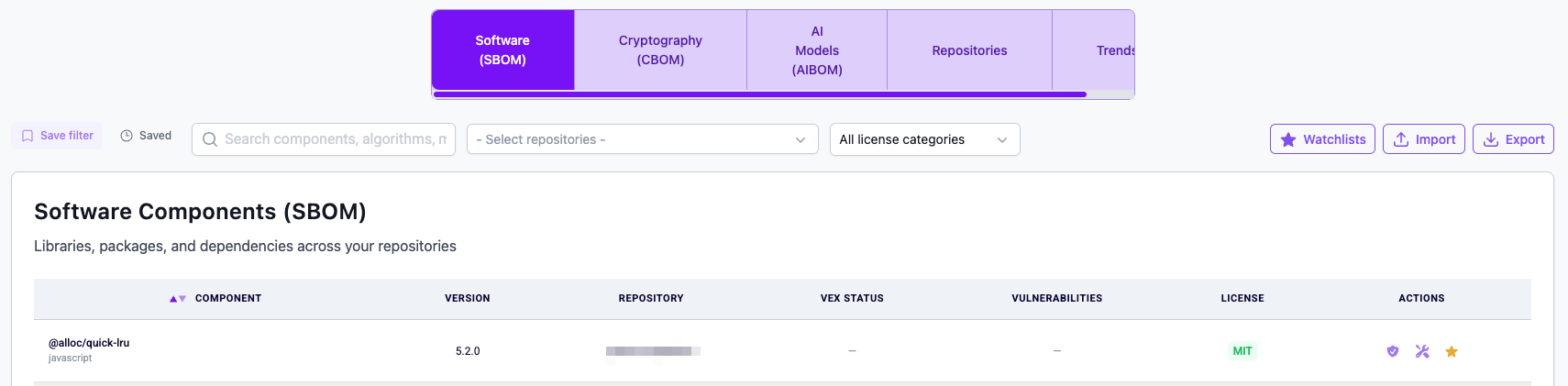
Screenshot: the XBOM inventory in the Plexicus platform, with tabs for software, cryptography and AI models, the filters and the software components table; the repository name is pixelated. Captured November 2026.
The product page also describes how that inventory stays current and explainable:
- Per-component VEX: one statement per CVE per component, with the statuses affected, not affected, fixed or under investigation.
- Linked to the evidence: VEX justifications reference the reachability path, the agent verdict and the source commit.
- Watchlists: watch any name, package URL or CVE, and get notified when a new finding matches.
- Diff, not snapshots: every scan is compared with the previous one for the same repository, and VEX is preserved across the diff.
- Bulk VEX import: import a supplier SBOM and VEX in one upload; Plexicus reconciles package URLs and surfaces the components you own.
- Exports: CycloneDX and SPDX in JSON, and a PDF attestation.
No PoC, no finding. AI Swarm Pentest validates exploitable paths across your application, API and source code. Deep Code Analysis traces the affected code path of a finding, so engineers see which endpoints, parameters and business logic it touches.
Then the fix. The Remediation product page lists supply-chain exposure among the issues it prepares changes for: typosquatted and slopsquatted dependencies replaced with the canonical upstream, including version pinning and lockfile updates. Each suggested change carries the evidence that produced it, and your team keeps merge control.
This is the bulk remediation view in the Plexicus platform:
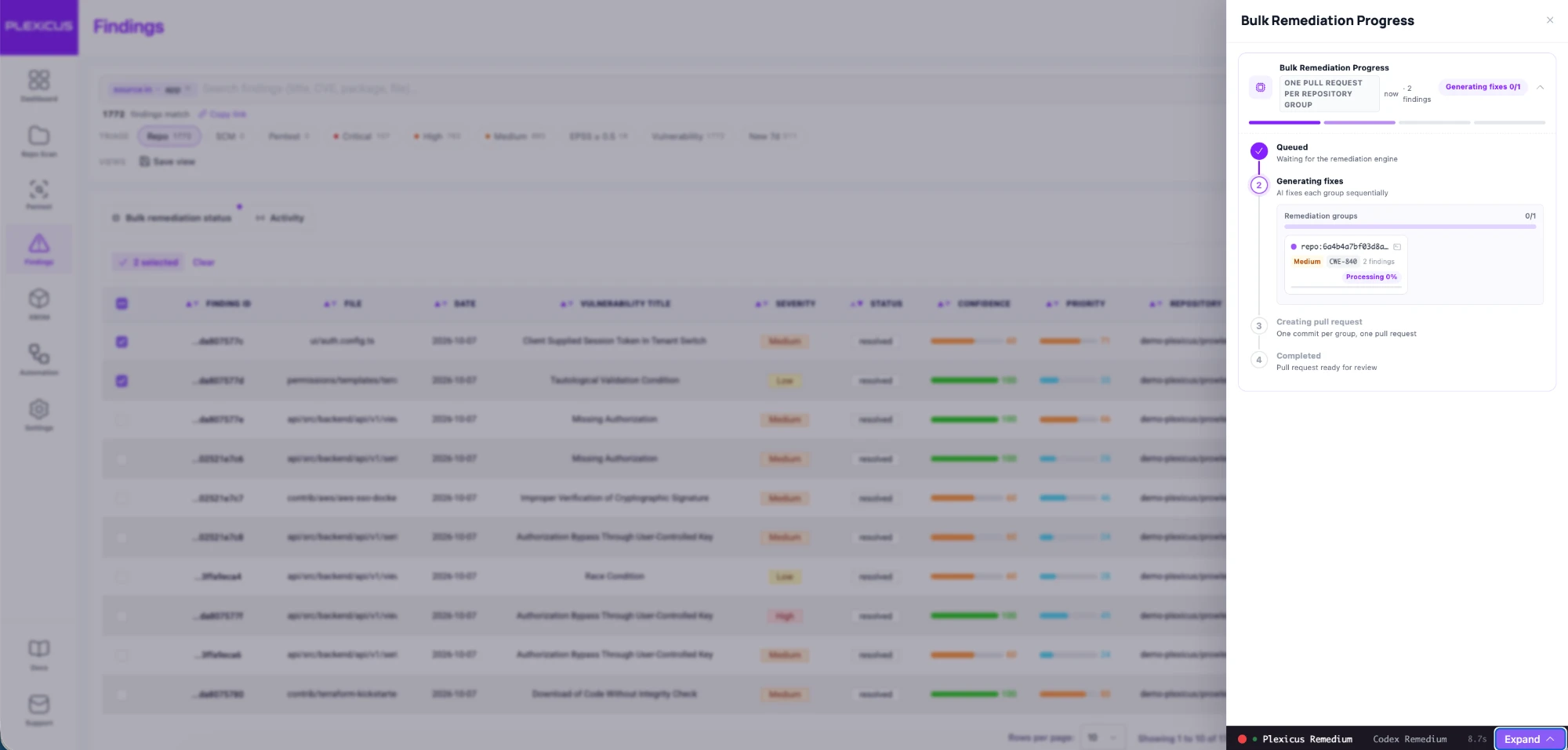
Screenshot: the Bulk Remediation Progress panel in the Plexicus platform, grouping findings into one pull request per repository group and showing each step from queued to a pull request ready for review. Demo data, captured October 2026.
That is the closed loop with PR: inventory, proof, reviewed change.
To go further, read What Is Application Security?, our XBOM guide, our introduction to AI-native remediation and our comparison of SCA tools. To check your own first-party code, try the free SAST tool.
Frequently Asked Questions
What does SCA stand for in security?
SCA stands for software composition analysis. It identifies the third-party and open-source components in your software and the risks they carry, such as known vulnerabilities, license obligations and outdated versions.
What is the difference between SCA and SAST?
SAST analyzes the code your team wrote to find unknown weaknesses. SCA identifies the components your team imported and matches them against known vulnerabilities and licenses. Most programs run both.
Is an SBOM the same as SCA?
No. An SBOM is a document listing the components in a build. SCA is the process that builds that list, checks it for risk and keeps it current.
What is a transitive dependency?
A transitive dependency is a package that one of your dependencies pulled in, rather than one your team declared. OWASP’s 2025 Top 10 says to track transitive dependencies as well as direct ones.
Which vulnerability databases do SCA tools use?
Common sources are the NVD, OSV and the GitHub Advisory Database. They differ in coverage, timing and version precision, so using more than one reduces gaps.
How should I prioritize SCA findings?
Start with vulnerabilities in the CISA KEV catalog that your code can reach. Then use EPSS, CVSS and reachability to order the rest, and record why the remaining ones do not apply.
What is reachability analysis in SCA?
Reachability analysis checks whether your code calls the vulnerable function inside a component. It cuts noise, but it is an estimate: it does not prove an attacker can exploit the path.
Can SCA detect malicious packages?
It can flag known malicious packages listed in advisory databases, and some tools look for suspicious signs such as typosquatted names. It cannot guarantee detection of a new backdoor before anyone reports it.
Does SCA check open-source licenses?
Yes. SCA tools map each component to a license, often using SPDX identifiers, and flag conflicts with your policy, such as copyleft licenses in a product you distribute.
How often should SCA run?
On every pull request that changes dependencies, on every build, and continuously against deployed versions, because new advisories are published after you ship.
Know What You Ship, and Prove What Matters
Build an inventory you can trust, prove which vulnerable components are exploitable, and close each one with a reviewed change.