Top 15 AI Penetration Testing Tools for 2026: Autonomous Pentesting Compared
AI penetration testing in 2026 splits into three lanes: autonomous pentest agents, BAS platforms and AI-assisted PTaaS. We compared 15 tools on signed-scope evidence, replay and pricing.
Beyond ASPM
Proof-Driven AppSec for teams building with AI
Plexicus uses AI Swarm Pentest to explore authorized application paths, validate what is exploitable, and give teams evidence they can use to prioritize remediation.
Explore AI Swarm PentestAI penetration testing uses AI agents to plan, run, and verify real attacks against an authorized scope, so you get exploit evidence in hours instead of weeks. The AI pentest tools you can buy in 2026 fall into three lanes: autonomous pentesting agents, breach and attack simulation (BAS) platforms, and pentest-as-a-service (PTaaS) vendors that put AI around human testers.
If you have ever waited three weeks for a human pentester to send back a PDF full of CVSS scores, you already know why the 2026 AI pentest market exists. Security teams need real attack evidence now, not next quarter. And they need it signed off in scope, with findings that hold up when an auditor reads them.
This guide ranks 15 of those tools. We grouped them by what they actually do. Some run real attacks against live systems. Some simulate adversary techniques against your defenses. Some wrap a human pentest platform with an AI assistant. Each one trades off signed-scope evidence, replay verification, and how much you pay per run.
If you only have a minute, skip to the comparison table. If you want the deep cuts, each vendor has its own section below.
At a Glance: Top 15 AI Pentest Tools for 2026
| Platform | Best For | Core Differentiator | Signed Scope | Pricing Model |
|---|---|---|---|---|
| Plexicus | Auditable Pentests | Signed-scope agent with replay-verified evidence | Yes | Fixed per engagement — see pricing |
| Horizon3.ai (NodeZero) | Continuous estate-wide attack surface | Autonomous pentest platform with Hack/Fix/Verify loop | Yes (per asset) | Quote-based |
| Pentera | Ransomware emulation across internal + cloud | Autonomous exposure validation | Yes (per scope) | Quote-based |
| Cymulate | BAS + threat-informed defense | Vero AI + agentic Cowork workflows | BAS scope | Quote-based |
| SafeBreach | Continuous control validation | SafeBreach Helm with three AI agents | BAS scope | Quote-based |
| AttackIQ | CTEM program with threat debt tracking | AVA Agentic OS for CTEM | CTEM scope | Quote-based |
| Picus Security | BAS + automated pentest in one platform | Picus Swarm of specialized AI agents | BAS scope | Quote-based |
| Scythe | EDR/SIEM validation against MITRE ATT&CK | Adversarial Exposure Validation with private AI | AEV scope | Per environment, no seat tax |
| Tidal Cyber | Threat-informed defense posture | NARC AI maps unstructured intel to ATT&CK | TID scope | Free + Enterprise |
| Bishop Fox (Cosmos) | Continuous offensive testing with humans | Cosmos AI engine + expert offensive consultants | Per engagement | Quote-based |
| Bugcrowd | Crowdsourced pentest with AI triage | Savant AI suite with Pathseeker agentic pentest | Per engagement | Quote-based |
| HackerOne | Pentest platform with Hai agentic AI | H1 Platform with agentic pentest, code, red team | Per engagement | Quote-based |
| Cobalt | PTaaS with AI assistant | 500+ vetted pentesters + Cobalt Sage AI | Per engagement | Credit model |
| XM Cyber | Continuous attack-path exposure management | Choke Point analysis across hybrid estates | CEM scope | Quote-based |
| Tracebit | Cloud-native attacker deception | Cloud canaries + high-signal alerting | Cloud scope | Quote-based |
Why Listen to Us?
At Plexicus, we built one of the 15 tools on this list, so we have a stake in the answer. But the playbook is simple: if your next pentest has to produce evidence an auditor accepts, you need a signed scope, a replay-verified finding, and a price you can write into a budget without three rounds of sales calls. That is the bar we used to rank the field.
If you already have a BAS platform, you already know which lane you sit in. If you are buying a pentest, read on.
1. Plexicus
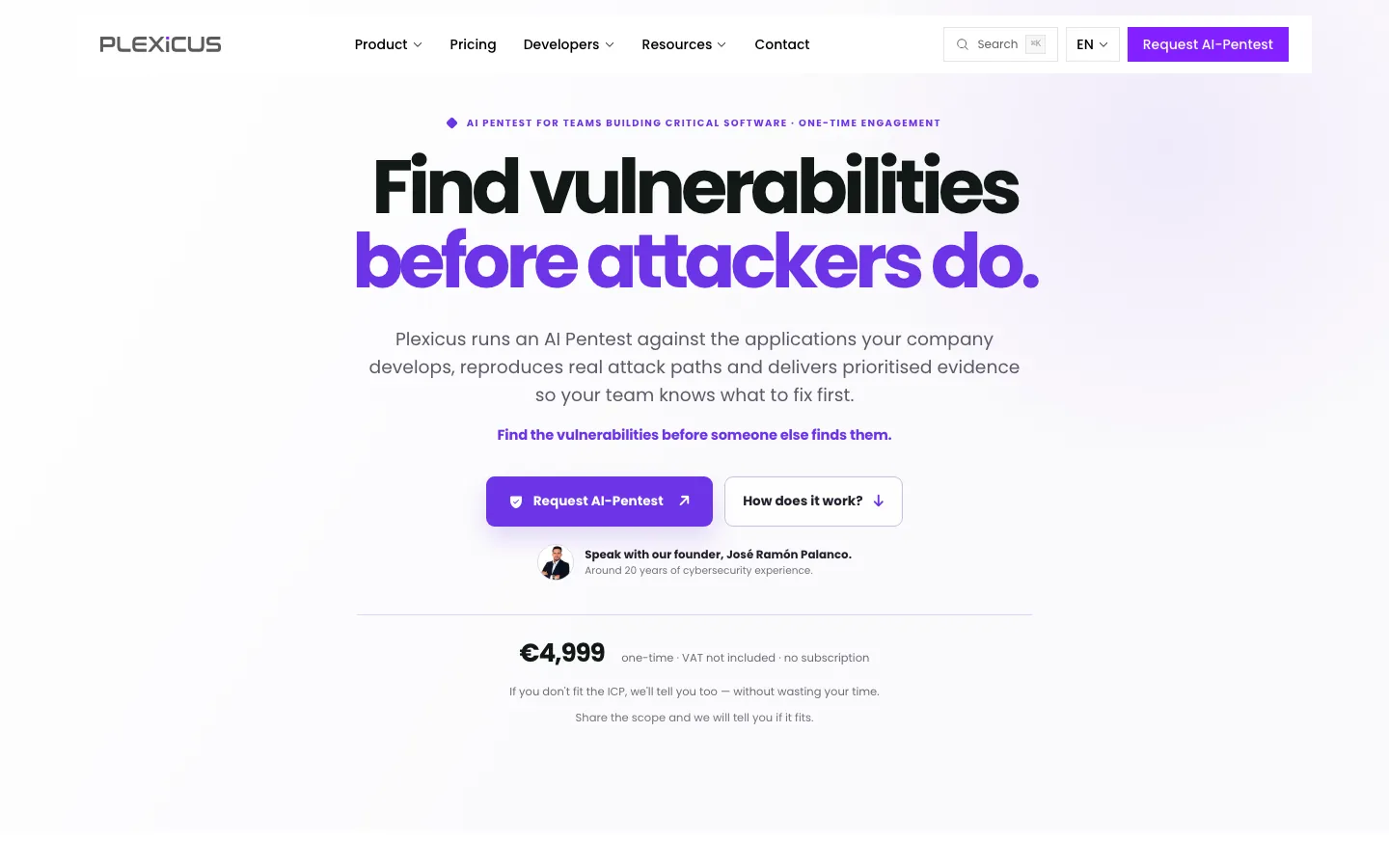
Plexicus is the autonomous signed-scope pentest. One engagement, one run, one replay-verified report. Pricing is published on the Plexicus pricing page and stays fixed per engagement.
- Key features: The Nexus engine explores attack paths in your signed scope and replays every finding with an independent second run before it shows up in your report. Plexicus Remediator generates reviewable correction proposals in a sandbox. The signed scope guard reads your authorized surface and rejects every action that falls outside it. The attack map shows tested chains plus rejected ones so you can see what your team tried. CI rule recommendations land alongside findings to prevent reintroductions.
- Pros: Fixed one-time price. No subscription creep. Findings are replay-verified, so an auditor can rerun them. Plexicus Remediator produces real PR-ready fix proposals, not alert text.
- Cons: One engagement at a time. If you want continuous estate-wide monitoring, Plexicus is not a BAS platform. Sign-up requires agreeing a scope before the run starts.
- Why choose it: If your team needs a real pentest run with audit-quality evidence at a price you can write into a budget.
- 2026 pricing: See Plexicus pricing — fixed per engagement, invoiced in EUR.
2. Horizon3.ai (NodeZero)
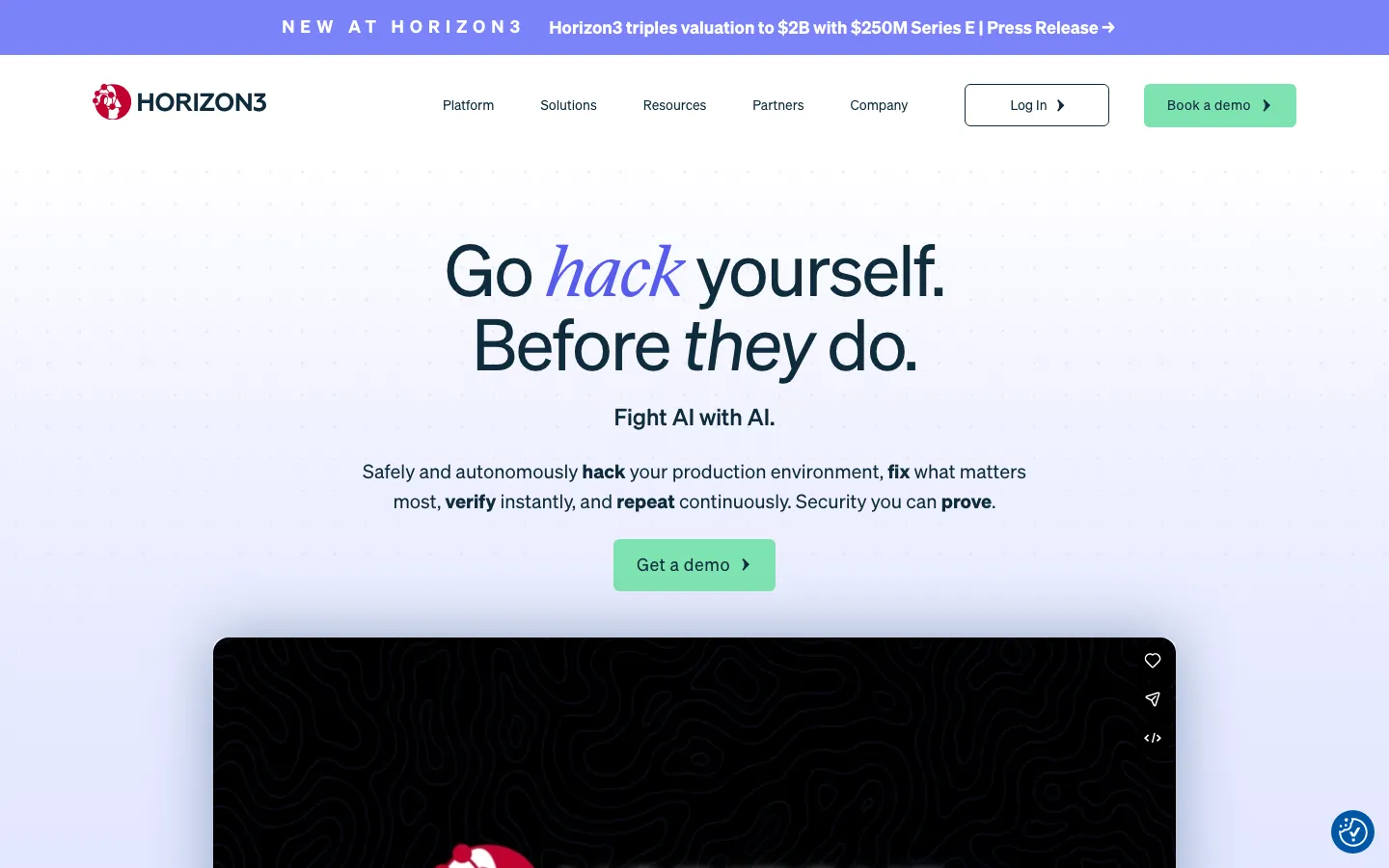
NodeZero is the closest direct competitor in the autonomous lane. It runs real attack techniques in production without agents, then prioritizes and re-tests what it finds.
- Key features: The Hack, Fix, Verify, Repeat loop. Internal, external, Kubernetes, cloud, AD, and web app coverage. Safe production execution with no agent to deploy and zero downtime. Risk-based exposure management.
- Pros: Continuous attack surface coverage. Strong proof-of-exploit output. Wide estate coverage.
- Cons: Priced per environment size, not per engagement. Less suited to a single signed-scope audit than to ongoing monitoring.
- Why choose it: If you want a continuous autonomous pentest running across your entire estate and you have budget for it.
- 2026 pricing: Quote-based.
3. Pentera
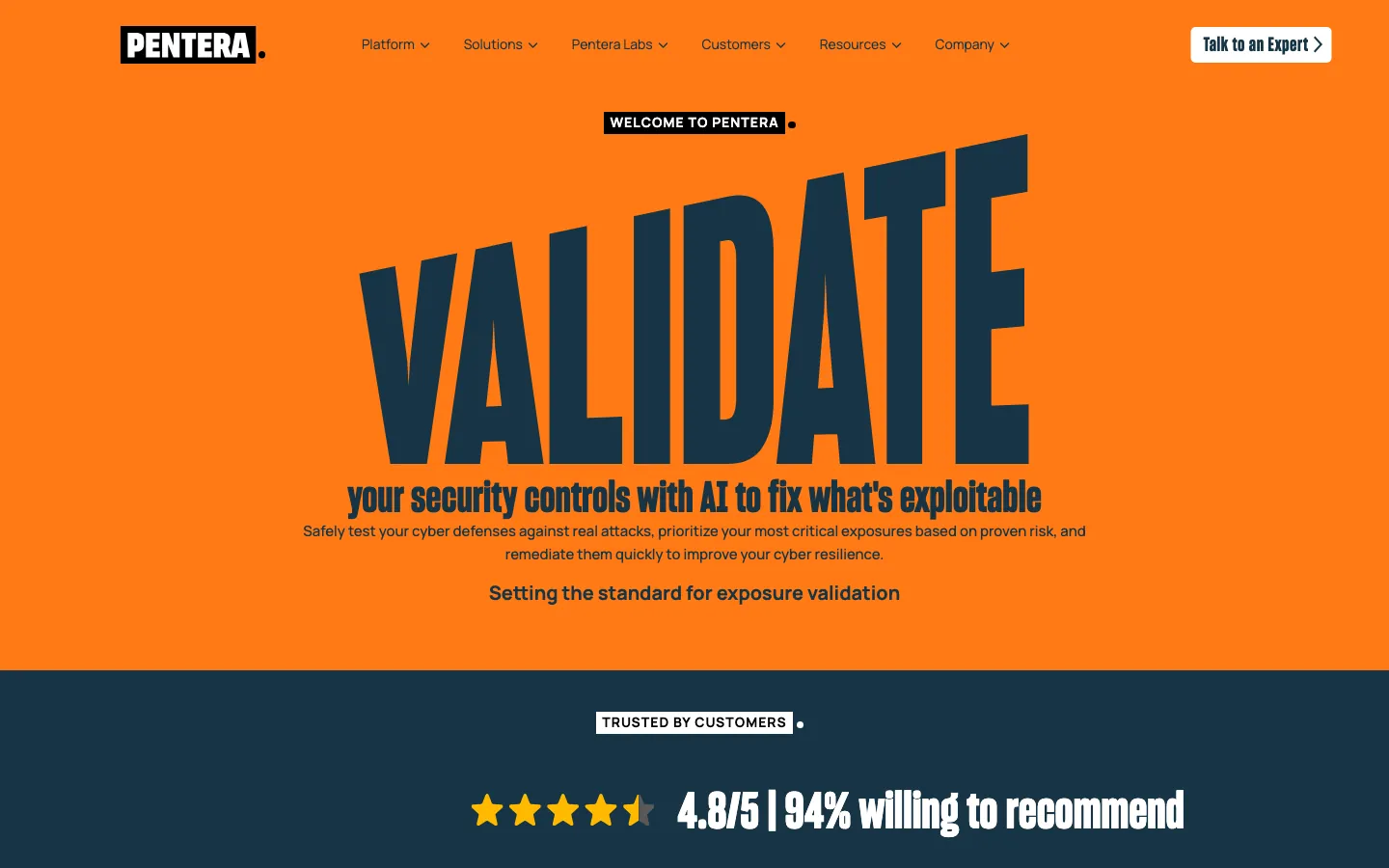
Pentera emulates real ransomware families against live production environments to prove which vulnerabilities are actually exploitable.
- Key features: Pentera Core, Surface, Cloud, and Resolve. Emulates LockBit, BlackCat, Play, Cl0p, REvil, Conti, Maze. Tests AD password security and leaked credentials. Continuous re-tests after fixes.
- Pros: Mature ransomware-emulation library. Covers all five stages of CTEM. Strong enterprise footprint.
- Cons: Sales-led pricing. Heavier operation than a single-pentest run.
- Why choose it: If ransomware emulation across internal + cloud is the specific proof you need.
- 2026 pricing: Quote-based.
4. Cymulate
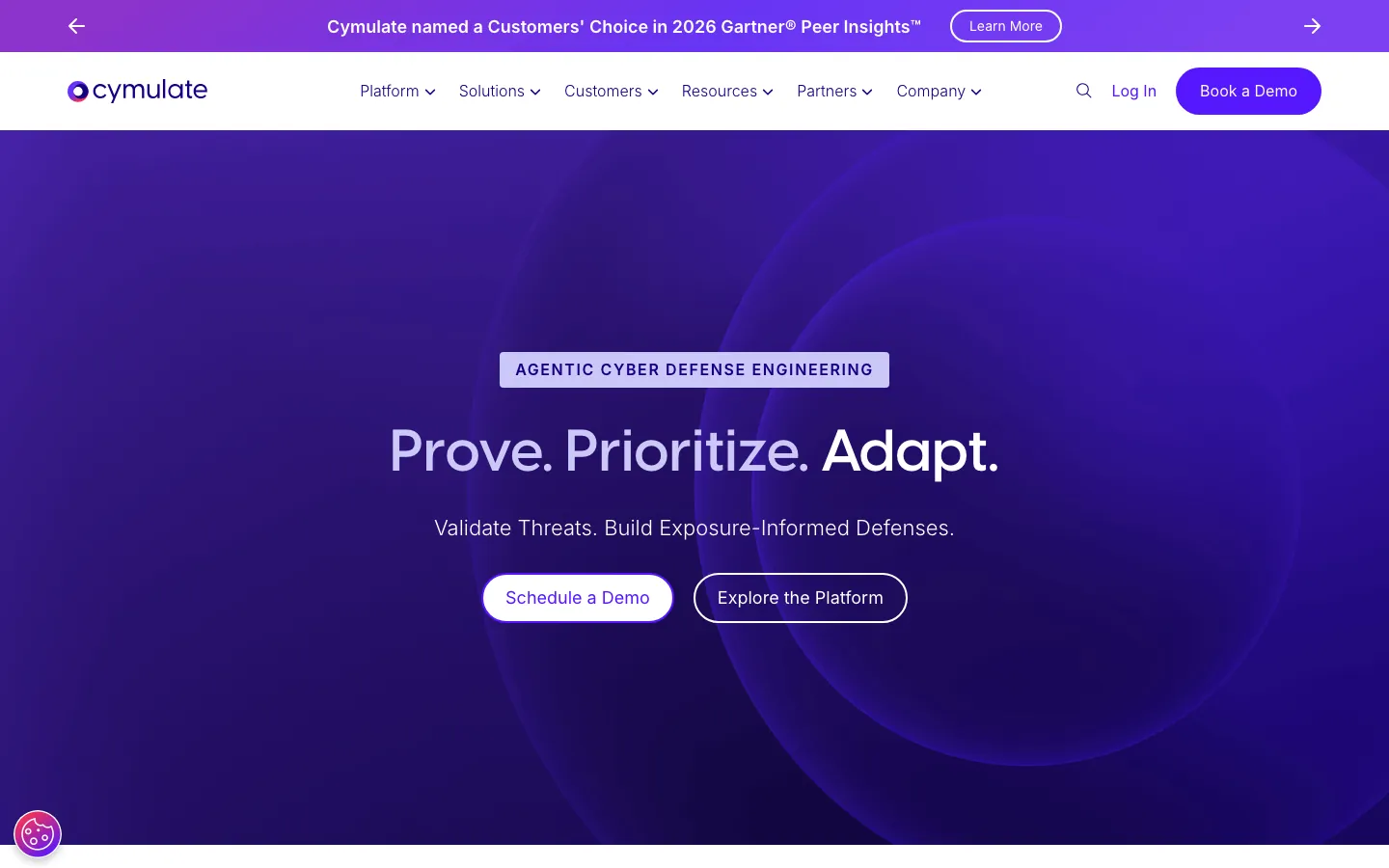
Cymulate is an AI-powered exposure validation platform with Vero AI for threat intel and Cymulate Cowork for agentic defense engineering.
- Key features: Attack library mapped to MITRE ATT&CK. Tests security controls across the existing stack. Vero AI understands new threats and tailors validation. Cowork automates defense workflows with agentic AI.
- Pros: Mature BAS brand. Strong threat-intel pipeline. Good for CTEM programs.
- Cons: BAS scope, not a signed-scope audit deliverable. Pricing requires a sales motion.
- Why choose it: If you already run a CTEM program and need BAS telemetry to feed it.
- 2026 pricing: Quote-based.
5. SafeBreach
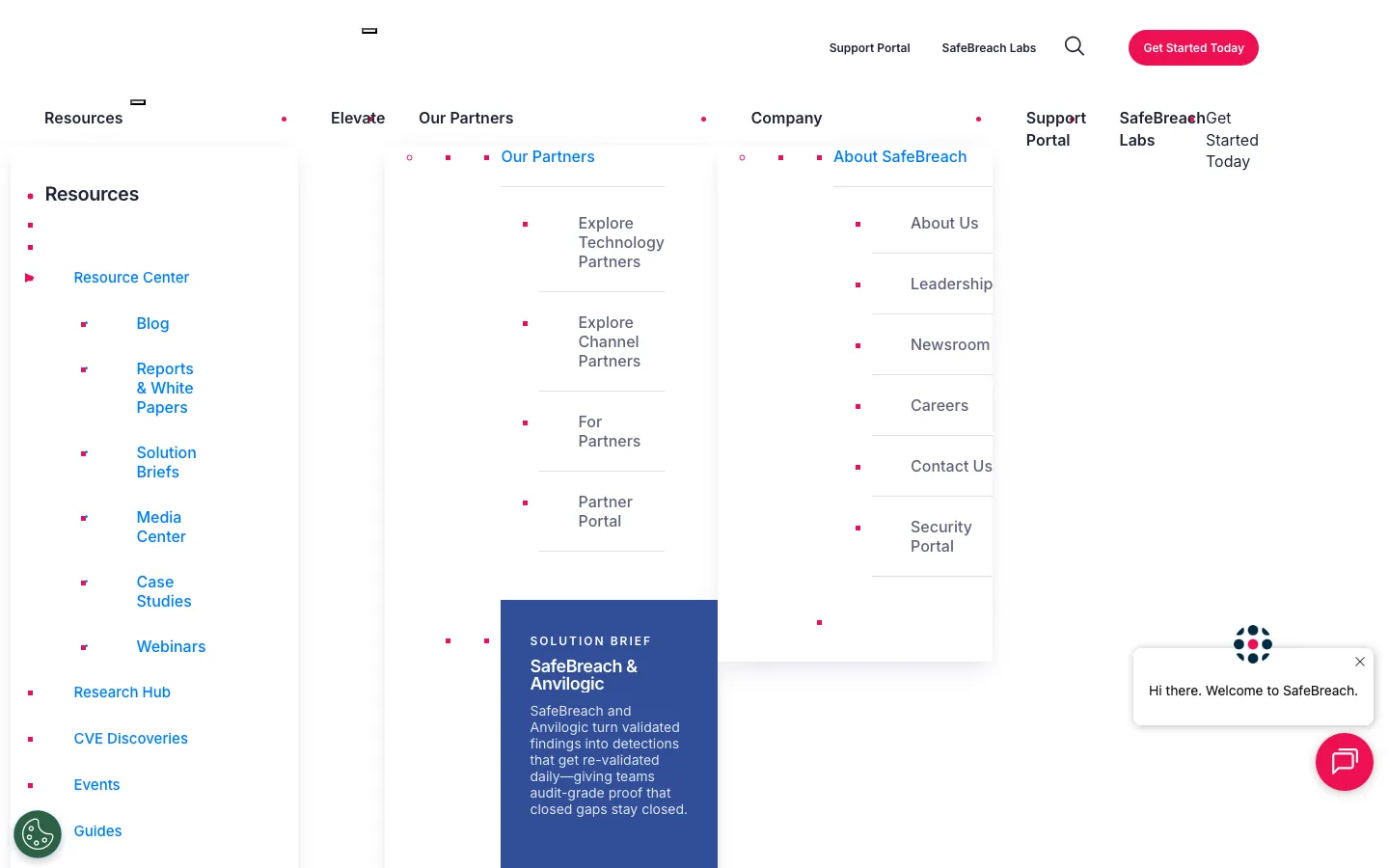
SafeBreach is a CTEM platform with a Helm AI layer that orchestrates three AI agents (Analyst, Validation, SecOps) behind a natural-language interface.
- Key features: SafeBreach Helm orchestrates three AI agents. Validate runs breach simulation. Propagate validates attack paths. Integrates with SIEM, SOAR, and vulnerability management. SafeBreach-as-a-Service managed option.
- Pros: Three-agent AI orchestration is a clean abstraction. Strong BAS heritage. Good CTEM coverage.
- Cons: BAS scope, not signed-scope audit deliverable. Pricing requires sales motion.
- Why choose it: If you want a BAS platform with an AI agent layer on top.
- 2026 pricing: Quote-based.
6. AttackIQ
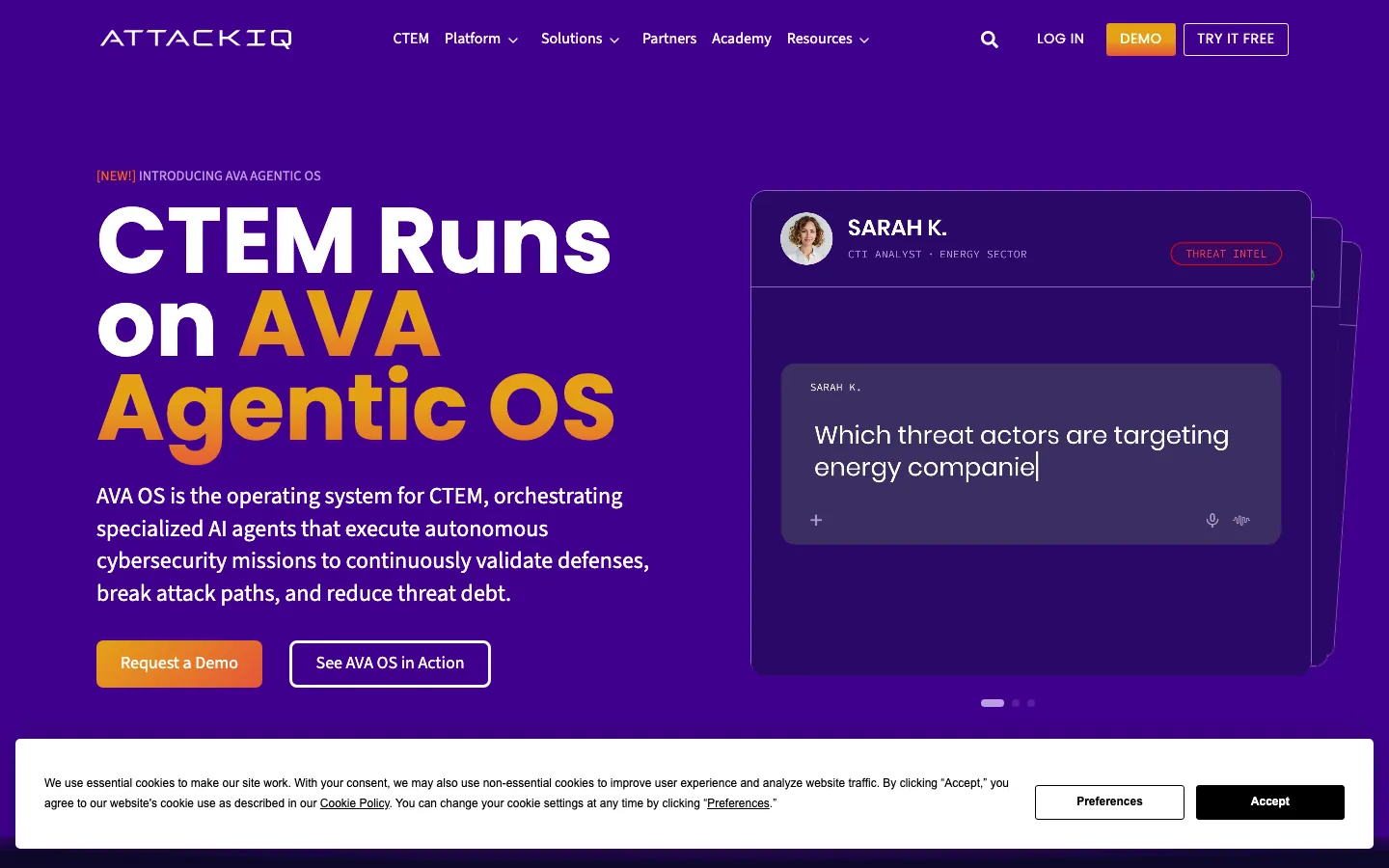
AttackIQ calls itself the agentic OS for CTEM. AVA orchestrates AI across Flex (on-demand), Ready (managed), Enterprise (full control), Command Center, and Watchtower AI threat intel.
- Key features: AVA Agentic OS. Threat Debt Index. AttackIQ Flex, Ready, Enterprise, Command Center, Watchtower. Adversary emulation + breach/attack simulation.
- Pros: Category-defining CTEM positioning. Strong threat-debt metric. Mature enterprise footprint.
- Cons: CTEM scope, not signed-scope audit deliverable. Pricing requires sales motion.
- Why choose it: If you want a CTEM platform with the most aggressive AI agentic framing.
- 2026 pricing: Quote-based.
7. Picus Security
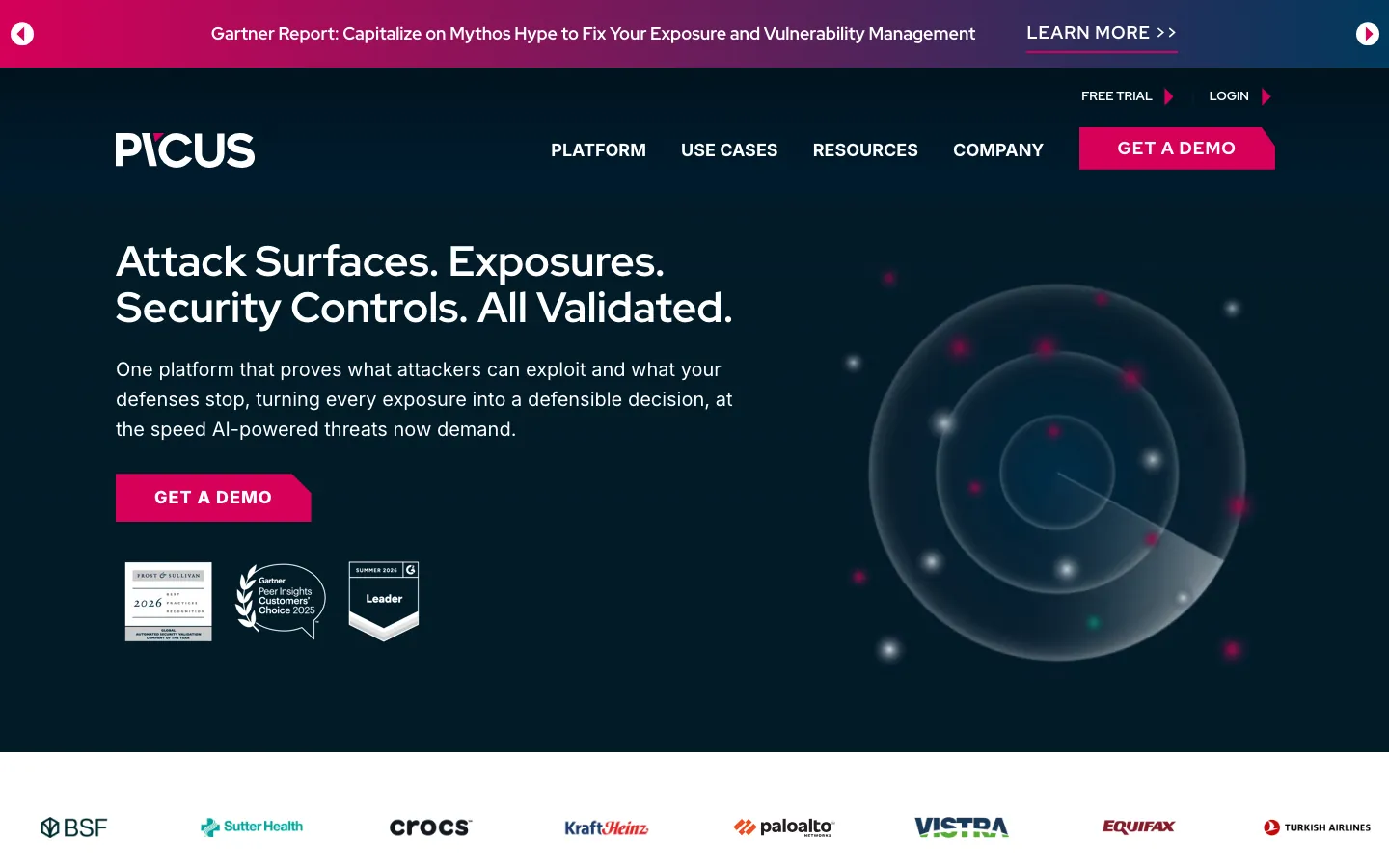
Picus Autonomous Exposure Validation pairs the Picus Swarm of specialized AI agents with ingestion from Tenable, Wiz, Snyk, and Active Directory.
- Key features: Picus Swarm combines automated pentesting, BAS, and exposure validation. Ingests exposure data from major scanners. Validates exploitability in customer environment. Tests EDR, SIEM, firewalls.
- Pros: Specialized AI agents for BAS + automated pentest. Strong ingestion story. Gartner Peer Insights Customers’ Choice.
- Cons: BAS scope, not signed-scope audit deliverable. Pricing requires sales motion.
- Why choose it: If you want a BAS platform that also does automated pentest under one AI agent fleet.
- 2026 pricing: Quote-based.
8. Scythe
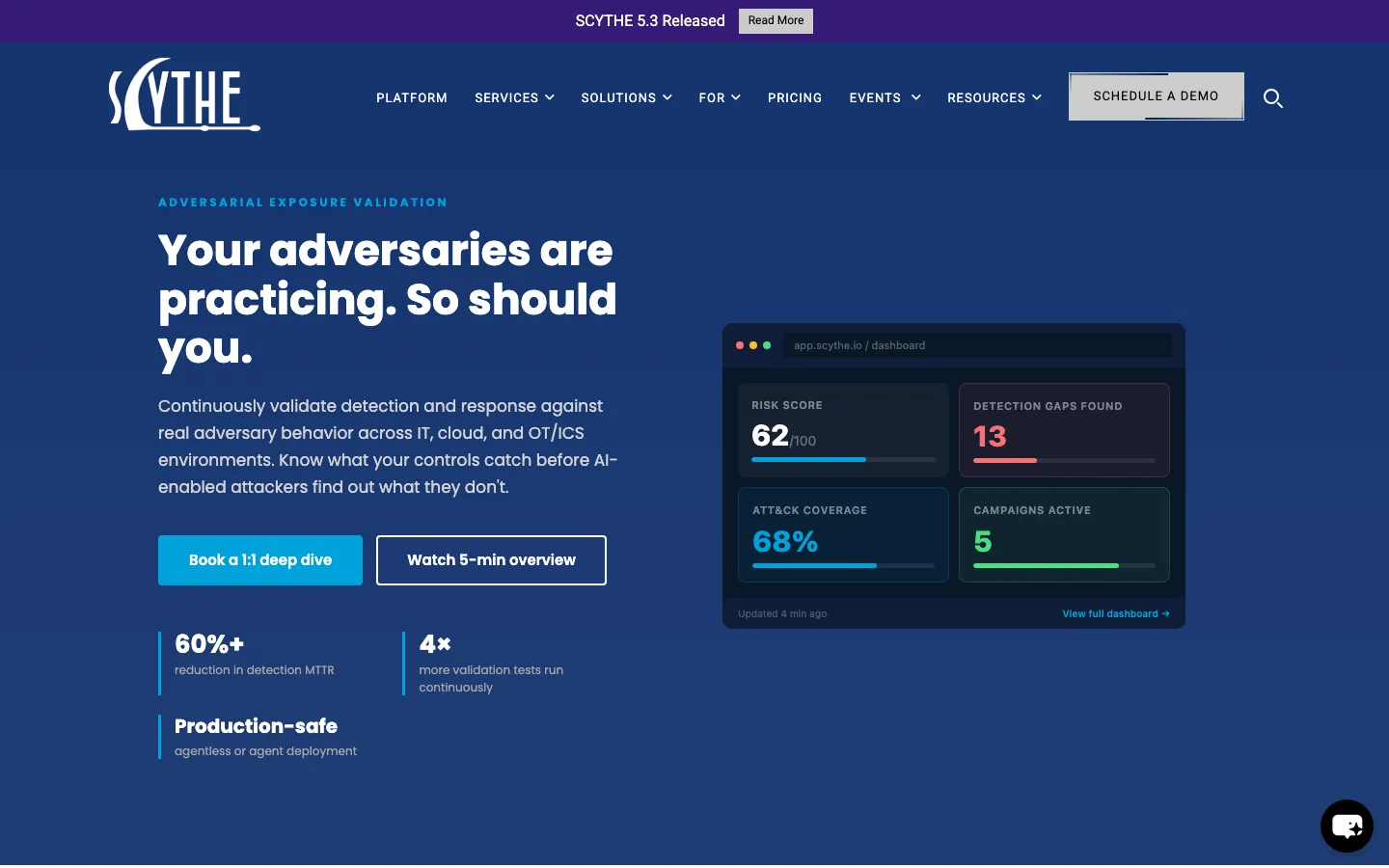
Scythe is a Continuous Adversarial Exposure Validation platform with private AI for test generation.
- Key features: EDR validation against MITRE ATT&CK. SIEM detection engineering. OT/ICS agentless emulation. Operationalizes CTI reports in hours. Red/blue/purple team workflows.
- Pros: Most transparent pricing of the BAS vendors. No seat tax. No agent limits. Private AI for test generation.
- Cons: AEV scope, not signed-scope audit deliverable. Variable cost scales with environment size.
- Why choose it: If you want BAS pricing transparency and MITRE-mapped validation without seat-based pricing.
- 2026 pricing: Four tiers; one price, everything included, scoped to your environment (see Scythe pricing).
9. Tidal Cyber
Tidal Cyber is a threat-informed defense platform with the NARC AI engine that converts unstructured intel into ATT&CK-aligned procedures.
- Key features: Centralized threat + defensive intelligence vs ATT&CK. Continuous assessments. Threat feed ingestion (external, internal, custom). Prioritized mitigations. Tool overlap and coverage gap analysis.
- Pros: Free Community Edition. NARC AI turns unstructured intel into procedures. Strong MITRE ATT&CK coverage.
- Cons: Threat-informed defense scope, not signed-scope audit deliverable. Enterprise tier requires sales motion.
- Why choose it: If you want a free starting point for threat-informed defense with an upgrade path.
- 2026 pricing: Free Community Edition + paid Enterprise Edition (quote-based).
10. Bishop Fox (Cosmos)
Bishop Fox is one of the most recognized offensive security brands. Cosmos is their continuous offensive security platform with a Cosmos AI engine, paired with human-led offensive services.
- Key features: Cosmos AI engine for continuous automated testing. Integration with Bishop Fox red team, app pentest, and cloud pentest services. Long-running offensive-security reputation.
- Pros: Strong brand recognition. Human consultants available for blended engagements. Cosmos AI engine for automation.
- Cons: Pricing requires sales motion. Human-in-the-loop means slower delivery than fully autonomous.
- Why choose it: If you want a brand-name offensive security partner with an AI automation layer.
- 2026 pricing: Quote-based.
11. Bugcrowd
Bugcrowd is a crowdsourced cybersecurity platform. The Savant AI suite adds Pathseeker agentic pentest and Vista on top of the crowdsourced network.
- Key features: Bug Bounty, VDP, PTaaS, RTaaS, ASM. Savant AI suite (Pathseeker for agentic pentest). CrowdMatch researcher pairing. Triage, reporting, and integrations with tools like Slack and Jira.
- Pros: Large crowdsourced researcher network. Multiple engagement models under one platform. New Savant AI layer.
- Cons: Pricing varies by engagement type. Crowdsourced delivery, not a single autonomous run.
- Why choose it: If you want a crowdsourced platform with an AI agentic pentest layer on top.
- 2026 pricing: Quote-based, with some self-service pen test packages (see Bugcrowd pricing).
12. HackerOne
HackerOne is the category-defining crowdsourced security platform. The H1 Platform runs continuous discovery, validation, prioritization, and remediation coordinated by the Hai agentic AI orchestrator.
- Key features: H1 Bounty, H1 Agentic Pentest, H1 Continuous Testing, H1 Code, H1 Validation, H1 Remediation, H1 AI Red Teaming, H1 Response. 1300+ companies trust the platform.
- Pros: Most-recognized crowdsourced brand. Hai agentic AI orchestrator spans multiple pentest products. AI Red Teaming capability.
- Cons: Enterprise sales motion. Multi-product platform, not a single autonomous run.
- Why choose it: If you want a multi-product pentest platform with an AI orchestrator.
- 2026 pricing: Quote-based.
13. Cobalt
Cobalt is the leading PTaaS brand. Cobalt Core pairs 500+ vetted human pentesters with Cobalt Sage AI on a unified platform.
- Key features: 500+ vetted pentesters in Cobalt Core. Web, API, AI/LLM, autonomous pentest scopes. Network and cloud pentesting. Red teaming. Secure code review. Cobalt Sage AI.
- Pros: Large vetted pentester network (500+ in Cobalt Core). Cobalt Sage AI for AI/LLM scopes. Strong platform integrations.
- Cons: Credit model pricing. Human-in-the-loop means slower delivery than fully autonomous.
- Why choose it: If you want a PTaaS platform with AI/LLM pentest scopes.
- 2026 pricing: Credit model (see Cobalt Credits).
14. XM Cyber
XM Cyber is a Continuous Exposure Management platform that maps full attack paths across hybrid estates and identifies Choke Points.
- Key features: Maps viable attack paths across AI, cloud, identity, external attack surface, vulnerability exposures. Choke Point analysis. Remediation operations. Security controls monitoring.
- Pros: Strong attack-path mapping. Choke Point concept helps prioritize remediation. Continuous exposure management.
- Cons: Continuous exposure management scope, not signed-scope audit deliverable. Pricing requires sales motion.
- Why choose it: If you want continuous attack-path exposure management across a hybrid estate.
- 2026 pricing: Quote-based.
15. Tracebit
Tracebit plants cloud-native canaries (decoy buckets, secrets, credentials, and identities) that look like real resources and alerts when attackers touch them.
- Key features: Cloud canaries that look like real resources and credentials. High-signal alerts with LLM-driven suggestions. SIEM integration. Covers AWS, Azure, GCP.
- Pros: Deception-based detection in cloud. Low-noise alerting. Native cloud integration.
- Cons: Adjacent lane. Tracebit detects attackers already inside your cloud. Pricing requires sales motion.
- Why choose it: If you want cloud attacker deception as a complement to your pentest program.
- 2026 pricing: Quote-based.
How We Chose These 15 AI Penetration Testing Tools
We focused on vendors that ship a product in 2026 and have either an autonomous pentest lane or an AI layer that materially shapes the pentest outcome. That left out:
- Open-source research projects like PentestGPT and HackerAI that are not commercial products. For that category, see our comparison of open-source AI pentesting tools.
- Cloud-only BAS platforms that do not produce pentest deliverables.
- Legacy DAST scanners with no AI component.
For each vendor we confirmed pricing model, signed-scope posture, and the core differentiator that matters when you actually run a pentest.
When the Plexicus Lane Wins
Three times in the last year we have heard the same request from security leaders: “I need a real pentest with audit-grade evidence, and I need to know the price before I pick up the phone.” That is the lane Plexicus occupies.
If you want continuous estate-wide monitoring, Horizon3.ai NodeZero is the autonomous option. If you want BAS telemetry for a CTEM program, AttackIQ, Cymulate, and Picus Security are the category leaders. If you want a crowdsourced platform with AI on top, Bugcrowd, HackerOne, and Cobalt are the safe picks.
If you want a single signed-scope pentest run with replay-verified evidence, that is Plexicus AI Swarm Pentest, part of the broader ASPM platform.
A pentest finding only pays off once it is fixed. Our guide on closing the loop from alert to fix with proof-driven AppSec shows how verified findings flow into automated remediation. If the system in scope is itself an AI agent, map the attack surface first with our MAESTRO framework field guide for agentic AI threat modeling.
For a closer look at how Plexicus fits into a broader security posture, see our guides on the top ASPM tools, the essential DevOps security tools for 2026, and how to secure AI-generated code.
FAQ: AI Penetration Testing Tools in 2026
What is AI penetration testing?
AI penetration testing is a pentest where AI agents plan, run, and verify attack steps against an authorized scope. An AI pentest tool runs automated, semi-automated, or fully autonomous attack techniques against a signed scope to produce evidence a security team can hand to engineers, leadership, or auditors. The AI layer typically maps attack paths, exploits vulnerabilities, replays findings, and prioritizes remediation.
What is autonomous pentesting?
Autonomous pentesting is the fully automated end of AI penetration testing: the platform chooses targets, chains exploits, and validates impact without a human driving each step. NodeZero, Pentera, and Plexicus work this way. People still set the scope and review the results, but the attack run itself needs no consultant at the keyboard.
How is an AI pentest different from a BAS platform?
An AI pentest delivers a single signed-scope report at the end of a run. A BAS platform runs continuous attack simulations to validate security controls. Both use AI. The deliverables and the cadence are different.
Are AI pentest findings auditor-acceptable?
They are if the tool reproduces the finding before publishing and keeps the evidence. Plexicus replays every finding in an independent second run. Horizon3.ai NodeZero and Pentera re-test findings after fixes to confirm them. Most BAS vendors publish control-validation telemetry rather than signed pentest findings.
How much does an AI pentest cost?
Pricing models split into three groups. Fixed per engagement (Plexicus — see pricing), per-environment (Scythe), and quote-based enterprise (NodeZero, Pentera, Cymulate, SafeBreach, AttackIQ, Picus, Tidal Cyber, Bishop Fox, Bugcrowd, HackerOne, Cobalt, XM Cyber, Tracebit).
Which AI pentest tool should I pick in 2026?
If you want continuous estate-wide monitoring, pick a BAS platform or NodeZero. If you want a single auditable pentest, pick a signed-scope agent like Plexicus. If you want crowdsourced coverage with AI triage, pick Bugcrowd, HackerOne, or Cobalt.
Final Thought
The 2026 AI pentest market has matured past the “AI agent” hype. The vendors that ship replay-verified evidence in a signed scope at a price you can budget for are the ones that earn their place on this list. If you are ready to see what a signed-scope autonomous pentest looks like in practice, book a Plexicus pentest engagement and we will scope your next run. You can also review the Plexicus pricing before you reach out.