What Is DevSecOps? The Complete Guide for 2026
A complete guide to DevSecOps in 2026: what it is, how it differs from DevOps, which checks belong in the pipeline, the standards behind it, and how to measure whether it works.
Beyond ASPM
Proof-Driven AppSec for teams building with AI
Plexicus uses AI Swarm Pentest to explore authorized application paths, validate what is exploitable, and give teams evidence they can use to prioritize remediation.
Explore AI Swarm PentestMost teams ship software the same way every week. A developer commits a change, a pipeline builds it, tests run, and the release goes out. Somewhere in that loop, security usually appears as a separate conversation: a scan someone runs on Thursday, a review before a big launch, a list that arrives after the code is already live.
DevSecOps is the practice of putting security checks, security ownership and security feedback inside the same pipeline that builds, tests and releases the software, so security work happens continuously instead of at a gate before release.
The name is an expansion of DevOps: development, security, operations. The extra word is the point. Development and operations were already being automated together. Security was the discipline that still waited its turn.
That wait has become expensive. In its 2026 Data Breach Investigations Report, published 19 May 2026, Verizon found that exploiting software vulnerabilities had become the leading way attackers get into an organization, accounting for 31% of breaches in its dataset. It is the first time in the report’s 19 editions that vulnerability exploitation has passed stolen credentials.
The same report found that breaches involving a third party now account for 48% of all breaches, with third-party involvement up 60%, and that AI has compressed the time between a vulnerability becoming known and being exploited from months to hours. These are Verizon’s figures, drawn from its 2025 incident data.
A pipeline that ships code daily and reviews security quarterly cannot close that gap.
This guide explains what DevSecOps is, how it differs from DevOps and from a security gate, how it works stage by stage, which checks belong in the pipeline, what the standards actually say, and how to tell whether any of it is working.
What Is DevSecOps?
DevSecOps is an operating model for software delivery in which security checks, security responsibilities and security feedback are built into the same automated pipeline that builds, tests and releases the software.
Three things separate it from the phrase it is usually confused with.
First, security runs in the pipeline, not beside it. The checks execute on the same commits, in the same runners, against the same artifacts as the rest of the build. They produce results where developers already look.
Second, security has an owner inside the delivery team. Not a queue that another team drains when it has time. Responsibility for the security of a change belongs with the people who make the change, supported by specialists rather than gated by them.
Third, the feedback is continuous. Applications change continuously, so a result from last quarter describes a system that no longer exists.
The OWASP Foundation states the goal of its DevSecOps Guideline plainly: detect security issues, whether design flaws or application vulnerabilities, as early and as cheaply as possible, and keep detecting them continuously.
Notice the two halves of that sentence. Early and cheaply describe when and at what cost. Continuously describes for how long. A DevSecOps program that scans once per release satisfies the first half and fails the second.
DevSecOps is also not a product category you buy. It is a set of practices you operate. A team can run every tool on a market list and still practice it badly, and a team with three checks can practice it well.
Why DevSecOps Matters in 2026
Four dated developments explain why this stopped being a good idea and became common practice for teams that ship often.
1. Vulnerability exploitation is now the leading breach entry point
As noted above, Verizon’s 2026 report puts vulnerability exploitation at 31% of breaches, ahead of stolen credentials for the first time in 19 editions, with AI accelerating the time to exploit known vulnerabilities from months to hours.
This changes what a backlog means. A queue of thousands of open findings is no longer only a compliance artifact. Somewhere in it sits the finding that gives an attacker a path. The question shifts from how many did we find to which of these can actually be reached, and how fast can we close it.
2. The supply chain is inside the definition of application risk
The OWASP Top 10
, the current released edition, lists Software Supply Chain Failures as A03 and Security Misconfiguration as A02. A03 is a broadened version of the older vulnerable-components category: it covers dependencies, build systems and distribution infrastructure, not only the code you wrote.Your pipeline is part of that surface. Build runners, CI credentials, package registries and signing keys are now inside the same risk model as your source code.
3. The EU reporting clock is already running
Under the Cyber Resilience Act, manufacturers of products with digital elements have been required since 11 September 2026 to report actively exploited vulnerabilities and severe incidents: an early warning within 24 hours, a full notification within 72 hours, and then a final report no later than 14 days after a corrective measure becomes available for an actively exploited vulnerability, or within one month of the 72-hour notification for a severe incident.
The Act’s full application follows on 11 December 2027. Reporting obligations only work if you can find, own and fix a vulnerability quickly, which is what a delivery-integrated security practice is for.
4. AI-assisted development moved the bottleneck
The 2024 DORA report found that AI adoption significantly increases individual productivity, flow and job satisfaction, while negatively affecting software delivery stability and throughput. The 2025 report frames AI as an amplifier: it magnifies an organization’s existing strengths and weaknesses.
Code gets faster to produce. Review does not get faster on its own. If security review stays manual while generation accelerates, security becomes the bottleneck, and the pipeline starts routing around it.
DevOps vs. DevSecOps
DevOps describes the integration and automation of software development and IT operations. The definition Len Bass, Ingo Weber and Liming Zhu published through CSIRO and the Software Engineering Institute in DevOps: A Software Architect’s Perspective is a useful one: “a set of practices intended to reduce the time between committing a change to a system and the change being placed into normal production, while ensuring high quality”.
DevSecOps takes that same definition and refuses to let “high quality” mean only functional quality.
| Dimension | DevOps | DevSecOps |
|---|---|---|
| Primary goal | Shorten the time from commit to production while keeping quality | The same, with security treated as part of quality |
| Where security sits | Usually a separate team, tool or stage | Inside the same pipeline and the same ownership |
| Feedback | Build, test and performance results | Build, test, performance, plus security evidence |
| Gate | Automated tests and approvals | Automated tests, approvals, and security checks that block on agreed thresholds |
| Ownership | The delivery team owns the release | The delivery team owns the release and its security posture in the code |
| Failure signal | A broken build or a failed test | A broken build, a failed test, or a finding that meets the block rule |
The last two rows are where teams get into trouble. Adding a scanner without deciding who owns its output does not create DevSecOps. It creates a new queue.
A useful test: ask what happens when a security check fails at 4pm on the day a release is scheduled. If the answer involves a meeting, an exception or a person in another timezone, the check is not integrated yet. It is adjacent.
DevSecOps vs. a Security Gate at the End
The older model is a security review or penetration test performed shortly before release, after the code is complete.
That model has a structural problem, not a moral one. A gate at the end receives work that has already been through design decisions, dependency choices and architecture commitments. Every issue it finds is expensive to change, because everything downstream of the decision has to move too.
Gate at the end:
Design → Code → Build → Test → [SECURITY REVIEW] → Release
                                    │
                                    └── findings arrive when the fix costs the most

Security inside the loop:
Design → Code → Build → Test → Release
   ↑         ↑        ↑       ↑
 threat     secret   SCA    DAST
 model      scan    in CI   in staging
Both diagrams can be true at once. The point is not that a pre-release review is wrong. A final validation pass still has value, particularly for complex logic and high-risk systems. The point is that it cannot be the only place security appears, because by then the cost curve has already turned.
There is a second difference: feedback speed. A finding returned minutes after a commit is still in the developer’s head. The same finding returned three weeks later requires them to reconstruct the context first.
How DevSecOps Works
A DevSecOps pipeline is the ordinary delivery pipeline with security checks placed where their results are cheapest to act on. Seven stages cover most implementations.
1. Plan and design
Threat modeling asks how the system could be attacked before implementation begins: trust boundaries, data flows, sensitive data, authentication and authorization requirements, unacceptable outcomes.
This is the only stage where some classes of weakness are still cheap to remove. An authorization flaw fixed in a design diagram costs a conversation. The same flaw found in production costs a rewrite.
2. Commit
The moment a change enters version control, cheap checks run: secret scanning for credentials in the diff, linting, and a fast static pass on the changed files.
Secret scanning has a specific property that shapes its placement. If a production credential reaches a public repository, deleting the string in a later commit is not enough. The credential has to be revoked or rotated. That is why it belongs at the earliest possible point, and why it behaves more like an incident response than a bug fix.
3. Build
The build stage resolves dependencies, compiles, and produces artifacts. This is where software composition analysis matches every package in the resolved tree against vulnerability data, and where artifact signing and provenance records are created.
The OWASP DevSecOps Guideline lists credential scanning, software composition analysis, static and dynamic testing, infrastructure-as-code scanning, supply-chain controls including SBOMs and artifact signing, and AI/LLM governance as the components of a secure pipeline.
4. Test
Static analysis runs against the code, dynamic analysis runs against a built application, and API tests exercise the interfaces. These answer different questions: static analysis asks what the code could do, dynamic analysis asks what the running application does.
For how the two differ in detail, see SAST vs. DAST: the difference and why to use both.
5. Validate
Not every finding deserves equal attention. Validation asks which findings can actually be reached and exploited, and through which path. Two findings with identical severity scores can differ enormously in practical risk: one may sit in unreachable code, the other may sit on an internet-facing endpoint that leads to customer data.
Many pipelines skip this stage entirely, and it is the one that decides whether the pipeline produces evidence or produces noise.
6. Release and deploy
Infrastructure-as-code scanning, container image scanning and policy checks run against what is about to be deployed rather than against the source. Deployments are recorded, reversible and attributable to a change.
7. Operate and feed back
Runtime signals, incident data and newly published vulnerability information flow back into the pipeline. A dependency that was safe at release can become vulnerable tomorrow, so composition analysis continues after deployment rather than ending there.
The loop closes when a runtime finding reopens a commit.
Security Checks in the Pipeline
Each check below answers one question. None of them answers all of them, which is why mature pipelines run several.
Secret scanning
Question: has a credential entered the repository?
Strengths: fast, runs on every commit, catches a class of problem that has an incident-style response.
Limitations: finds strings that look like credentials, not necessarily live ones. Rotation is still a human step.
Static application security testing (SAST)
Question: does the code contain patterns or data flows that could lead to a vulnerability?
Strengths: runs early, points at the file and line, needs no running system.
Limitations: false positives, and limited visibility into runtime context and business logic. Our SAST guide covers what static analysis can and cannot establish.
Software composition analysis (SCA)
Question: which third-party components are present, and which of them carry known vulnerabilities or license risk?
Strengths: covers the part of the application you did not write, which is most of it.
Limitations: presence is not reachability. A vulnerable dependency is not the same as a reachable vulnerable function. See What Is Software Composition Analysis?.
Infrastructure-as-code and container scanning
Question: is the infrastructure about to be deployed configured insecurely?
Strengths: catches public storage, permissive permissions, containers running as root and exposed ports before anything is provisioned.
Limitations: evaluates the definition, not the running environment, so drift still has to be checked separately.
Dynamic application security testing (DAST)
Question: does the running application expose weaknesses from the outside?
Strengths: observes real behavior, so its findings are inherently closer to what an attacker sees.
Limitations: little visibility into the code responsible, and it needs a testable environment.
Penetration testing and exploit validation
Question: can this weakness actually be exploited, and with what impact?
Strengths: evidence. Instead of reporting that an endpoint may be vulnerable, a test can demonstrate that an unauthenticated attacker can retrieve another customer’s records.
Limitations: expensive to run manually at the cadence of a pipeline. This is one reason AI Swarm Pentest exists: automated exploration and reproduction inside an agreed scope.
Where the checks land
The Repo Scan view below shows a repository scan running through its stages in the platform’s activity center, from queue to completion, with the tool set attached to the run.
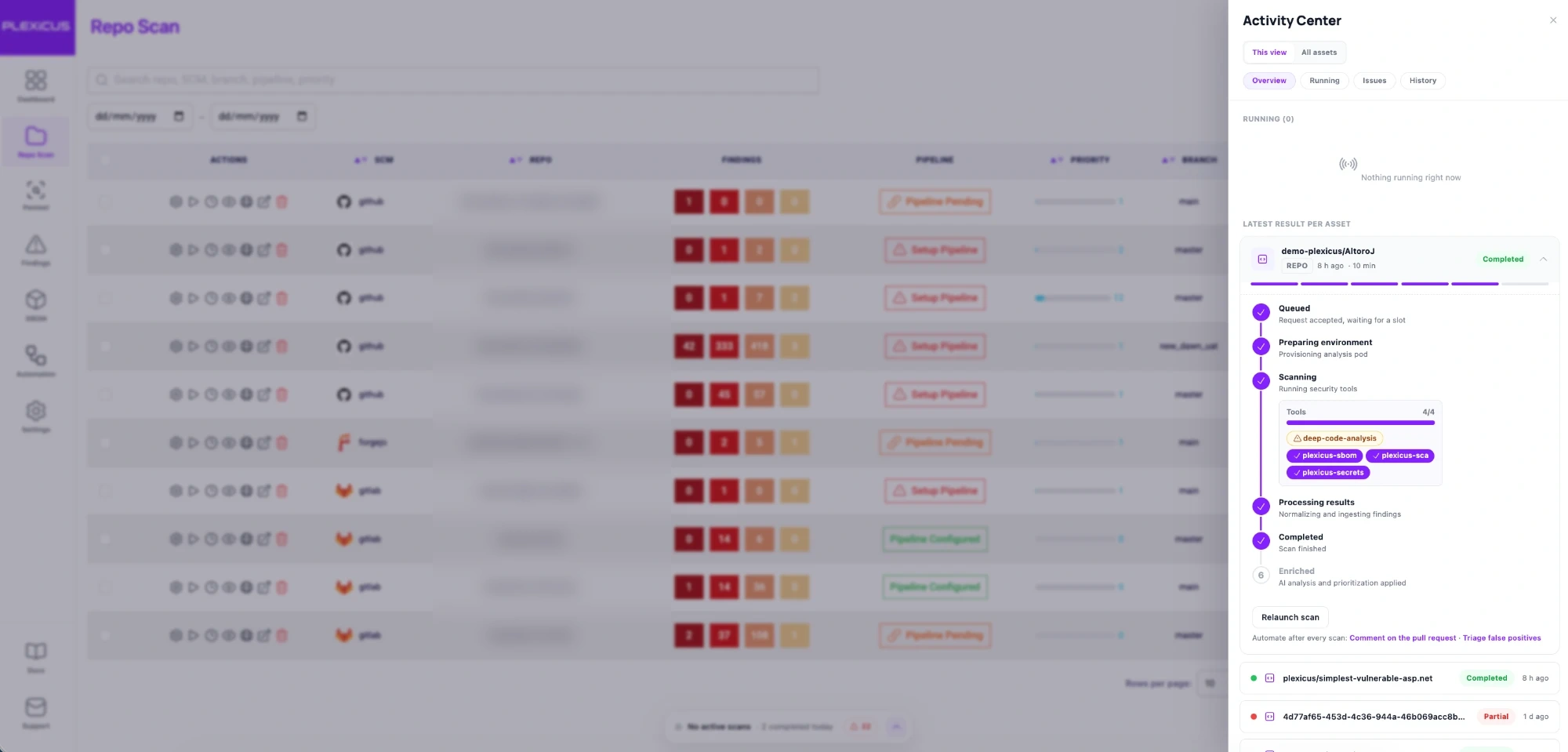
Screenshot: the Repo Scan page in the Plexicus platform with the Activity Center open on a completed repository scan, showing the run’s stages from queued through scanning and processing to completed, alongside the repository list and its pipeline status; the repository names in the table are pixelated. Internal repository scan, captured October 2026.
The point of showing the stages rather than a result is the sequencing: environment preparation, scanning, processing, enrichment. A security check that belongs in a pipeline has to behave like the other checks in it. Bounded, repeatable, attributable to a commit, and able to report a state rather than a surprise.
The CI/CD Pipeline Is Part of the Attack Surface
A pipeline has credentials, because it has to. Deploy tokens, registry logins, cloud roles, signing keys and package credentials all live where the automation runs.
That makes the pipeline itself a target. The OWASP DevSecOps Guideline warns explicitly that CI/CD tools can expand the attack surface, and treats supply-chain security as a first-class part of the pipeline rather than an afterthought.
Three consequences follow.
Credentials in the pipeline are scoped. A runner that can deploy to production can also leak a production secret. Least privilege applies to automation with the same force it applies to people.
Builds are reproducible and attributable. If you cannot say which commit produced the artifact currently running, you cannot respond to a disclosure about that artifact. Frameworks such as SLSA exist to give that provenance record a common vocabulary: preventing tampering, improving integrity, and securing packages and infrastructure.
Inputs are untrusted, including your own dependencies. A package that was safe last month can change owner, change content or change maintainer. Composition analysis that runs only at the first build misses all three.
This is also why “we scanned the source code” is an incomplete answer. The source is one of several inputs into what ships.
Shift Left Is Not Enough
For years the standard advice was: shift security left, meaning test earlier. That remains true. Finding a coding mistake before production is cheaper than finding it after deployment.
But many weaknesses only become meaningful once the code meets real infrastructure, real authentication, real configuration and real data flows. A static check cannot see how a misconfigured cloud permission interacts with a runtime role.
The application security guide on this site argues the same conclusion from the other direction: shifting left without shifting right leaves half the lifecycle uncovered.
PLAN → DESIGN → CODE → BUILD → TEST → DEPLOY → OPERATE → ↺
  ↑                                            │
  └──────────── evidence flows back ───────────┘
The practical reading is narrow. Shift left for what left can see: patterns, data flows, secrets, dependencies. Shift right for what only runtime can show: reachability, exposure, misconfiguration, actual behavior. And keep the loop open so that what production learns returns to the plan.
How to Measure DevSecOps
If it cannot be measured, it cannot be distinguished from intent. DORA’s research provides the most widely used baseline, and the current metric set is five metrics in two groups.
| Group | Metric | What it measures |
|---|---|---|
| Throughput | Change lead time | Time from commit to deployment in production |
| Throughput | Deployment frequency | Number of deployments over a period |
| Throughput | Failed deployment recovery time | Time to recover from a deployment requiring immediate intervention |
| Instability | Change fail rate | Share of deployments needing immediate intervention, rollback or hotfix |
| Instability | Deployment rework rate | Share of deployments unplanned, driven by a production incident |
Two notes on using these. DORA moved from four metrics to five: mean time to recover became failed deployment recovery time in 2023, and deployment rework rate was added in 2024. DORA’s own history of these metrics dates both changes. Citing “the four keys” without a date is now ambiguous.
Second, these measure delivery, not security. A DevSecOps program needs its own set on top, and the useful ones are about closure rather than volume:
- Time from introduction to detection for a finding.
- Time from detection to verified fix, measured with the retest, not with a closed ticket.
- Share of findings that survive validation, which tells you how much of your pipeline output is signal.
- Recurrence rate, because the same weakness reappearing is a process failure, not a new bug.
- Coverage, meaning which repositories and pipelines actually run the checks.
Avoid counting scans performed. It measures activity, and activity is what a pipeline has the most of.
Best Practices for DevSecOps
1. Run the cheap checks on every commit
Secret scanning and fast static analysis belong where their feedback is still free: immediately. Reserve slower, deeper analysis for merge or nightly cadence.
2. Fail the build on agreed thresholds, not on every finding
A pipeline that blocks on any warning tends to get bypassed, because a gate that fires constantly stops being informative. Agree the rule in advance: which severity blocks, which reports, which waits. Predictability is what makes an automated gate acceptable to a delivery team.
3. Put results where developers already work
Pull requests, issue trackers, the IDE. Every additional place a developer has to check is a place they will eventually stop checking.
4. Scan dependencies continuously, not only at first build
A safe dependency today is a variable, not a constant. Re-run composition analysis on a schedule and on new advisories, not just when the lockfile changes.
5. Protect the pipeline itself
Scope credentials to the job. Pin and verify the actions and images your pipeline pulls. Record which commit produced each artifact. The OWASP DevSecOps Guideline treats this as part of the same problem as scanning the code.
6. Give developers the evidence, not the alert
A developer needs to know what is vulnerable, where it sits, how it can be reached, what it affects, how to fix it and how to confirm the fix. Six questions, answered in the finding itself, remove most of the back-and-forth between security and engineering.
7. Retest after the fix
A closed ticket is not proof. If the original attack no longer reproduces, the fix worked. If nobody checked, the finding was administratively closed, not remediated.
8. Measure the closure, not the volume
More findings do not mean more security. Track how fast real ones close and how often they come back.
Common DevSecOps Mistakes
Mistake #1: buying scanners instead of deciding ownership
Five tools producing overlapping alerts, with no one responsible for their output, increases workload without reducing risk. The question to answer first is who acts on a result, and when.
Mistake #2: making every finding a blocker
A gate that stops on everything stops the pipeline once, and then gets bypassed. Thresholds are a design decision, not a configuration default.
Mistake #3: treating a green pipeline as a secure application
Automated checks are strongest against recognizable patterns. Business logic abuse, authorization design and workflow manipulation do not look like known patterns, and an attacker is not restricted to them.
Mistake #4: measuring scans instead of outcomes
“How many scans ran” says nothing about how many weaknesses were fixed or how quickly. Vanity metrics survive because they are easy to collect, not because they are informative.
Mistake #5: scanning once and calling it covered
Applications change continuously. A result from a quarter ago describes a system that no longer exists, particularly when AI-assisted development is increasing how much changes per quarter.
Standards and Frameworks
DevSecOps has a thin vendor-neutral literature compared with its tooling market. Five documents carry most of the weight.
NIST Secure Software Development Framework (SSDF)
NIST SP 800-218 defines a core set of high-level secure software development practices intended to be integrated into any existing lifecycle, and provides a common vocabulary that purchasers and producers can share.
Status matters here, and is worth stating precisely. Version 1.1 is the final release, dated 3 February 2022. A Version 1.2 revision was released as a draft on 17 December 2025 and is not yet final, per NIST’s SSDF publications list. Citing 1.2 as current guidance is premature; citing 1.1 as if nothing newer exists is incomplete.
A separate publication, SP 800-218A, addresses secure development practices for generative AI and dual-use foundation models and was finalized on 26 July 2024.
OWASP DevSecOps Guideline
The OWASP DevSecOps Guideline is the closest thing to a direct standard for the pipeline itself. It is an OWASP incubator project, which is worth knowing when you cite it: it is maintained and community-driven, but it is not a ratified specification.
It covers credential scanning, composition analysis, static and dynamic testing, infrastructure-as-code scanning, supply-chain controls including SBOMs and artifact signing, cloud-native checks, and AI/LLM governance. It also points to OWASP Proactive Controls as the starting set of developer-facing requirements.
OWASP ASVS and SAMM
The Application Security Verification Standard gives testable requirements. ASVS 5.0.0 was published on 30 May 2025 and is the current stable release. OWASP describes its own Top Ten lists as awareness documents, “not meant to be a complete list, only a starting place”, and recommends ASVS when you need requirements that can be verified. OWASP
OWASP SAMM is the maturity model: an evolutive, risk-driven way to assess where a program is today and what to improve next. It is technology and process agnostic on purpose, because there is no single recipe that fits every organization.
Supply chain: SLSA
Supply-chain Levels for Software Artifacts is a framework of standards and controls to prevent tampering, improve integrity, and secure packages and infrastructure. The current site lists SLSA v1.2 and v1.1 alongside a working draft, so the version you target should be named rather than implied.
Regulation, not framework
The EU Cyber Resilience Act behaves differently from the documents above: it carries dates and obligations rather than recommendations, as set out earlier in this guide. It is the reason a reporting-capable vulnerability process has stopped being optional for products placed on the EU market.
A Practical Example
An AI-generated service goes into production. A developer commits a change to its authorization logic on Monday morning.
Commit
  ↓  secret scanning        no credentials in the diff
  ↓  static analysis        a missing ownership check flagged at line 214
  ↓  composition analysis   one transitive dependency has a new advisory
  ↓  build                  artifact built and signed against the commit
  ↓  dynamic test           the endpoint answers, no injection observed
  ↓  validation             the ownership check is reachable from the public API
  ↓  review                 finding arrives in the pull request with code, flow, impact
  ↓  merge                  fix lands with the original context attached
  ↓  retest                 the original attempt no longer reproduces
  ↺  runtime                no recurrence after the change ships
Compare that with the alternative. The same finding surfaces six weeks later in a pre-release assessment, in a different branch, written up by someone who did not write the code. The fix now requires reacquainting an engineer with a decision they made six weeks ago, under release pressure.
Same finding. Different cost, entirely determined by where in the pipeline it appeared.
The dependency advisory has a second lesson. Nothing in the developer’s change caused it. It arrived from outside, after the code was written. That is the class of problem a continuously running composition check catches and a point-in-time scan does not.
What DevSecOps Is Not
Stating the negative boundaries is more useful than another definition, because most failed implementations are these things in disguise.
It is not a tool you purchase. No vendor sells DevSecOps the way a vendor sells a firewall. Tools are components of a practice, and the practice is the part that determines the outcome.
It is not the same as having many scanners. Overlapping output without prioritization is alert volume. OWASP makes the same point about its own Top Ten, noting that tools cannot comprehensively detect, test or protect against the Top 10 “due to the nature of several of the OWASP Top 10 risks”, with insecure design named as the example. OWASP
It is not “security left” only. Runtime behavior, deployment configuration and exposure are not visible to static analysis. A pipeline with only left-side checks produces confident answers about an incomplete question.
It is not a guarantee that every vulnerability will be found. No honest practice claims that. The claim is that what is found is found earlier, costs less to fix and closes faster.
It is not a way to remove human judgment. Someone decides which findings block a release, whether a risk is acceptable, and whether a fix is correct. Automating the detection does not automate the decision.
Where Plexicus Fits
Plexicus builds for the delivery-integrated model, under one category: Proof-Driven AppSec. The organizing principle is that a finding only matters once it carries evidence, and that the loop is not closed until a reviewed fix exists.
Deep Code Analysis is the inside-the-pipeline pass. The product page states the problem it addresses directly: SAST can flag a pattern, an LLM can explain code, and neither establishes how a weakness affects the application. Each finding carries the affected flow, the data it can reach, the role that can trigger it, and a suggested change, bound to CWE and ranked against the canonical OWASP Top 10. Findings are analyzed across 12 languages.
AI Swarm Pentest is the validation pass: a swarm of agents working an authorized scope, with scope and rules agreed before testing begins, findings presented as verified only after separate reproduction, and human teams retaining the final decision.
The two are described on the product page as “Two passes. One ground truth.” Deep analysis attaches context, swarm validation tests priority paths, reviewers see the evidence, and the team receives an actionable handover.
Remediation closes the loop. Its page opens with the sentence this whole guide has been circling: Detecting is not fixing. Only findings that your team has reviewed reach the remediation step; affected flow, reach, weakness class and rationale are bundled into the proposed change; a reviewer-ready diff is prepared with the original finding explained inline, with regression tests and notes where relevant; and the change lands in your existing repository with a reviewer assigned and a re-test hook wired to CI. Your team merges or rejects with evidence, and your team keeps merge control.
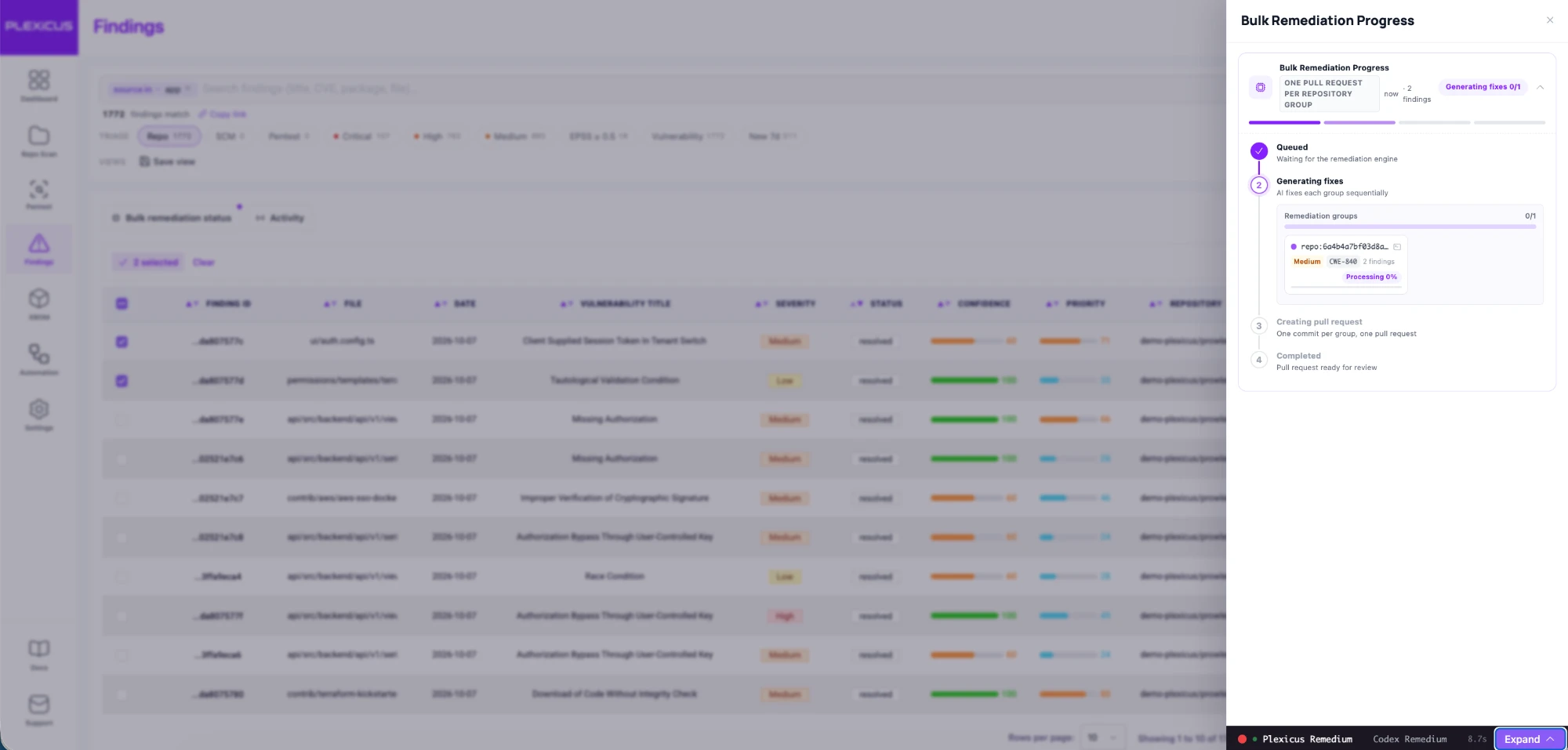
Screenshot: the Bulk Remediation Progress panel in the Plexicus platform, showing a run moving from queued to generating fixes, then creating a pull request, then completed, with the findings list behind it. Demo data, captured October 2026.
That panel is the closed loop with PR made visible: evidence in, reviewed change out, merge decided by a person.
XBOM supplies the inventory the rest depends on: one inventory combining SBOM, CBOM and AIBOM, CycloneDX and SPDX compatible, with license category and VEX status attached to components and quantum-readiness classification for cryptographic assets.
For a first look at what the analysis produces on your own code, start with the free SAST tool.
Frequently Asked Questions
What does DevSecOps stand for?
Development, Security and Operations. It names the operating model in which security is part of the same delivery practice as development and operations, rather than a separate stage performed before release.
What is the difference between DevOps and DevSecOps?
DevOps integrates development and operations to move changes from commit to production quickly with quality. DevSecOps adds security to that same pipeline and the same ownership: security checks run with the build and tests, and the delivery team owns their results.
Is DevSecOps just adding security tools to CI?
No. Tools in a CI job produce results. DevSecOps additionally requires that someone owns those results, that thresholds are agreed, and that feedback returns to the developer while the change is still current. A pipeline with ten scanners and no ownership is a queue, not a practice.
What checks belong in a DevSecOps pipeline?
Secret scanning, static analysis, software composition analysis, infrastructure-as-code and container scanning, dynamic testing, and some form of validation or penetration testing. Which ones run on every commit versus at merge or nightly depends on how long each takes.
Does DevSecOps replace penetration testing?
No. It changes where automated checks run and how often. Manual and specialized testing remain valuable for complex logic, novel attack techniques and high-risk systems. What changes is that the routine classes of weakness are handled continuously, so the specialist effort can go to the parts automation does not cover.
How is DevSecOps different from shift left?
Shift left is a direction: test earlier. DevSecOps is an operating model that includes shift left but also shifts right, into deployment and runtime, and keeps the feedback loop open. Shifting left alone leaves runtime behavior, configuration and exposure unexamined.
How do you measure whether DevSecOps is working?
Start with delivery metrics: change lead time, deployment frequency, failed deployment recovery time, change fail rate and deployment rework rate, as defined by DORA. Add security-specific ones: time from introduction to detection, time from detection to verified fix, share of findings that survive validation, recurrence rate, and coverage of repositories and pipelines.
What standards apply to DevSecOps?
NIST SSDF (SP 800-218, Version 1.1 final) for secure development practices, the OWASP DevSecOps Guideline for the pipeline itself, OWASP ASVS 5.0.0 for testable requirements, OWASP SAMM for maturity assessment, and SLSA for supply-chain integrity. For products placed on the EU market, the Cyber Resilience Act adds dated reporting obligations.
What is the hardest part of adopting DevSecOps?
Deciding what blocks a release and who owns it. The tooling is the most mature part of the problem; the threshold is the part most organizations leave undecided. The question is which finding stops a deployment, who is accountable when it fires, and what happens when it fires on the day of a release.
Can small teams practice DevSecOps?
Yes, and the practice scales down better than it scales up. A few checks run on every commit with one clear owner will typically do more for your risk than a long list of checks run quarterly with nobody accountable for the output. Start with secrets, dependencies and a static pass, then add validation as the finding volume justifies it.
Security That Keeps Up With the Pipeline
A DevSecOps program is working when a finding reaches the person who can fix it with the evidence needed to fix it correctly, and the fix is verified by the original test no longer reproducing.
Everything in this guide is in service of that one sentence: where the check runs, what it must carry, who owns it, and what you measure instead of activity.
Start with a repository check using the free SAST tool.